Underbody Coating
UNDERBODY COATING
Definition:
Underbody coating means a coating that is used at an automobile or light-duty truck assembly coating facility where the coating is applied to the undercarriage or firewall to prevent corrosion and provide chip protection. It is usually a dense cladding applied uniformly to the undercarriage of an automobile and is normally sprayed or painted on when the car is just out of the dealership and is clean. But even if you are getting the undercoating applied after a couple of years, it’s fine too. This is because it can prevent further damage to the under-carriage.
Types of underbody coating:
There are six major underbody coating types. They are,
- Rubberized Underbody Coating.
- Wax Based Underbody Coating.
- Asphalt Based Underbody Coating.
- Polyurethane Underbody Coating.
- Water Based Underbody Coating.
- Petroleum Based Underbody Coating.
Rubberized Underbody Coating:
- It is generally thought of as the best underbody coating for your car as it preserves the underbody well protecting it from scratches. It is ideal for cars driven in rough terrain this undercarriage coating involves applying a rubber agent to the underbelly to protect and cushion it against dents, dust & moisture and can also be applied around wheel wells and quarter panels.
- Examples of rubberized undercoating include 3M 3584 Professional Grade Rubberized Undercoating Rust-Oleum Black Rubberized Undercoating, 3M Body Schutz Rubberized Coating Black, SEM 40523 Low Rubberized Undercoating Aerosol.
Wax Based Underbody Coating:
- This is more or less ephemeral undercoating will wear away in a few month’s time. Wax-based undercoating holds best against moisture and it is also the most affordable option out there.
- It is the preferred undercarriage coating for cars often driven on highways and normal roads. Sometimes referred to as Paraffin based Undercoating, it provides sufficient guard for cars in fairly moist regions.
- An example of a Wax/ Paraffin Undercoat is Fluid Film 1, a rust inhibitor, anti-corrosion, and anti-rust undercoat.
Asphalt Based Underbody Coating:
- It is best suited for lorries, trucks and large vehicles this provides a greater degree of protection compared to rubber-based coatings. However, asphalt-based coatings contain little amounts of rubber for sound-insulation purposes. The process of applying this coating is a bit time-consuming though.
- It has the most damage-resistant properties and will also help protect your car, truck, motorcycle, and heavy machinery from nature. Asphalt-based undercoating provides added durability against rocks, chips, and moisture.
- Examples of asphalt-based undercoats are Rust Bullet, an automotive inhibitor paint for rust preventive and protective coating. As well as Skyco-Ospho protective coating.
Polyurethane Underbody Coating:
- This coating closes up splits and fractures on the underbody of the vehicle. It offers up good protection against corrosion and also bonds with the metal. Unlike in the case of asphalt-based coating, you can paint over the polyurethane coating.
- It uses a polyurethane-based sealant that comes in canisters ready to be loaded into a spray gun and sprayed to guard the undercarriage of your vehicle. It is ideal for standard vehicles.
- An example of a Polyurethane undercoat is Adam’s SiO2 Infused Invisible Undercarriage Dressing Spray for car detailing.
Water Based Underbody Coating:
- Water-based undercoating is a protective layer that helps your car stay protected from harsh weather conditions. It is made from an advanced polymer that is non-toxic and environmentally friendly.
- Examples of Water-based undercoats are Total Coat Automotive Sprayable Undercoating, Corroseal Water-Based Rust Converter Metal Primer, CRC SP-300 Corrosion Inhibitor, and the Evapo-Rust-Block Water-Based Rust Inhibitor.
Petroleum Based Underbody Coating:
- Petroleum-based undercoating is a heavy, viscous oil-based liquid product that provides an effective barrier against moisture and corrosion. The liquid dries and hardens to provide tough, durable, and long-lasting protection against moisture and corrosion.
- Examples of Petroleum-Based undercoating are CRC Heavy Duty Corrosion Inhibitor and the Fluid Film Rust Inhibitor for rust prevention and anti-corrosion.
Example:
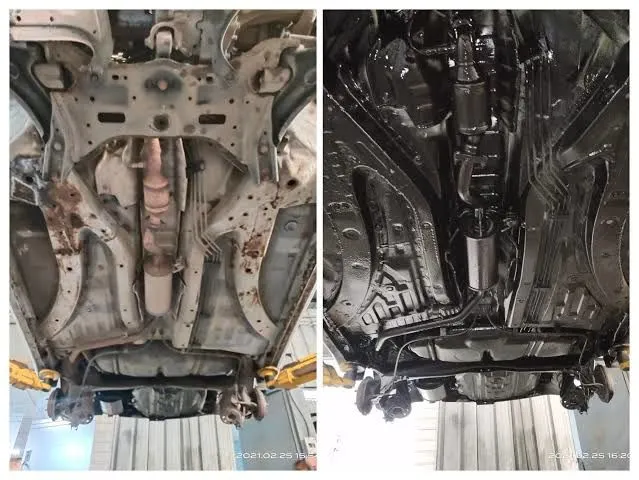
Before Underbody Coating After Underbody Coating
Pros:
- It provides a layer of protection against rust and corrosion when an underbody coating is properly applied to a vehicle. Instead of contacting the metal components of the vehicle, the debris encounters the underbody coating, which then proactively repels the dangerous items away.
- It will extend the life of your vehicle because of its rust-stopping power. Corrosion can get into your metal wires and cables, affecting any component which is comprised of steel or aluminum.
- Over time, the underbelly of your vehicle is going to develop nicks, chips, and scratches because of the debris you encounter while driving. An underbody coating usually creates a living barrier that your vehicle can use to promote a self-healing experience.
- It may help to reduce interior noise when you’re driving, the sounds of the road can be soothing if they aren’t too loud. For lightweight vehicles, noise pollution can be overwhelming to the driver in some situations. Applying a layer of undercoating creates a barrier against the sound, which creates an interior that is quieter.
- Water-based underbody coating has a thin-set, it takes a short time to dry and can be done at home.
- Petroleum underbody coating has greater deflective abilities for road salts, grime and repels ice and water.
Cons:
- It is less helpful if corrosion is already present. So, it should be in place before the underbelly of your car begins to rust. If you have rust present, it is better to remove the rust and then apply the underbody coating.
- If you’ve purchased a used vehicle, you must remove all the residue from the bottom before underbody coating can be applied and failing to do so will seal in the debris that is present already which can lead to more problems. The best time to have an undercoating applied is when a vehicle is purchased new because it offers a superior level of protection then.
- For vehicle owners who purchase something new every 3 to 5 years, then rust proofing may not be a good use of your cash. Most vehicles that are on the road today are able to make it five years before any corrosion begins to show and it may be 7 to 10 years before the functionality of the vehicle is negatively impacted by the lack of an underbody coating.
- The amount of weight added to a vehicle with an underbody coating is minimal (between 10 to 20 pounds for most vehicles), there is a small element of fuel economy to consider when your vehicle weighs more, the distance you can travel on a single tank of fuel is reduced.
- Depending on where you drive, the lifespan of this product may be minimal. If you drive your vehicle on gravel roads or dirty areas frequently, you reduce the integrity of the protective layer.
Conclusion:
New vehicles are coming to the market with a pre-applied underbody coating. So, if you are purchasing a used vehicle or for your vehicle after few years underbody coating must be done properly. The underbelly of your vehicle must be removed of all the debris, chips and rust in order to have a proper fully covered underbody coating which will increase the lifespan of your vehicle’s undercarriage. Having an underbody coating for your vehicle not only protects undercarriage of your vehicle but also increase the value your vehicle when you are reselling it. Underbody coating also gives a noise reducer effect and vibration cancellation effect for your vehicle which helps the customer to have a comfortable ride. It also protects all the components in the undercarriage form debris, chips or salt brines when riding in different terrains.