Underbody Coating
Under-Body Coating :-
- Underbody coating provides long term protection from corrosion to car's underbody. It also protects parts like internal body panels, frame rails and other inner cavities that are not physically accessible but are prone to corrosion.
TRENDS IN AUTOMOTIVE COATING :
- The current trends in automotive coating process motivated by lowering manufacturing costs, delivering customer satisfaction via aesthetic features and corrosion protection, and mitigating environmental concerns.
- Compared to 30 years ago, the problem of corrosion is almost alleviated, and the durability & appearance of the topcoats have become acceptable for the lifetime of a car.
- In fact, with the worldwide emergence of two-layer topcoats, the color, gloss, & chip resistance of automobile coating remain in relatively excellent condition during the first 7-10 years of an automoblie’s use.
- Aesthetic features are also trending with automotive fashions. Hence, a closer look at recent trends in automotive coatings is presented in the Following :-
Powder coating :- One solution to the emission of VOCs has been the replacements of liquid coatings with coatings in the form of dry, particulate solids, commonly called ‘powder coatings’. Their compositions contain very low concentrations of volatile solvents, on the order of 2% substanstially less than any other paint system. Currently, the automotive industry uses powder coating on wheels, bumpers, hubcaps, dorr handles, decorative trim & accent parts, truck beds, radiators, & numerous engine parts. A clear powder topcoat has been developed; BMW & Volvo are using it on their new model cars, & GM, Ford, & Chrysler have formed a consortium to test it on their production lines.
MODERN AUTOMOTIVE COATING PROCESSES :-
Modern Auomotive Coating process consists of five main step
1) Pre treatment
2) Electrodepostion
3) Rust Proof Material: Sealer/PVC
4) Primer
5) Top-coat
- PRE-TREATMENT :-
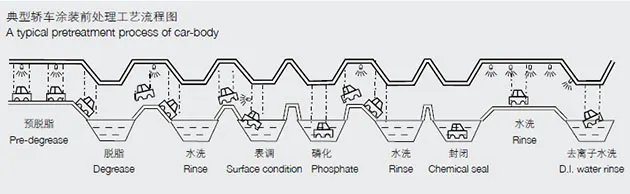
- The first sequence in preparing the BIW for subsequent coating is pretreatment sees Fig.1. Preatrament removes & clean excess metal & forms an appropriate surface structure enabling bonding of a corrosion protection layer. It consists of cleaning the body surface to remove remaining oils from the staming process & welding residues through three primary liquid dip processes of degreasing, conditioning, & phosphating.
- Pretreament helps the primer to bond onto the metal. A phosphate treatment applies an inert layer of metal phosphate, providing resistance to corrosion spread. The degreasing solution is composed of alkaline salts & surfactants & can include caustic soda, sodium carbonate.
- The surfactants are types of detergents for emulsifying oils & lubricants on the BIW. In surface conditioner which creates nucleation sites for phosphate crystal growth. It increases the number of crystallization nuclei on the metal surface that enchance bonding mechanism for the subsequent phosphate sequence. Finally, the liquid dip phosphate ions, nitrate ions, zinc & hydrogen ions. The free acid etches the steel surface, causing hydrogen to be released while metal phosphate ions are precipitated onto the surface in a crystalline form.
- ELECTRODEPOSITION :-
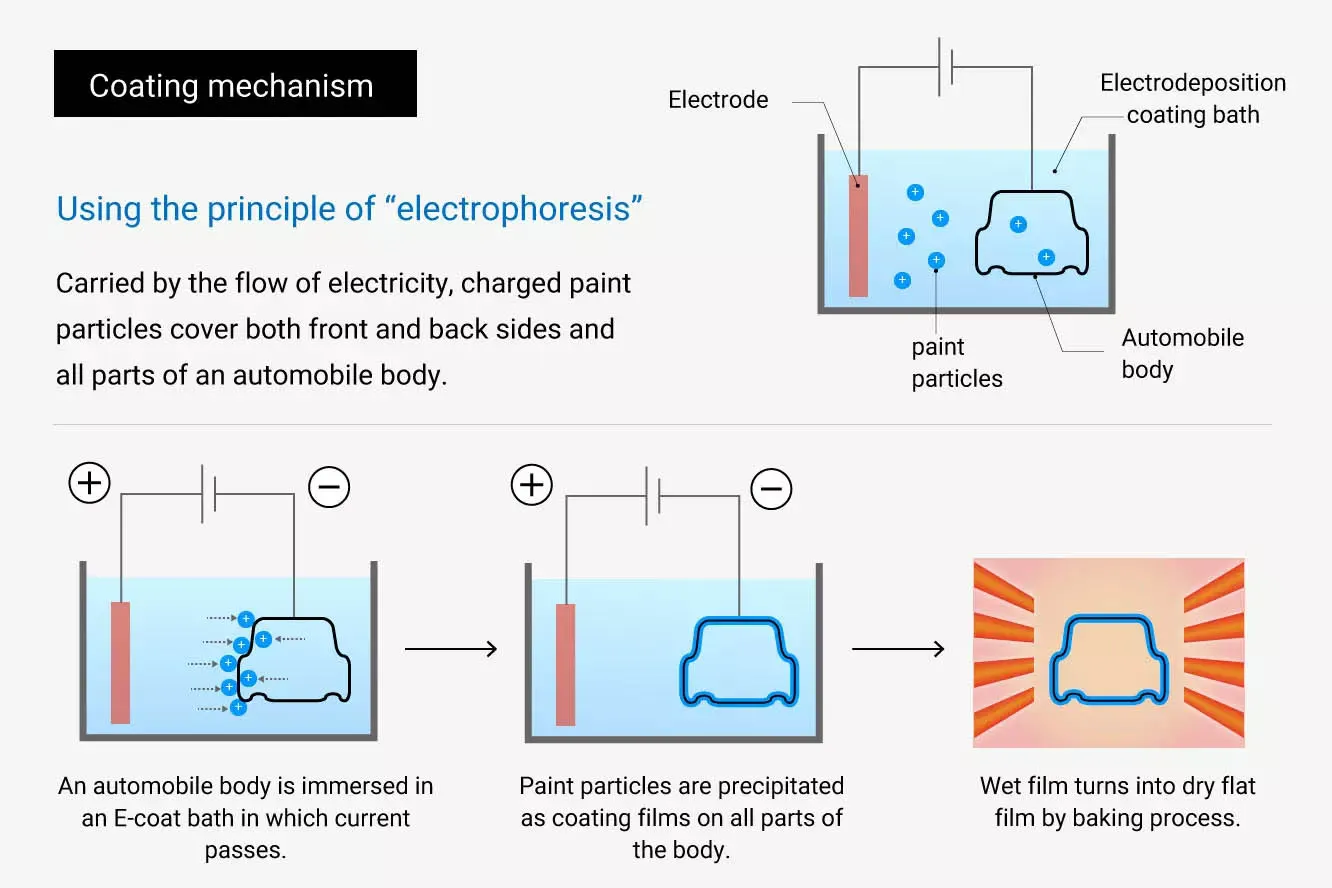
- E-coating involves dipping automobile bodies into the coating solution & passing an electric current through the body & the liquid ED paint solution. Because of the charged nature of this coating process, the ED paint penetrates into places a spray would not reach.
- During operation, a mixture of resin, binder, & a paste containing the pigments is fed into the ED tank. The automobile body is lowered into the tank, & an electric current applied; the solution in the tank consists of 80-90% de ionised water & 10-20% paint solids.The resin is the backbone of the final paint film & provides corrosion protection, durability, & toughness. Pigments are used to provide color & gloss.
- After E-coat, the automobile body enters a bake oven, in which heating & keeping at a temperature of 160_C for 10 min causes film curing to promote maximum performance properties. The oven temperature & heating time primarily enchance chip resistance & film adhesion to the body; corrosion protected is affected less by these conditions. Because surface roughness influences the smoothness & brilliance of the topcoat, some sanding of the surface is usually performed to remove or eliminate defects before the body enters the next application step.
- RUST PROOF MATERIALS :-
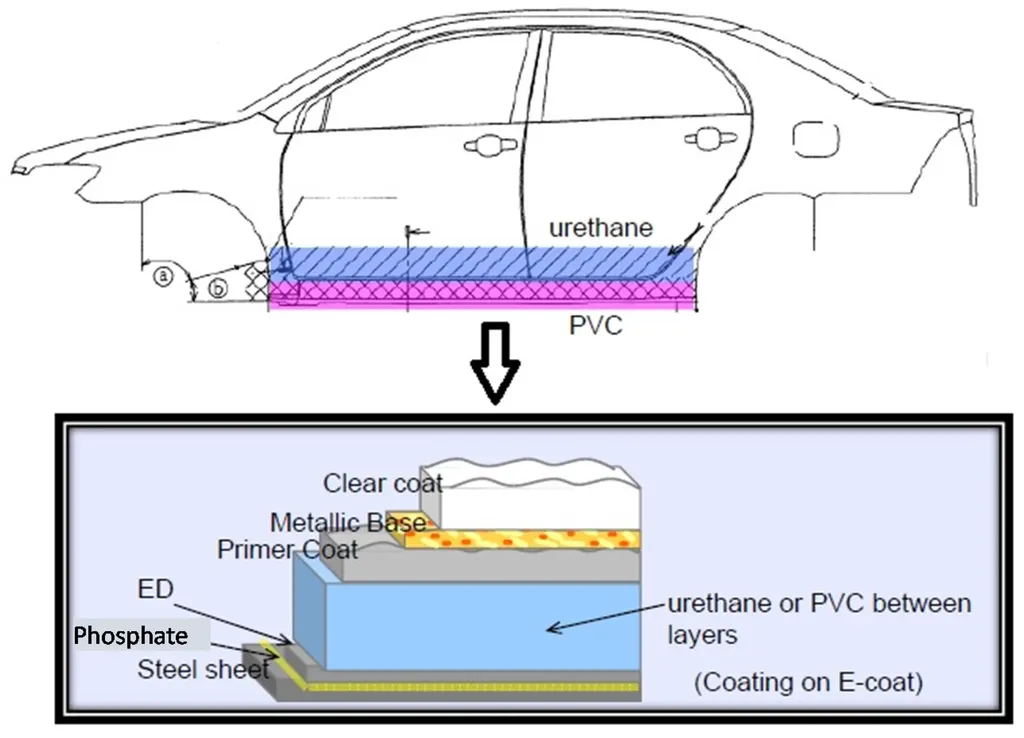
- The third step is underbody coating & seam sealing using PVC. Fig.4 displays the lower door sections & rocker panel locations where PVC or urethanes are applied as an anti-chipping protection, & shows the cross section of this layer with respect to the other coatings on the body parts.
- During this third step, it is also typical to apply a soft tip primer coat that improves the chipping resistance . This layer is applied to the front edge of the hood , which is an area prone to chipping shock, using a high elastic resin that resides between the ED & primer coats.
- PRIMER :-
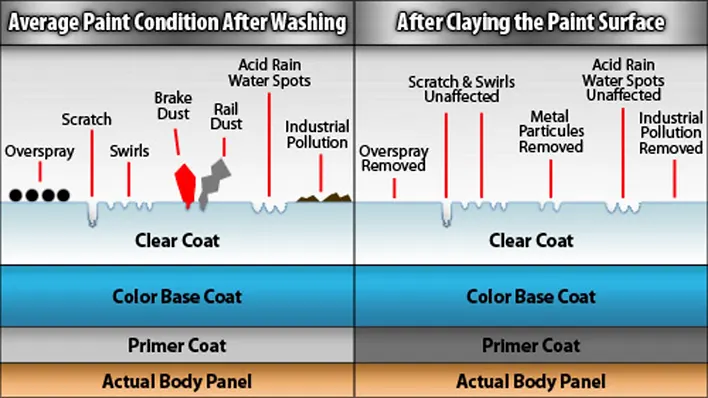
- Primer is an undercoat used to prepare your car for painting. It builds up rough surfaces, smoothing them over enough to paint on top of. It also stops topcoats from slipping, peeling or flaking. Primer has several other characteristics to help paint apply evenly.
TOP COAT :-
The final step in the body coating process is to apply the topcoat, which consists of two layers the basecoat & clearcoat.
Basecoat: It contains the primary coloring pigments. As part of the topcoat, the basecoat is third layr added to the car after the primer & before the clearcoat.
Clear coat :-The final coating on an automobile surface is the clearcoa; it provides durability, environmental etch, & scratch resistance to the overall coating.
TYPES OF UNDERCOATIG :-
1) Rubberized Underbody Coating:-
This is generally thought of as the best underbody coating for your car. It preserves the underbody well, protecting it from scratches. Applying this to the undercarriage is not much of a hassle either.
2) Wax Based Underbody Coating :-
This – more or less – ephemeral undercoating will wear away in a few months’ time. On the upside, wax-based undercoating puts up a big fight against moisture. It is also the most affordable option out there.
3) Asphalt Based Automotive Undercoating :-
Best suited for lorries, trucks and large vehicles this provides a greater degree of protection compared to rubber-based coatings. However, asphalt-based coatings contain little amounts of rubber for sound-insulation purposes. The process of applying this coating is a bit time-consuming though.
4) Polyurethane Underbody Coating :-
This coating closes up splits and fractures on the underbody of the vehicle. It offers up good protection against corrosion and also bonds with the metal. Unlike in the case of asphalt-based coating, you can paint over the polyethane coating.
Advantages of Undercoating :-
1)Fights Rust - It plays an important role in keeping corrosion at bay. Underbody coating can come in handy especially if you live near the sea, where there is too much humidity, and rusting is just one of those everyday things. You should also seriously consider undercoating if you reside in a place where it snows in winter.
2)Absorb Noise - Believe it or not, very thick undercoating can soften the noises that reach the cabin. Since the undercoating is often made up of rubber it absorbs some of the rackets. The occupants of the car could spare themselves of the road noises – at least up to a certain extend.
3)Reinforcement - If your car comes with stock underbody coating, using another coating on top of it, is not going to hurt. It will offer additional reinforcement, protecting the underbody from water, road debris, gravel and small pebbles. There would also be a lesser chance for the factory coat to flake away.
4) Prolong cars life - Good undercoating not only defends the underbody from corrosion but also protects the engine and transmission as well! Less rusting coupled with slower wear and tear can surely add years to the lifespan of your vehicle. There would be fewer dents, dings and scratches on the undercarriage for you to fret about.
Disadvantages of Undercating :-
A used vehicle may already have residue on the bottom of the car or even have spots of rust and corrosion. Undercoating will not help you if corrosion already exists and the corrosion needs to be removed first before it can be applied, which can be expensive for you.