Underbody Coating
INTRODUCTION:-
Muddy water,Potholes,stones and other road obstructions subjects a car undercarriage to the most damage.We frequently fail to see the damage because it is hidden from plain sight.
The underbody of an automobile is especially sussceptable to corrossion on Indian roads.The cars underbody is long term protected against corrossion by an underbody coating.Additionally it shields corrosive components including internal body pannels,frame rails and other hard to access inner cavities.
The vehicle chassis is shielded from the outside environment by a underbody protective layer preserving the vehicles structural integrity and enhancing safety.The usage of underbody coating affects the vehicles service life significantly.
UNDERBODY COATING:-
Underbody coating is a thick strong coating enforced to the chassis of an Automobile to protect the chassis from the impact of any obstacles which would cause damage to the paint of the car and gets start rusting.It also protects the various internal parts of an automobile that are not physically accessible but are prone to corrossion.It is normally sprayed or painted.
PURPOSE OF UNDERBODY COATING:-
1. It prevents from stone chips.
2. It prevents paint chipping.
3.It prevents against Rust and corrossion.
4. External Influence.
5. It protects vital components.
6. It Keeps the value.
7. Reduces Noise vibration harshness levels.
TYPES OF UNDERBODY COATINGS:-
1. RUBBERIZED UNDERCOATING:- In general Rubberized undercoating offers the best protection for the undercarriage of a car,protecting it against moisture,rust,dings and dents.Rubberized undercoating is safe for use on quarter pannels and wheel walls and dries with a soft finish.
2. ASPHALT BASED UNDERCOATING:- Providing a higher level of protection asphalt based undercoating is suitable for trucks,recreational vehicles and heavy machinery.It is formulated with some rubberized material for noise reduction as well as extra protection against chips and moisture but is paintable and therfore only suitable for undercarriages.
3. POLYURETHANE UNDERCOATING:- The polyurethane coating seals cracks and seams,displaces salt and moisture,and prevents in oxidized metal from rusting.It is often distributed in preloaded canisters ready for application but it requires some surface preparation.
4. WAX (OR) PARAFFIN BASED UNDERCOATING:- The absolute cheapest and fastest choices are undercoating sprays with a wax or paraffins basis.However,their effects are short lived and after just few months you could need to apply a new coat on metal surface,the wax is also not particularly sticky.Its primary benifit is that it penetrates cracks and seems rapidly and provides mediocre moisture protection.
METHODS OF UNDERBODY COATING:-
1. ELECTRONIC METHOD:- This little device can half the corrossive effects of rust by using a mild electric current.
We have the option of saving the money by purchasing these electronic components elsen where (or) having them fitted at the dealership
2. UNDERCOATING:- The exposed areas of a vehicles underbody are treated using a tar based spray.
Once it has dried and become hard,the tar like undercoating serves as a barrier,keeping out things like moisture and salt.
When used on a brand new vehicles undercarriage this undercoating performs best.It also needs to applied properly otherwise it could crack and let in moisture.
3. DROPLESS OIL SPRAY:- It is a wax like substance that is applied over the whole body of the car and hardens after drying.
One drawback of dripless oil sprays is that in order for them to work,certain holes must be drilled into the cars body at specific locations.
The spray also has a high viscosity,which means that it ocassionally misses some crevices within car.
4. DRIP OIL SPRAY:- The most frequently suggested rust protection is this.once applied,drip oil sprays frequently continue to trickle until they dry up to 48 hours after application this dripping may continue.
Although we still need to have holes drilled in our cars fender doors,and other areas to ensure that it gets to all the areas it needs to,drip oil sprays go into more spots on your vehicle than dripless versions due to their more watery nature.
PROCEDURE OF UNDERBODY COATING:-
1. Remove the wheel and plastic wheel covering by raising the car.
2. Use high pressure water to thoroughly clean the vehicles undercarriage,compressed air blasting could hasten the drying process.
3. Where it is prohibited to spray,such as on the exhaust pipe,brake system,engine,paint surface etc.Mask off the surrounding areas and components with paper
4. Before using,give the can a good 40 shakes and attach the sprayer.
5. Spray in an X-pattern at room temperature and a distance of about 25 cm to apply a continuous coat.
6. Spraying shouldn't be done near the engine,exhaust,brake system.
7. till the layer thickness is attained,apply this product.
8. Allow layers to dry in place if a thick layer is needed.
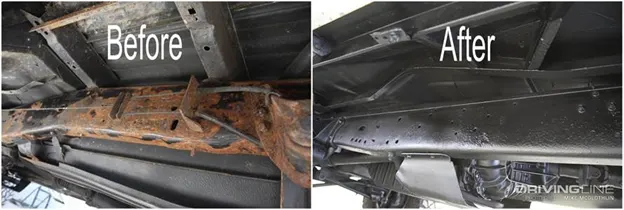
IMAGE SHOWING THE CAR UNDERBODY BEFORE UNDERBODY COATING AND AFTER UNDERBODY COATING.
ADVANTAGES OF UNDERBODY COATING:-
1. It provides a layer of protection against corrossion.
2. It will extend the life of the vehicle.
3. It can be applied to damaged areas.
4. It can be self-applied.
5. Multiple undercoating methods which can be used.
6. Service might help with the cost of your insurance.
7. It may help to reduce interior noise.
8. Saves money.
9. Reduces road noise.
10. Adds an extra layer of protection.
DISADVANTAGES OF UNDERBODY COATING:-
1. It won't do anything about the corrossion which is already present.
2. It works best on new cars.
3. Most of vehicles make it five years before corrossion begins to show.
4. A third party underbody coating service might void vehicles warranty.
5. It adds weight to vehicle.
6. An undercoating is not impervious to damage.
7. It must be reapplied for every 3-5 years for good results.