Section Modulus calculation and optimization
SECTION MODULUS OF A HOOD
Section Modulus:-
-
Any sectional area of an object's strength along a reference axis is directly measured by its section modulus (neutral axis).
-
Strength is nothing more than the ability to withstand heavier loads, hence the more strength something has, the more heavy loads it can withstand.
-
This strength can be calculated directly using the formula for the section modulus, which is given below.
-
Section modulus is denoted by the letter "S"
S=I/Y
where 'I'moment of inertia'
'Y' is the distance from the reference line(neutral axis) to one of the extreme end of an object.
- If we apply any external stress to the body, how much resistance is the body offering to tend to deform? This is what the term "moment of inertia" refers to: offering resistance against of moment, bending or twisting.
- Therefore, larger moment of inertia values have more resistance to deforming under a given load; as a result, we can claim that moment of inertia is directly related to material strength, which can be estimated using section modulus.
- The body's total strength will drop if the neutral axis is changed to the positive or negative side because when the neutral axis line is in the middle of the section, only that particular spot has increased strength, which is why the 'Y' value was inversely proportional to section modulus.
-
Thats why formula represented as above.
By using the same principle i going to calculate the strength of an hood panel.
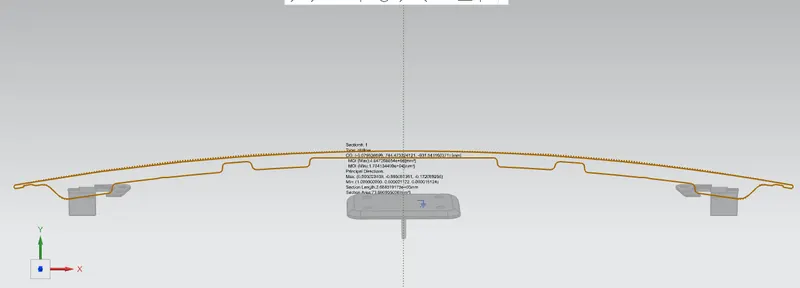
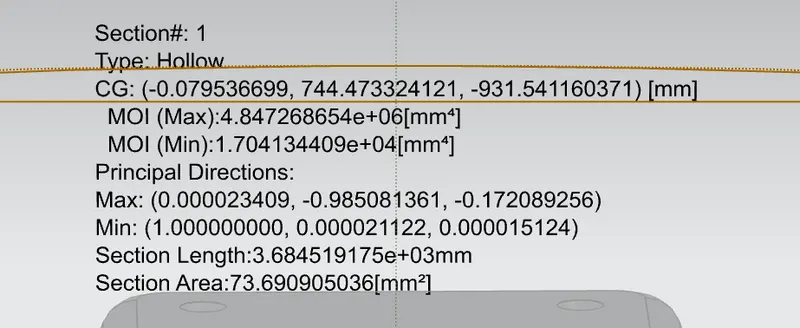
Here the moment of inertia was calculated by using the NX-software obtained values are
IMAX:-4.847X106mm4
Imin:-1.704x104mm4
Total length of 'Y' value was 876.7320mm.
So,at neutral axis we need 'Y' value:-Y/2=876.7320/2=438.2347mm.
1)Section modulus(S):-I/Y=4.847x106mm4/438.2347mm= 1.106X103mm3(Maximum strength).
2) Section modulus(S):-I/Y=1.704x103mm4/438.2347mm = =0.038x103mm3(minimum strength).
So the hood strength varies from 0.038x103mm3to 1.106X103mm3
one more trail is now available, with the results displayed below. Here, the inner panel curvature is offset from the outer by one millimetre, increasing the cross sectional area.
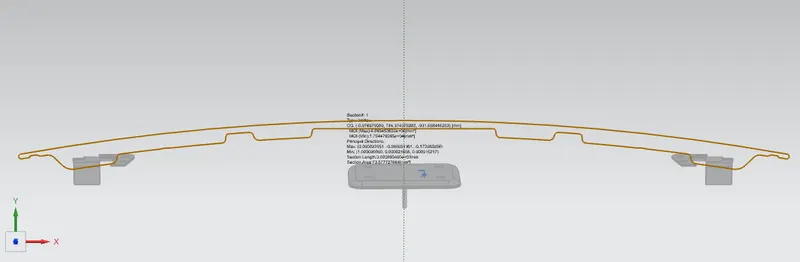
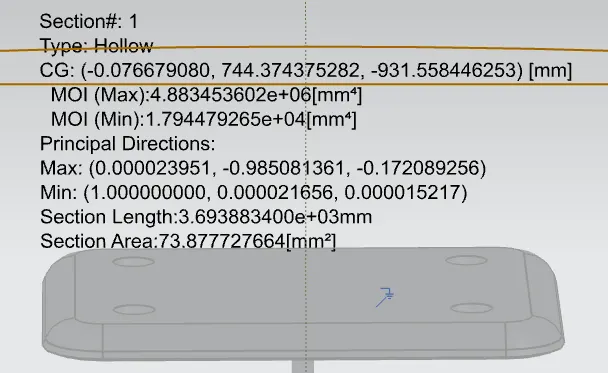
I obtained the values of
IMAX:-4.88X106mm4
Imin:-1.794x104mm4
Total length of 'Y' value was 876.7320mm
So,at neutral axis we need 'Y' value:-Y/2=876.7320/2 = 438.2347mm
1)Section modulus(S):-I/Y=4.88X106mm4/438.2347mm = 1.113X103mm3(Maximum strength).
2) Section modulus(S):-I/Y=1.794x104mm4/438.2347mm = 0.040x103mm3(minimum strength).
So the strength of an hood varies from 0.040x103mm3to 1.113X103mm3.
- As a result, when comparing the MAX and MIN strength values for the two hoods, I discovered that increasing the cross sectional area by 2 mm resulted in an increase in minimum strength from 0.038 x 103mm3 to 0.040 x 103mm3. Accordingly, increasing the cross sectional area leads to an increase in strength.
- However, when we look at the value of maximum strength, it slightly decreases from 1.113X103mm3 to 1.106X103mm3 , which I believe is a result of the design of the hood. Here, what we want to know is whether minimum strength or maximum strength will increase when cross sectional area increases, or whether both will increase.
- Therefore, Newton's first law also explains why, if an object has a higher mass, a greater force is needed to move it.
- So, according to Newton's first law, a heavier object requires a greater power to move it since there is more resistance to overcome. This resistance is known as a MOMENT OF INERTIA.
- The same theory applies to hoods as well; according to our observations from the preceding discussion, the minimum load carrying capacity or strength rose by about 8% percentage for every 1mm increase in cross sectional area.
- The composition of the material, thickness, and cross sectional area of an object are all factors that affect a material's strength.
CONCLUSION:-
The relationship between a material's strength and moment of inertia means that as its sectional area increases, so does its overall mass, which in turn increases its strength.