Underbody Coating
Underbody Coating:
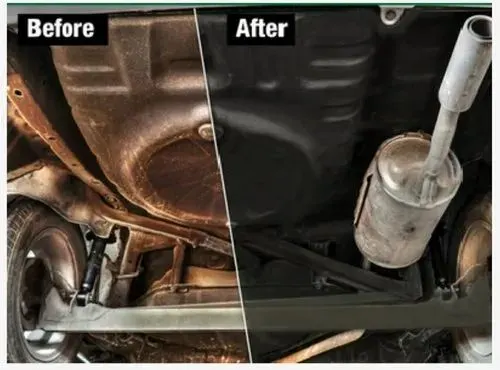
Underbody coation is an application where body is painted to form corrosion resistance so that it can be used for prolonged application. It also protects parts like internal body panels, frame rails and other inner cavities that are not physically accessible but are prone to corrosion.The treatment offers an long term solution for issues against rust and corrosion. Under coating helps i nprotecting the underbody from water, road debris, gravel and small pebbles.
Process of under coating:
1st : The body is washed and ungressed.
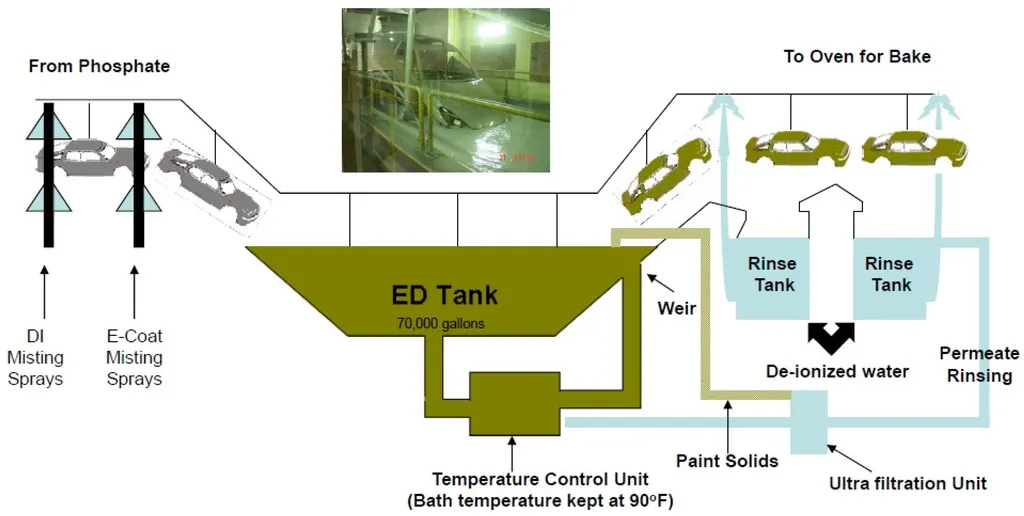
2nd: Then the body is dipped into ED bath where as per the plant capacity time for each dipping activity is decided.
3rd: The body is then removed from the bath at an particular angle to avaoid slag formation on the paint .
4th: It is then passed to heating chamber, where the color is left to dry.
5th: After that primer coating is done on the surace of the car to ensure life of the components.
6th: The car is then painted with particular coating which can be automatic or semiautomic depending on the type of industry.
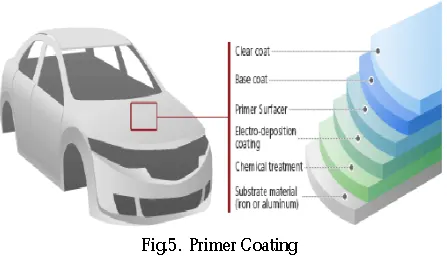
Modern automotive coating process.
Pretreatment:
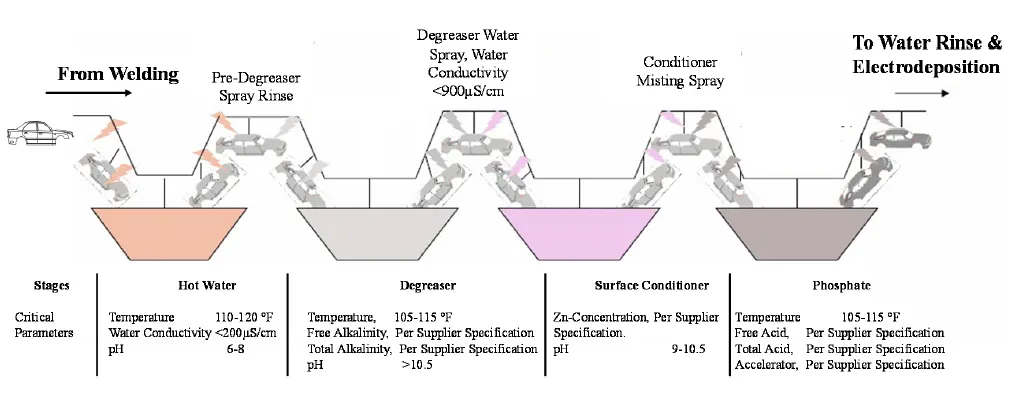
2. ELETRODEPOSITION
In ED deposition the automobile is dipped into coating solution at certain angle according to the need, and with the help of electricity the part is coated.Beacuse of the charge process the body is coated in the best way where the charge in not able to reach.
During operation, a mixture of resin, binder, & a paste containing the pigments is fed into the ED tank. The automobile body is lowered into the tank, & an electric current applied; the solution in the tank consists of 80-90% deionised water & 10-20% paint solids.The resin is the backbone of the final paint film & provides corrosion protection, durability, & toughness. Pigments are used to provide color & gloss. after ED coating it enters into the hearting chambe of 160 degree celcius causes film curing to promote maximum performance properties.A common challenge in the cureent E-coating process is that of water spots that contaminate coated surfaces. If water spots are present, they have removed any sanding. Hence, it is necessary to use well-deionoised water& routinely monitor its conductivity. Alternatively, operators also add surfactants or ultrafiltrates to the water rinse zone to eliminate or manage water spots.
3.RUST-PROOF MATERIALS: SEALER/PVC
4.Primer.
It helps in increaing paint durability.
Pros of under coating:
It helps in long lasting of car parts.Undercoating gives you an extra layer of protection against rust and corrosion, protecting your ca.
Cons: For already affected car i.r for a car which had already have rusted undercoating will not work well for it. i.e ndercoating will not help you if corrosion already exists and the corrosion needs to be removed first before it can be applied, which can be expensive for you.
Types of coating:
1. Rubberized Under body coating.
It preserves the underbody well, protecting it from scratches.
2.Wax Based Underbody Coating.
This – more or less – ephemeral undercoating will wear away in a few months’ time. On the upside, wax-based undercoating puts up a big fight against moisture. It is also the most affordable option.
3.Asphalt Based Automotive Undercoating
Best suited for lorries, trucks and large vehicles this provides a greater degree of protection compared to rubber-based coatings. However, asphalt-based coatings contain little amounts of rubber for sound-insulation purposes. The process of applying this coating is a bit time-consuming though.
Advantages of undercoating :
1.Fight against rust
2.Absorbs noise.-Since it is made of rubber it absorbs noise.
3.Reinforcement.
4. Prolonged life.