Underbody Coating
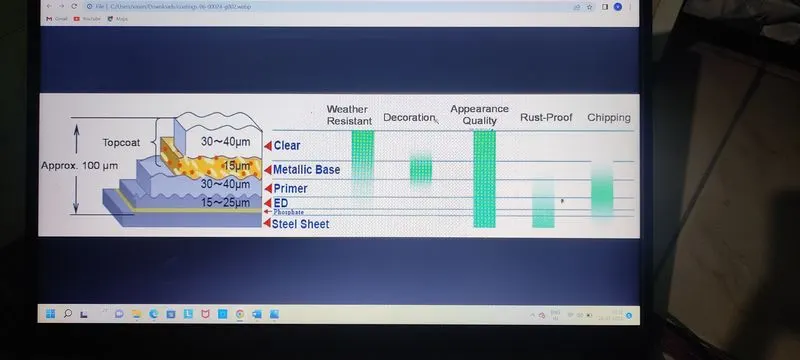
Modern automotive coating methods consist of five main steps. They include the following:
Pre-treatment sequences for the body-in-white
ELETRODEPOSITION
RUST-PROOF MATERIALS: SEALER/PVC
PRIMER
TOPCOAT
Pre-treatment sequences for the body-in-white
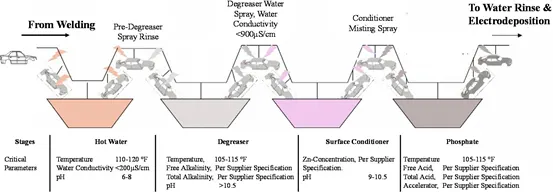

Pretreatment:removes and cleans excess metal and forms an appropriate surface structure
enabling bonding of a corrosion protection layer
ELETRODEPOSITION
 ELETRODEPOSITION
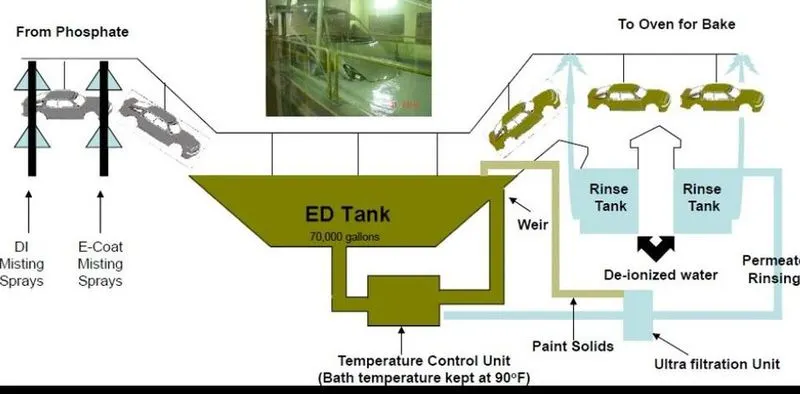
Electrodeposition coating process E-coating involves dipping automobile bodies into the coating solution & passing an electric current through the body & the liquid ED paint solution. Because of the charged
RUST-PROOF MATERIALS: SEALER/PVC
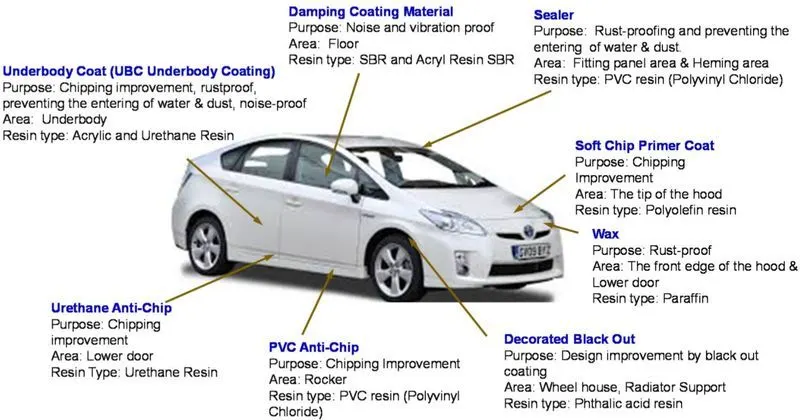
- The third step is underbody coating (UBC) and seam sealing using PVC (Polyvinyl Chloride) and urethane. This sealing has multiple purposes, as shown in Table
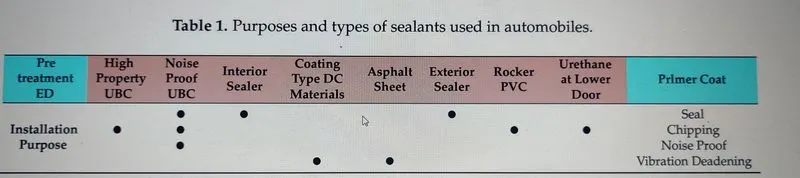
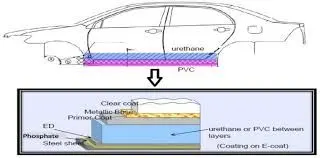
The sealant is applied around and inside the doors, hood, trunk, and front dash, and onto the exterior and interior of metal joints and outer area of the back wheel well; application of the sealant
is accomplished either manually or with robots and prevents air and water ingress and inhibits rust formation. Recently, PVC and acryl/urethane sealants have also been used in the underbody areas, a process called the Dampening Coat (DC), to impart noise-proofing and vibration-deadening. The noise and vibration are transferred from the engine, drive train, suspension system, road noise of the tires, and flowing air, and the underbody sealants reduce noise transfer into the passenger compartment of the automobile
PRIMER
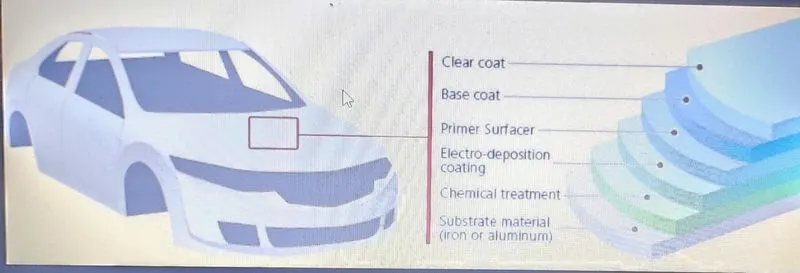
The fourth coating step is the application of a primer surfacer or simply primer. It can be water-borne, solvent-borne, or a powder. The main reason for primer application until 1990 was to improve weather resistance, appearance, and chipping resistance. Since 1990, primers have been developed in solvent-borne and water-borne materials, and powders (explicitly for reducing the amount of volatile organic compounds (VOC) discharged into the atmosphere or pollutant capture equipment). Today’s primers have to improve adhesion between the E-coat and topcoat, provide chipping protection, enhance paint appearance and, also, be environmentally compatible with emission regulations. The primer fills and smooths minor imperfections and scratches that may be created during prior steps and by the intermediate sanding or grinding used to remove small imperfections. Additionally, most automobile bodies have surface imperfections that arise from the pressing, stamping, and welding operations, and these defects are typically accentuated during the ED step. Hence, although the main purpose of the primer has been to act as a leveler that produces a smoother finished surface
TOPCOAT
The final step in the body coating process is to apply the topcoat, which consists of two layers the basecoat & clearcoat.
Basecoat: It contains the primary colouring pigments. As part of the topcoat, the basecoat is third lair added to the car after the primer & before the clearcoat. It imparts the automobiles colour; roughly 40,000 base coat colours are known today, & approximately 1000 new colours are added to this list each year. Three different types of basecoats are used for automobiles, including
solvent-borne medium solids (MS),
solvent-borne high solids (HS), & water-borne.
The MS basecoats contain 15%–20% solid levels and have a spray viscosity of 100 mPa.s at 1000 rpm. The HS basecoats were developed from MS basecoats in response to the U.S. Environmental Protection Agency (EPA) requesting that the solid levels in solvent-borne spray paints be increased, and the organic solvents decreased to minimize VOC emissions. Waterborne basecoats have become the primary basecoat used throughout the U.S. automobile manufacturing industry since 2000 due to their environmental benefits.
Clearcoat: The final coating on an automobile surface is the clearcoat; it provides durability, environmental etch, & scratch resistance to the overall coating. It protects against damage such as fading that is caused by UV rays from the sun & imparts a gloss & depth that otherwise are not as vivid. The clearcoat also makes repairs & maintenance easier. Environmental etch is an appearance issue associated with the formation of permanent water spots or nonremovable marks from bird droppings, tree
resin, or other chemicals after contact with an automobiles surface. The physical damage resulting from etching is associated with a localized loss of material & deformation or pitting of the clearcoat surface
To impart UV durability, HALS (hindered amine light stabilizer) chemicals are mixed with UVA (ultraviolet light absorbers) into automotive clearcoats during their manufacturing. The primary functions of these chemicals are to prevent UV-induced degradation of the polymeric backbone (by HALS) and to absorb UV radiation within the 290–400 nm wavelength range. The concentration of UVAs in clearcoats has been shown to decrease by about 50% after four years of exposure to the sun; this depletion is a consequence of photochemical degradation and subsequent diffusion from the clearcoat. The HALS complements the activity of the UVAs by scavenging free radicals that are formed on the surface of the coating, where the UVAs cannot effectively shield the polymer, or within the coating at wavelengths at which the UVAs may not absorb efficiently
Rubberized Underbody Coating
Rubberized vehicle undercoating is easy to apply and offers sound-cushioning as well as protection from dust, moisture, and dings or dents.
In addition to your undercarriage, rubberized undercoating is also safe to use on wheel wells and quarter panels, and dries to a soft rubbery finish that prevents further rust, damage, or moisture seeps. The coating can be painted over and, if necessary for bodywork, can be easily removed with an undercoating removal spray.
Overall, rubberized coating is generally the best option for protecting your vehicle's undercarriage, as it provides the simplest and best protective measures against rust and moisture.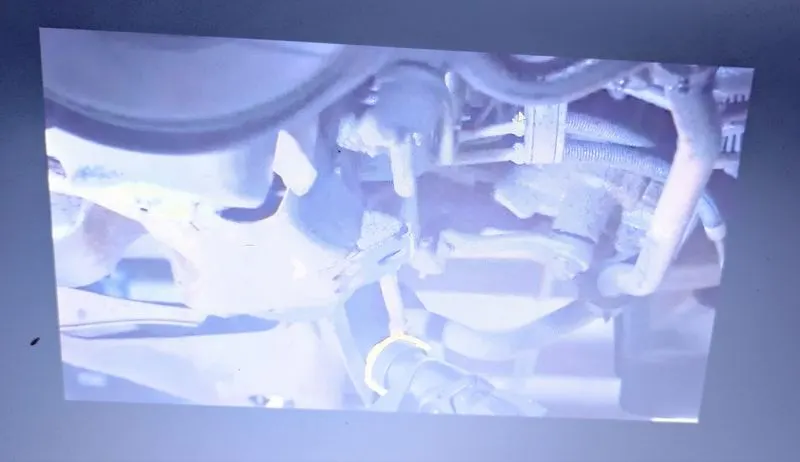
Wax Based Underbody Coating
A paraffin-based undercoating will be the cheapest and quickest option available with which to protect the undercarriage of your vehicle. However, keep in mind that it will wear off quicker than other types of undercoating and will need to be stripped and reapplied at least once every year.
Wax-based undercoating’s never truly harden. During application, they drip or flow into seams and cracks to provide protective properties. They are usually available in a spray gun canister or in an aerosol can and offer at least a base protection in moderately humid climates.
Asphalt Based Automotive Undercoating
For standard vehicles, any of the aforementioned types of undercoating will provide sufficient protection. For large trucks and heavy machinery, asphalt-based undercoating provides a bit of extra durability against rocks, chips, and moisture.
Asphalt-based undercoating generally contains a little bit of rubberized material that sets up firmly and also helps soften noise. Generally sold in five-gallon containers, this type of undercoating also needs more cure time than the other three, and is NOT paintable, making it best to use only for undercarriages.
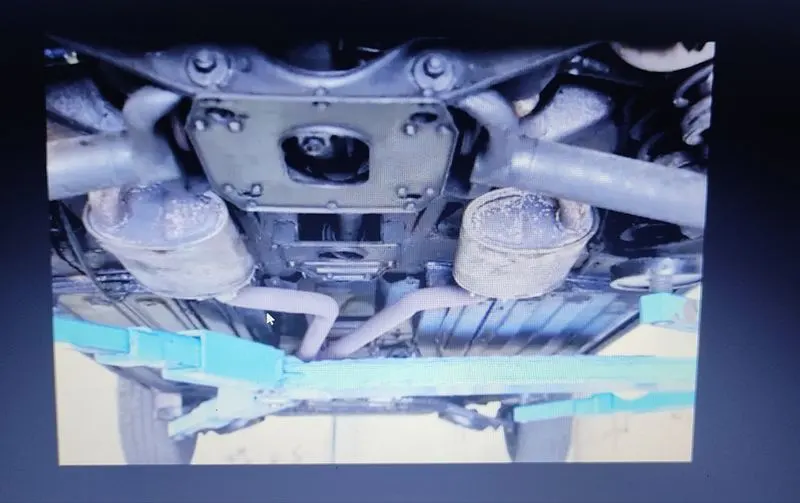
Polyurethane Underbody Coating
The other option for undercoating your vehicle is to use a polyurethane-based sealant. This type of vehicle undercoating is a little bit quicker and easier to apply.
Oftentimes, polyurethane undercoating will come in canisters ready to preload into an application gun. This type of sealant works by seeping into all cracks and seams, displacing salt and moisture and oozing around rusty areas to bond with and protect unoxidized metal. It also sands quickly in case you'll need to perform bodywork and can be painted over.
On the flipside, this type of car undercoating generally requires a little bit more surface prep work before applying -- sanding and applying an etching primer to bare metals before using are generally recommended.
Advantages of Undercoating
Now we will tell you why you should consider investing in a vehicle underbody coating.
Fights Rust
It plays an important role in keeping corrosion at bay. Underbody coating can come in handy especially if you live near the sea, where there is too much humidity, and rusting is just one of those everyday things. You should also seriously consider undercoating if you reside in a place where it snows in winter.
Absorbs Noise
Believe it or not, very thick undercoating can soften the noises that reach the cabin. Since the undercoating is often made up of rubber it absorbs some of the rackets. The occupants of the car could spare themselves of the road noises – at least up to a certain extend.
Reinforcement
If your car comes with stock underbody coating, using another coating on top of it, is not going to hurt. It will offer additional reinforcement, protecting the underbody from water, road debris, gravel and small pebbles. There would also be a lesser chance for the factory coat to flake away.
Prolong Car’s Life
Good undercoating not only defends the underbody from corrosion but also protects the engine and transmission as well! Less rusting coupled with slower wear and tear can surely add years to the lifespan of your vehicle. There would be fewer dents, dings and scratches on the undercarriage for you to fret about.
AUTOMOTIVE COATING PERFORMANCE
- a) Coating Quality: It can be judged on three main criteria: protection against harsh environment; durability; & appearance quality.
- b) Colour: Uniform & consistent colour is essential to achieve the impression of a high-quality finish & avoid customer complaints. This issue is important not only at the time of purchase but also at the time of purchase but also throughout the lifetime of a vehicle. Factors that influence colour tone are pigment orientation & concentration.
- c) Corrosion Protection: Automobile coatings are subjected to a number of different environments & situations during their service life. Degradation of the coating depends on three main factors: coating formula, the intensities of the environments or situation, & their duration. Exposure to UV from the sun, heat, & humidity has a long-term deleterious effect with different degrees of intensity depending on the climate & weather conditions
CONCLUSION
Automotive coatings confront an almost limitless variety of environments & environmental assaults. Targeting customers, expectations, together with maximizing efficiencies & meeting environmental regulations with new processes, has brought automotive coating to a level not imagined 100 years ago.
The current paper gave a semi-comprehensive & up-to-date review of these new processes & coating technologies to be of value to industrial practitioners & researches. New developments in automotive coatings were chronicled & discusses, & then related to improvements in production technologies & paints. Modern automotive coating procedures were also discussed in details. Finally, the discussion covered recent trends in automotive coating processes & potential future developments.