Structural dynamics
1.The main difference between static and dynamic analysis is TIME! If the load is applied so slowly, that inertia effects won’t play a role, all you need is static analysis. Dynamic analysis handles impacts and other “fast” happening situations, but also vibrations(which happen in time).
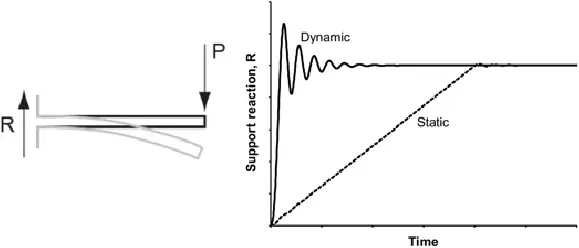
A static analysis can only be performed if the system being simulated does not depend on time, and if the loads being applied are constant. In a dynamic analysis, the system itself, the load application, or both might change with time.
In a dynamic analysis, the inertial loads developed by the system due to acceleration are taken into account. Static analyses don’t consider inertia.
Mathematically, the difference between static and dynamic analysis is that in a static analysis, only the stiffness matrix of the FEA model is solved. In a dynamic analysis, in addition to the stiffness matrix, the mass matrix (and damping matrix, if not zero) is solved as well. That is one of the reasons why dynamic analyses require more computational time than static analyses, for the same structure.
2.a)Elastic behavior
Elasticity is the ability of a body to resist any permanent change to it when stress is applied. When stress application ceases, the body regains its original shape and size. Different materials show different elastic behavior. The study of the elastic behavior of a material is of much importance.
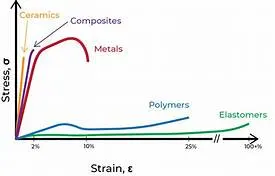
The rubber strip of the slingshot has high elasticity. Elasticity is the ability of a body to resist any permanent change to it when stress is applied. When stress application ceases, the body regains its original shape and size. Different materials show different elastic behaviour. The study of the elastic behaviour of a material is of much importance. Almost every engineering design requires knowledge of the elastic behaviour of materials. In the construction of various structures like bridges, columns, pillars, beams, etc. knowledge of the strength of the materials used in the construction is of prime importance.
For example: while constructing a bridge, the load of traffic that it can withstand should be adequately measured beforehand. Or while constructing a crane used to lift loads, it is kept in mind that the extension of the rope does not exceed the elastic limit of the rope. To overcome the problem of bending under force the elastic behaviour of the material used must be considered primarily.
b)Inelastic behavior
"Inelastic" is an economic term referring to the static quantity of a good or service when its price changes. Inelastic demand means that when the price goes up, consumers’ buying habits stay about the same, and when the price goes down, consumers’ buying habits also remain unchanged.
c) plastic behavior
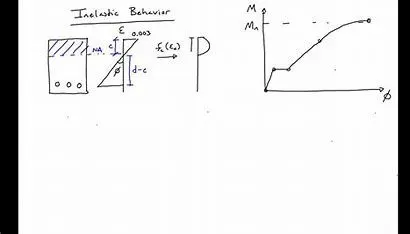
Plastic behavior is characterized by an irreversible straining which is independent of time and which can only be sustained once a certain level of stress has been reached. In this section we outline the basic assumptions and associated theoretical expressions for a general continuum.
d)Non-linear Inelastic behavior
The nonlinear behavior of the mentioned structural systems has been evaluated as, in earthquakes, structures usually enter into an inelastic behavior stage and, hence, the applied energy to the structures will be dissipated
3.Mass and stiffness are related together through the resonance frequency f0= (1/2pi)*sqrt (Stiffness/Mass). Damping effect is negligible/unimportant compared to both mass or stiffness, except when the SDOF is near from the resonance frequency.
Equation of motion:Earthquake excitation
m*u(acceleration)+c*u(velocity)+k*u=-m*ug(t)
4.
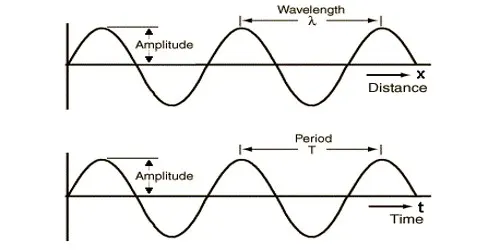
We know that the number of complete vibrations of a vibrating particle in one second is called its frequency. Frequency is denoted by f. Again the time period is the time of one complete vibration. Frequency and period are inversely related quantities. The frequency (f) of a wave is the number of full waveforms generated per second. This is the same as the number of repetitions per second or the number of oscillations per second.
Time Period (T) is the number of seconds per waveform or the number of seconds per oscillation. It is clear that the frequency and time period are reciprocals.
If the time period is T, then in T second, the number of vibration is 1
Therefore, the number of vibration in one second is = 1/T
The number of vibration in 1 second is frequency. So, the frequency, f = 1/T
Explain the Relation between Frequency and Time Period
We know that the number of complete vibrations of a vibrating particle in one second is called its frequency. Frequency is denoted by f. Again the time period is the time of one complete vibration. Frequency and period are inversely related quantities. The frequency (f) of a wave is the number of full waveforms generated per second. This is the same as the number of repetitions per second or the number of oscillations per second.
Time Period (T) is the number of seconds per waveform or the number of seconds per oscillation. It is clear that the frequency and time period are reciprocals.
If the time period is T, then in T second, the number of vibration is 1
Therefore, the number of vibration in one second is = 1/T
The number of vibration in 1 second is frequency. So, the frequency, f = 1/T
Explain the Relation between Frequency and Time Period
We know that the number of complete vibrations of a vibrating particle in one second is called its frequency. Frequency is denoted by f. Again the time period is the time of one complete vibration. Frequency and period are inversely related quantities. The frequency (f) of a wave is the number of full waveforms generated per second. This is the same as the number of repetitions per second or the number of oscillations per second.
Time Period (T) is the number of seconds per waveform or the number of seconds per oscillation. It is clear that the frequency and time period are reciprocals.
If the time period is T, then in T second, the number of vibration is 1
Therefore, the number of vibration in one second is = 1/T
The number of vibration in 1 second is frequency. So, the frequency, f = 1/T
Frequency refers to how often something happens; whereas Period refers to the time it takes for something to happen. Frequency means how many times a periodic event happens in a second.
A period is a time between any 2 events. As a general rule, the period should be the reciprocal of the frequency, hence the equation: Period = 1/Frecuency.
Frequency, f, is how many cycles of an oscillation occur per second and is measured in cycles per second or hertz (Hz). The period of a wave, T, is the amount of time it takes a wave to vibrate one full cycle. These two terms are inversely proportional to each other: f = 1/T, and T = 1/f.
5.A response spectrum is a graphical plot of the frequency of an oscillator and its damping. The response spectrum plot represents the peak or steady-state response (velocity, displacement, or acceleration) of a series of oscillators of varying natural frequency.
-Steps involve in construction of Response Spectrum
Step1-Numerically define ground acceleration
Step2-Select natural vibration period and damping ratio at SDF system
Step3-Compute deformation rsponse of this SDF system due to ground motion
Step4-Determine uo, peak value u(t)
Step5-Spectral ordinates are D=uo, V=(2π/Tn)*D and A=(2π/Tn)*D