Structural dynamics
1)
static analysis
- A static analysis can only be performed if the system being simulated does not depend on time, and if the loads being applied are constant.
- Static analyses don’t consider inertia.
Dynamic analysis,
- In a dynamic analysis, the system itself, the load application, or both might change with time.
- In a dynamic analysis, the inertial loads developed by the system due to acceleration are taken into account.
Mathematically, the difference between static and dynamic analysis is :
- that in a static analysis, only the stiffness matrix of the FEA model is solved.
- In a dynamic analysis, in addition to the stiffness matrix, the mass matrix (and damping matrix, if not zero) is solved as well.
That is one of the reasons why dynamic analyses require more computational time than static analyses, for the same structure.
For a dynamic analysis, the loads can be in either the time domain or in the frequency domain.

2)
Elastic behavior
Elastic behavior of materials defines the limits that material does not show any permanent shapeshifting. For example, you applied a force or pressure to an engineering system such as a metal bar, the metal bar will show some flexure, but when you take the force or pressure back it will completely turn back to the initial shape
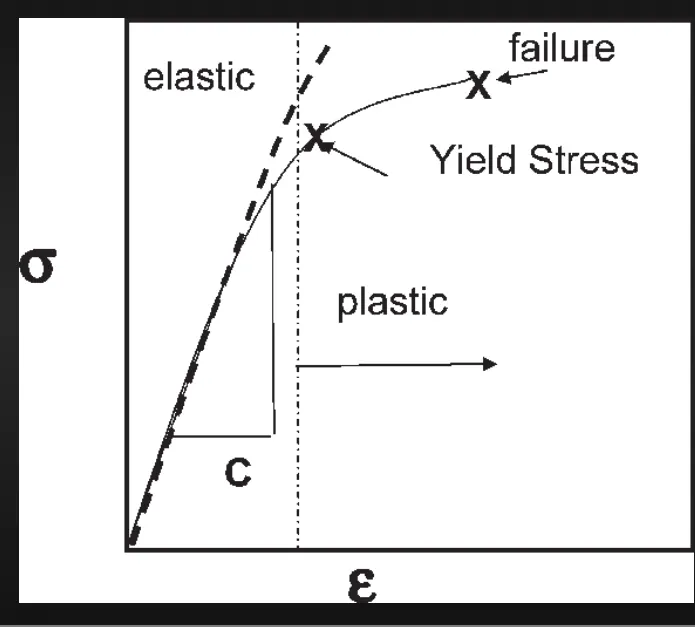
inelastic behavior
This model defines the inelastic behavior of a material by a yield function that depends on the three stress invariants, an associated flow assumption to define the plastic strain rate, and a strain hardening theory that changes the size of the yield surface according to the inelastic volumetric strain.

PLASTIC BEHAVIOR
Behavioral plasticity refers to a change in an organism's behavior that results from exposure to stimuli, such as changing environmental conditions. Behavior can change more rapidly in response to changes in internal or external stimuli than is the case for most morphological traits and many physiological traits
NON LINEAR ELASTIC
This model defines the inelastic behavior of a material by a yield function that depends on the three stress invariants, an associated flow assumption to define the plastic strain rate, and a strain hardening theory that changes the size of the yield surface according to the inelastic volumetric strain
3)
- Mass and stiffness are related together through the resonance frequency f0= (1/2pi)*sqrt (Stiffness/Mass). Damping effect is negligible/unimportant compared to both mass or stiffness, except when the SDOF is near from the resonance frequency.
-
Damping Method. The calculation for frequency-dependent added mass and damping loads is more complex, and is described in Vessel Theory: Impulse Response and Convolution, but the units given below apply in both cases.
Damping Load
When using the Constant Added Mass and Damping Method, the damping load is equal to -D.V, where D is the specified damping matrix and V is the (6 degree of freedom) vector of vessel velocity and angular velocity relative to the earth at the specified reference origin.
The damping load is calculated using the following matrix equation:
L = -D.V where
L = [Fx,Fy,Fz,Mx,My,Mz]T is the column 6-vector containing the components, in the vessel primary heading axes directions, of the damping force (Fx,Fy,Fz) and moment (Mx,My,Mz) that acts on the vessel at the reference origin. (The superscript T denotes transpose, simply to turn the row-vector written into a column vector.)
4)
'
- The equation gives the relation between the frequency and the period: The relation between the frequency and the period is given by the equation: f=1/T For a sinusoidal wave represented by the equation:
Natural frequency?
-
A building’s natural frequency (n) is simply the inverse of the fundamental period (T), and, for flexible and dynamically sensitive buildings and other structures, this natural frequency is used in the calculation of the Gust Factor
- A building’s natural frequency (n) is simply the inverse of the fundamental period (T), and, for flexible and dynamically sensitive buildings and other structures,
- this natural frequency is used in the calculation of the Gust Factor. The ASCE 7 standard specifies that buildings are considered “flexible” if they have a fundamental period greater than 1 second. Tall building or moment-frame buildings tend to be more flexible than others, so these code criteria can have a significant impact on their design and their construction costs.
- And engineering judgement is required when the natural frequency/fundamental period of the structure is near 1.0 and note that the nonbuilding structure or components with the fundamental period less than 0.06 s shall be considered a rigid element
- Natural period
Natural period of a thing refers to its intrinsic property i.e. time period of vibrating at a specific frequency which is based on the mass as well as the stiffness of the thing.
-
So e.g. if you hold a steel foot ruler firmly from one end and hit it on at the other end, it will start to vibrate at a specific frequency.
-
This is its natural frequency and its inverse is its natural period. If you take a longer ruler or a ruler of some other material like plastic, you will find that they will vibrate at different frequencies.
Now consider a building. It is also a sort of a ruler held at the base and free at the top. During the earthquake, building will vibrate, just like a ruler, at its natural frequency. However, the vibration is not restricted to just this first mode, it can vibrate in multiple modes with
5)
Response Spectrum
- Definition of a Response Spectrum A response spectrum is a function of frequency or period, showing the peak response of a simple harmonic oscillator that is subjected to a transient event. The response spectrum is a function of the natural frequency of the oscillator and of its damping.
-
A response spectrum is a plot of the peak or steady-state response (displacement, velocity or acceleration) of a series of oscillators of varying natural frequency, that are forced into motion by the same base vibration or shock The resulting plot can then be used to pick off the response of any linear system, given its natural frequency of oscillation. One such use is in assessing the peak response of buildings to earthquakes. The science of strong ground motion may use some values from the ground response spectrum (calculated from recordings of surface ground motion from seismographs) for correlation with seismic damage.
If the input used in calculating a response spectrum is steady-state periodic, then the steady-state result is recorded. Damping must be present, or else the response will be infinite. For transient input (such as seismic ground motion), the peak response is reported. Some level of damping is generally assumed, but a value will be obtained even with no damping.
Response spectra can also be used in assessing the response of linear systems with multiple modes of oscillation (multi-degree of freedom systems), although they are only accurate for low levels of damping. Modal analysis is performed to identify the modes, and the response in that mode can be picked from the response spectrum. These peak responses are then combined to estimate a total response. A typical combination method is the square root of the sum of the squares (SRSS) if the modal frequencies are not close. The result is typically different from that which would be calculated directly from an input, since phase information is lost in the process of generating the response spectrum.
-