Structural dynamics
AIM
To get the better understanding of following topics which are explained below.
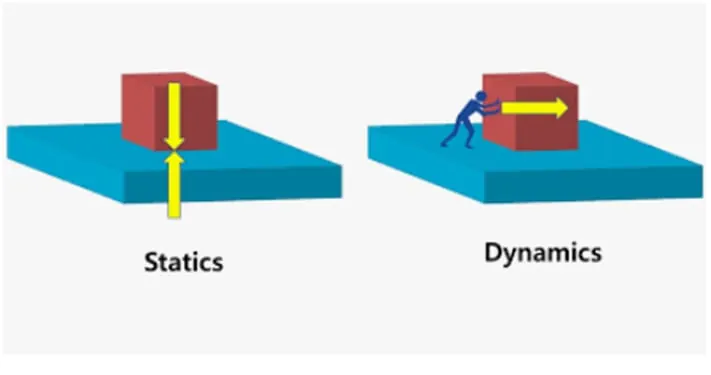
1. Differentiate Static analysis and Dynamic analysis with proper representing pictures.
ANS
Static Analysis:
- A static. structural analysis calculates. the effect of study loading condition on a structure
- It ignores inertia and damping effeccts, such as those caused by time vaeying loads.
- Static analysis is an essential process. to design a structure.
- Using static analysis, the structure response to the applied external force is obtained. Moreover, the static analysis is perford when the structure is subject to extrenal displacements such as differential support settlements.
Dynamic analysis
- Dynamic analysis is a type of structural analysis which covers the behavior of a structure subjected to dynamic loading
- A dynamic load is any load that changes over time. These type of loads exert forces into a structure that are often much greater than their static equivalents.
- Dynamic analysis is the testing and evalution of a program by executing data in real-time.
- The objective is to find errors in a program while it is running, rather than by repeatedly examining the code offline.

2. Explain the following with relevant force-displacement graph.
ANS
- Elastic behavior
- Inelastic behavior
- Plastic behavior
- Non-linear Inelastic behavior
- Elastic behavior
Ability of a deformed material body to return to its original shape and size when the forces causing the deformation are removed. A body with this ability is said to behave elastically
- Inelastic behavior
Material that does not return to its original shpes after being deformed or when the external forced is removed.
- Plastic behavior
For stresses beyond the elastic limit, a material exhibits plastic behavior. This means the material deforms irreversibly and does not return to its original shape and size, even when the load is removed. When stress is gradually increased beyond the elastic limit, the material undergoes plastic deformation.
- Non-liner inelastic behavior
Materials have elastic behavior usually only up to a certain load, which is called the 'yield point'. Rubber, for instance, has an elastic stress-strain curve, but the relation is not linear - in such cases nonlinear elastic models are required.
3. Explain Mass, Stiffness & Damping components in the equation of motion.
ANS
The equation of motion can be derived from Newton's second law of motion is F = ma, or force is equal to mass times acceleration.
The stiffness components- The frame without damping or mass. The external force fs on the stiffness component is related to displacement ‘u’ by fs=ku, if the system is linear.
The damping component- The frame with its damping property but no stiffness or mass. The external force on the damping component is related to velocity by fd=cv
The mass component- The roof mass with out the stiffness or damping of the frame. The external force fi on the mass component is related to the acceleration by fi=
Hence it becomes,
4. Provide relationship between Natural period (Tn) & Natural frequency (f) and provide their definitions.
ANS
Natural frequency(f)-
Natural frequency, also known as eigenfrequency is the frequency at which a system tennds to oscillate in the absence of any driving force.
Natural period(Tn)-
The period of one complete oscllation of a body or system.
Relationship-
- Both refers to quantities which are mass and stiffness.
- Natural frequency is inversely proportional to natural period.
- Formulas for Dinamics of structure
5. Explain in detail about Response spectrum & its Graph.
ANS
- It is a central concept in earthquake engineering, response spectrum is a practical means of charactrum is a practical means of characterizing ground motions and their effects on structures of diffeent.
- It provides a convenient means to summarize the peak response of all possible linear SDF system to a particular component of ground motion.
- It also provides a particular approach to apply the knowledge of structural dynamics to the design structures and developments in building codes.
- A plot of the peak value of a response quantity as a function of the natural vibration period Tn of the system,is called the response spectrum for that quantity.
- Each such plot is for SDF systems having a fixed damping ration and several such plots for different values are included to cover the range of damping values encountered in actual structures