Structural dynamics
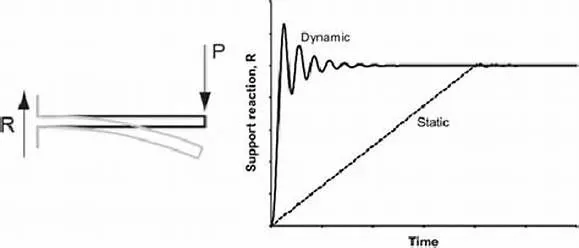
1. Differentiate Static analysis and Dynamic analysis with proper representing pictures (30 marks)
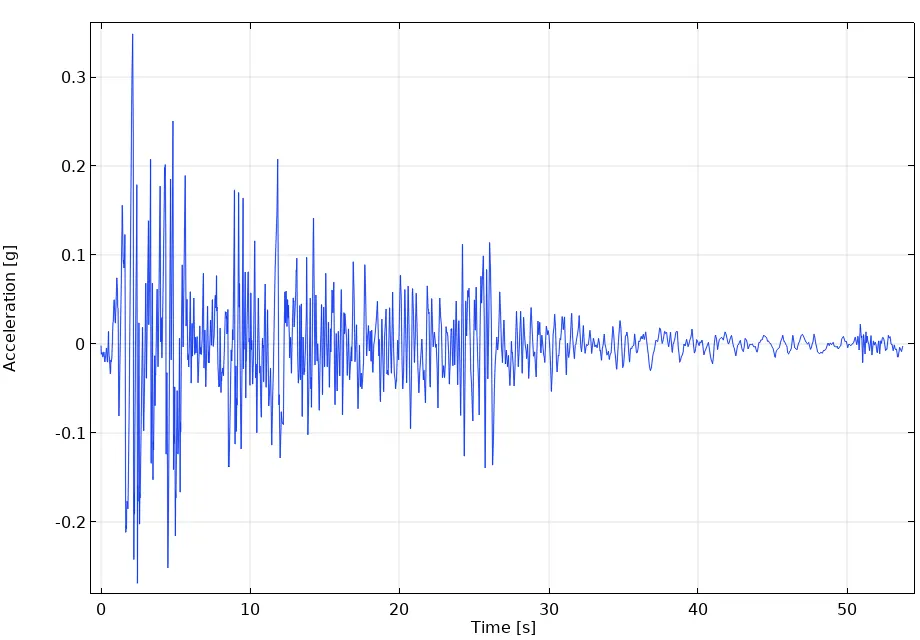
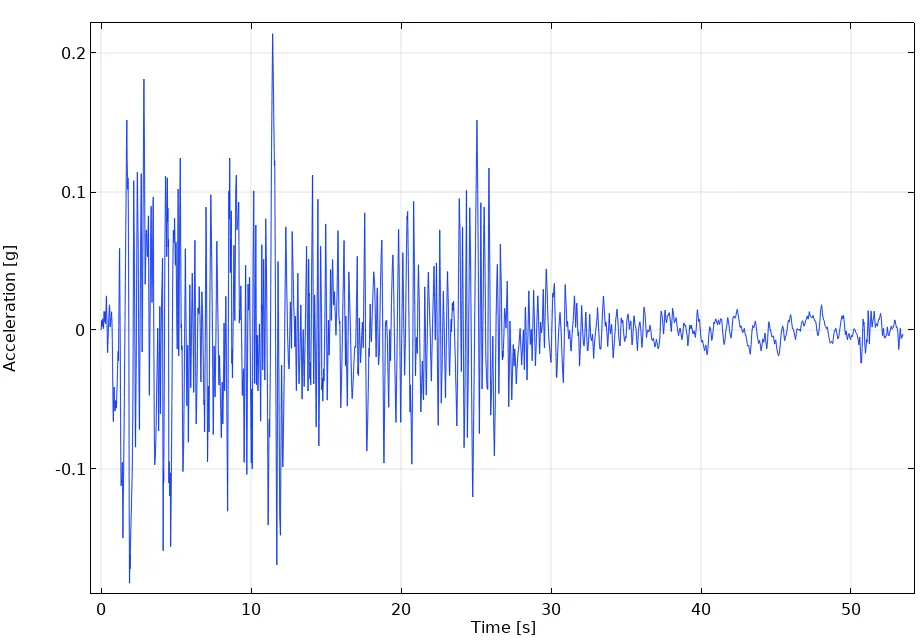
- Static analysis is really a simplification of dynamic analysis, because earthquake forces are dynamic in nature. But still we can make this simplification in many cases if the building is regular enough and not very tall. Static and dynamic analysis are both grouped also as linear and non linear analysis. (Or linear and non linear analyses are both grouped as static and dynamic analysis)
- .A static analysis can only be performed if the system being simulated does not depend on time, and if the loads being applied are constant. In a dynamic analysis, the system itself, the load application, or both might change with time.
- .In a dynamic analysis, the inertial loads developed by the system due to acceleration are taken into account. Static analyses don’t consider inertia.
- Static Loads are the loads which varies very slowly (the acceleration of load is very very less than the natural frequency of the structure)
- Dynamic Loads are the loads which changes with time fairly quickly in comparison to the structure's natural frequency
- .Mathematically, the difference between static and dynamic analysis is that in a static analysis, only the stiffness matrix of the FEA model is solved. In a dynamic analysis, in addition to the stiffness matrix, the mass matrix (and damping matrix, if not zero) is solved as well. That is one of the reasons why dynamic analyses require more computational time than static analyses, for the same structure.
- .In static analysis, we assume loads are applied very slowly, such slow that they are not even comparable with the natural vibration frequency of the structure. So it is as if the loads are static. And when the loads are static, we do not need to consider the effect of inertia and damping in the equation of motion but in dynamic analysis effect of inertia and damping force are to be considered in EOM.

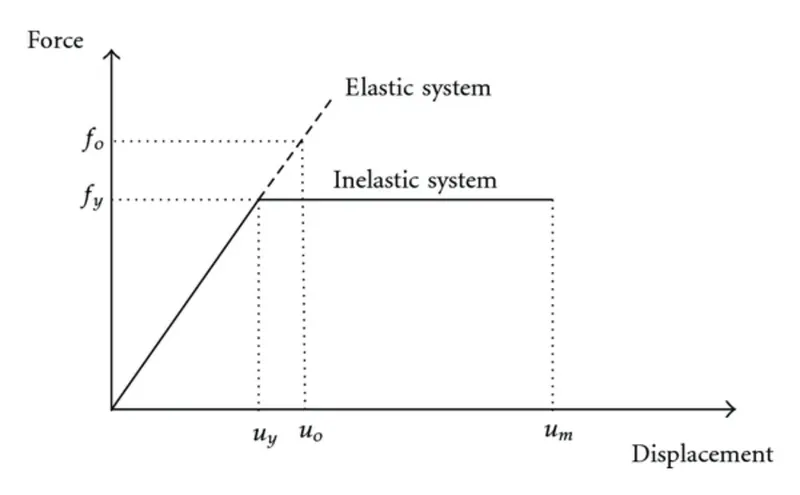
Explain the following with relevant force-displacement graph (40 marks)
- Elastic behavior
- Inelastic behavior
- Plastic behavior
- Non-linear Inelastic behavior
- Elastic behavior
The rubber strip of the slingshot has high elasticity. Elasticity is the ability of a body to resist any permanent change to it when stress is applied. When stress application ceases, the body regains its original shape and size. Different materials show different elastic behaviour. The study of the elastic behaviour of a material is of much importance. Almost every engineering design requires knowledge of the elastic behaviour of materials. In the construction of various structures like bridges, columns, pillars, beams, etc. knowledge of the strength of the materials used in the construction is of prime importance.
For example: while constructing a bridge, the load of traffic that it can withstand should be adequately measured beforehand. Or while constructing a crane used to lift loads, it is kept in mind that the extension of the rope does not exceed the elastic limit of the rope. To overcome the problem of bending under force the elastic behaviour of the material used must be considered primarily.
To study the elastic behaviour of materials let us consider a beam of length l, breadth b and depth d supported at the ends and loaded at the centre by load W.
2. Inelastic behavior
Inelastic behavior is the property of the material when the material can't retain it's previous shape after a certain deformation.
3. Plastic behavior
Plastic behavior occurs when the material completely lost it's ductility.For stresses beyond the elastic limit, a material exhibits plastic behavior. This means the material deforms irreversibly and does not return to its original shape and size, even when the load is removed. When stress is gradually increased beyond the elastic limit, the material undergoes plastic deformation.
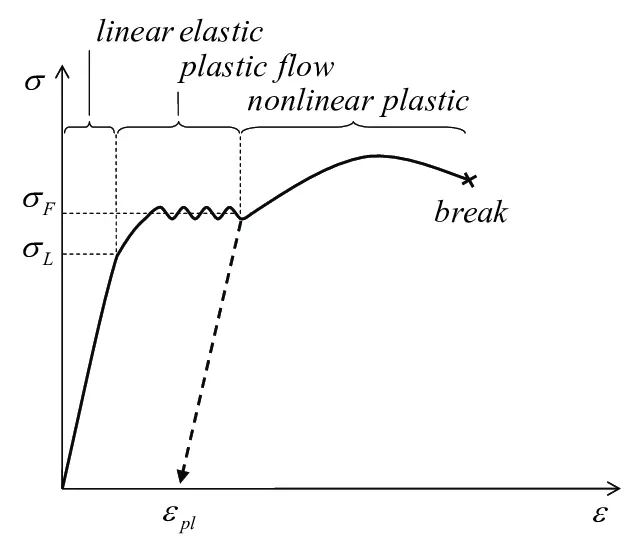
4. Non-linear Inelastic behavior
Materials have elastic behavior usually only up to a certain load, which is called the 'yield point'. After that, the deformations are plastic. Rubber, for instance, has an elastic stress–strain curve, but the relation is not linear − in such cases nonlinear elastic models are required.
3. Explain Mass, Stiffness & Damping components in the equation of motion.
AIM-:Explain Mass, Stiffness & Damping components in the equation of motion
Single degree of freedom system can be viewed as combination of three pure independent system
The stifffness component- ; the frame without damping or mass , the external forces fs on the stiffness componenet is relaed to displacement by u by fs=ku if the system is linearly elastic
The Damping component -: the frame with its damping property but no stiffness or mass the external force on the damping component is related to velocity by fd=cv
The mass component = The roof mass without the stiffness or damping of the frame the external force fi on the mass component is related to acceleration by fi=mu
m..u��..+fd+fs = pt rightarrow mddot u++cdot u`+ku = pt
4. Provide relationship between Natural period (Tn) & Natural frequency (f) and provide their definitions.
AIM-Provide relationship between Natural period (Tn) & Natural frequency (f) and provide their definitions
Natural period (tn)-The time required for the undamped system to complete one cycle of free vibration natural period of vibration of the system, which we denote as Tn in units of sec It is related to the natural circular frequency of vibration, ωn in units of radians per second
Tn=2π/ωn
A system executes 1/Tn cycles in 1 sec. This natural cyclic frequency of vibration is denoted by
fn=1/Tn
5. Explain in detail about Response spectrum & its Graph.
The typical earthquake ground motion response spectrum represents an envelope of the peak responses of many single-degree-of-freedom (SDOF) systems with different periods. The acceleration response spectrum of a ground motion is a relationship between the natural period of vibration of a sdof system and the maximum absolute acceleration that it experiences under the ground motion. Similarly, a displacement response spectrum typically represents the peak displacement, relative to the ground, of many sdof systems with different periods. Hence, the construction of a response spectrum involves the analysis of many different sdof systems. The value of each point on the spectrum is the peak response of a single degree of freedom system of a given period.