Structural dynamics
Q.1. Differentiate Static analysis and Dynamic analysis with proper representing pictures.
ANS: -
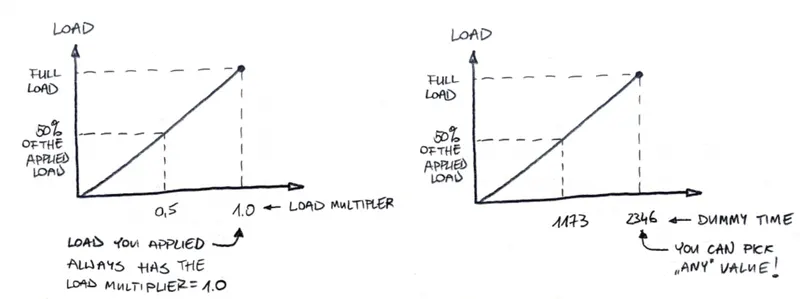
STATIC ANALYSIS: The main difference between static and dynamic analysis is TIME! If the load is applied so slowly, that inertia effects won’t play a role, all you need is static analysis.
DYNAMIC ANALYSIS: Dynamic analysis handles impacts and other “fast” happening situations, but also vibrations (which happen in time).
STATIC ANALYSIS:
- displacement is static
- no velocity and acceleration
- solution time taken less
- Output: stress and displacement
DYNAMIC ANALYSIS:
- displacement is function of time and frequency
- velocity and acceleration developed due to variation in displacement
- damping force and inertia force due to velocity and acceleration
- solution time taken more
- Output: stress, displacement, velocity and acceleration with respect to time and frequency
Q.2. Explain the following with relevant force-displacement graph.
- Elastic behaviour
- Inelastic behaviour
- Plastic behaviour
- Non-linear Inelastic behaviour
ANS: -
Elastic behaviour: Elasticity is the ability of a body to resist any permanent change to it when stress is applied. When stress application ceases, the body regains its original shape and size. Different materials show different elastic behaviour. The study of the elastic behaviour of a material is of much importance.
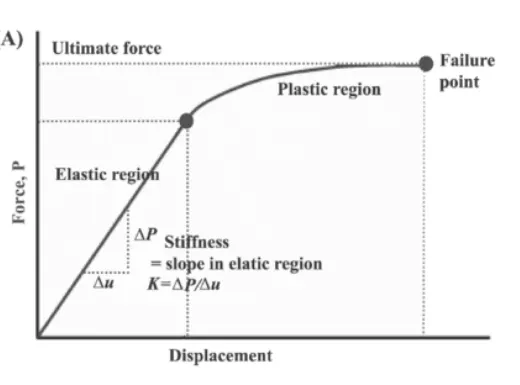
Inelastic behavior: Deformation of a material that does not disappear on removal of the force that produced it.
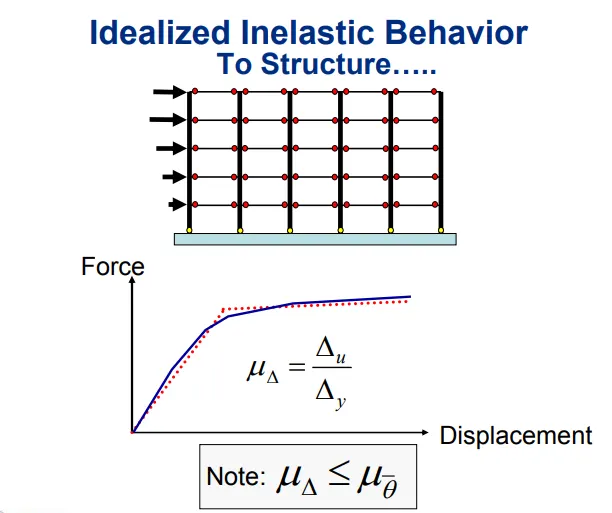
Plastic behaviour: For stresses beyond the elastic limit, a material exhibits plastic behaviour. This means the material deforms irreversibly and does not return to its original shape and size, even when the load is removed. When stress is gradually increased beyond the elastic limit, the material undergoes plastic deformation.
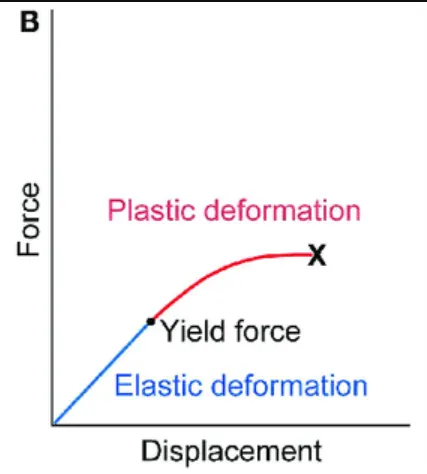
Non-linear Inelastic behaviour: Materials have elastic behaviour usually only up to a certain load, which is called the 'yield point'. After that, the deformations are plastic. Rubber, for instance, has an elastic stress–strain curve, but the relation is not linear − in such cases nonlinear elastic models are required.
Q.3. Explain Mass, Stiffness & Damping components in the equation of motion.
ANS: -
Mass: Newton's second law, which states that the force F acting on a body is equal to the mass m of the body multiplied by the acceleration a of its Centre of mass, F = ma, is the basic equation of motion in classical mechanics.
Mass is always constant for a body. One way to calculate mass: Mass = volume × density. Weight is the measure of the gravitational force acting on a mass.
Stiffness: Stiffness relates to how a component bends under load while still returning to its original shape once the load is removed. Since the component dimensions are unchanged after load is removed, stiffness is associated with elastic deformation. A material can have high strength and low stiffness.
Damping: Damping is a reduction in vibration over a period of time. Damping will eventually bring a vibrating object to rest. A damping mechanism suppresses vibrations of the structure.
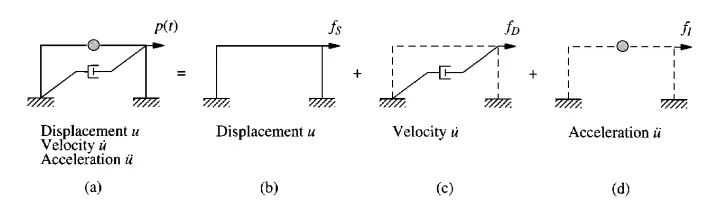
In this section the governing equation for the idealized one-story frame is formulated based on an alternative viewpoint. Under the action of external force p(t) the state of the system is described by displacement u(t), velocity u̇(t), and acceleration ü(t); the system as the combination of three pure components:
(1) Stiffness component: the frame without damping or mass
(2) Damping component: the frame with its damping property but no stiffness or mass and
(3) Mass component: the roof mass without the stiffness or damping of the frame. The external force fs on the stiffness component is related to the displacement u by Eq. fs = Ku if the system is linearly elastic, the external force fd on the damping component is related to the velocity u̇ by Eq. fd = cu̇, and the external force fi on the mass component is related to the acceleration by fi = mü. The external force P(t) applied to the complete system may therefore be visualized as distributed among the three components of the structure, and fs + fd + fi must equal the applied force P(t) leading to Eq. mü+cu̇+ku = P(t)
Q.4. Provide relationship between Natural period (Tn) & Natural frequency (f) and provide their definitions.
ANS: -
Natural period: The natural period of a building is simply a time taken by it to undergo one complete cycle of oscillation. The natural period is one of the properties or building which is controlled by mass and stiffness.
The time period of a building is its natural period of oscillation when subjected to ground shaking in the event of an earthquake.
The building is modelled to be under harmonic oscillation and the time period is calculated in a similar way as in harmonic oscillation
T = 2π√(k/m)
where k is the total stiffness and m is the total mass.
k is calculated as the sum of the lateral stiffness of all stiffness providing and moment resisting vertical members (columns, moment resisting frames, sheer walls, etc.) m is calculated as the sum of masses of all members on the Storey.
[ Note: The above method is only applicable for single Storey buildings and for multiple Storey buildings, these are vector quantities depending on the mode of vibration. A detailed vector analysis (modal analysis) is done to calculated time periods for each vibration mode, which requires detailed explanation.]
IS 1893 part I lists empirical formulae for approximate estimation of time period of multi-Storey buildings given in section 7.6 on page 24.
Natural Frequency: A natural frequency is defined as that frequency at which a body will vibrate if excited by an external force.
The frequency is nothing but the number of vibrations in a second and is the inverse of the time period
f = 1/T
Q.5. Explain in detail about Response spectrum & its Graph.
ANS: -
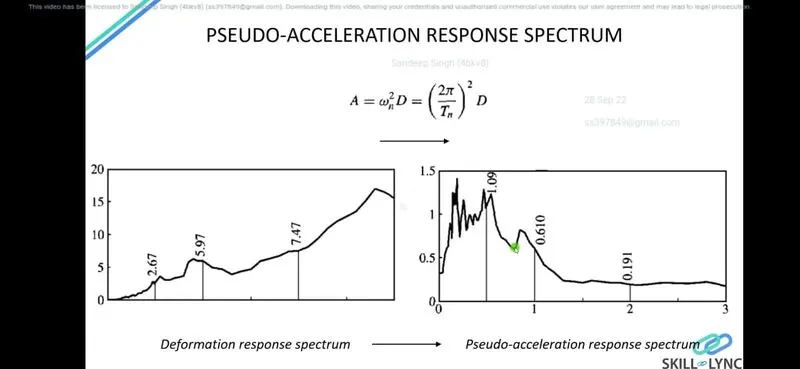
The typical earthquake ground motion response spectrum represents an envelope of the peak responses of many single-degree-of-freedom (SDOF) systems with different periods. The acceleration response spectrum of a ground motion is a relationship between the natural period of vibration of a sdof system and the maximum absolute acceleration that it experiences under the ground motion. Similarly, a displacement response spectrum typically represents the peak displacement, relative to the ground, of many sdof systems with different periods. Hence, the construction of a response spectrum involves the analysis of many different sdof systems. The value of each point on the spectrum is the peak response of a single degree of freedom system of a given period.
RESPONSE SPECTRUM
- A central concept in earthquake engineering, response spectrum is a practical means of characterizing ground motions and their effects on structures of different Tn
- It provides a convenient means to summarize the peak response of all possible linear SDF systems to a particular component of ground motion.
- It also provides a practical approach to apply the knowledge of structural dynamics to the design of structures and development of lateral force requirements in building codes.
- A plot of the peak value of a response quantity (u, v, and a) as a function of the natural vibration period Tn of the system, is called the response spectrum for that quantity.
- Each such plot is for SDF systems having a fixed damping ratio and several such plots for different values of are included to cover the range of damping values encountered in actual structures.
- The response spectrum can be of 3 types. The deformation response spectrum is a plot of peak u, against Tn for fixed. A similar plot for peak ú, is the relative velocity response spectrum, and for peak üT, is the acceleration response spectrum.
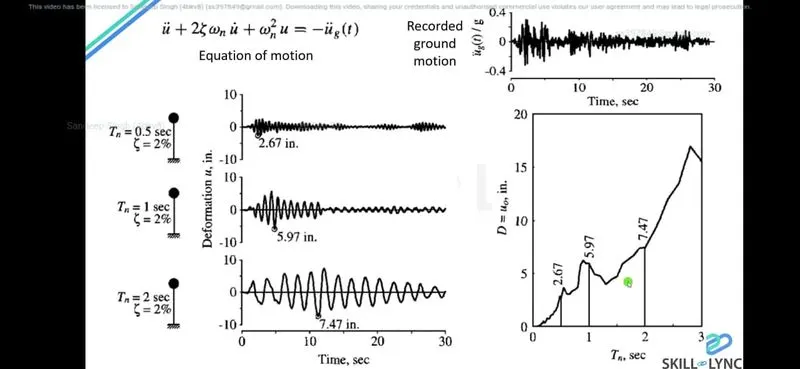
- Pseudo acceleration for an SDF system with natural frequency ɷn is related to its peak deformation D = u0, due to earthquake ground motion:
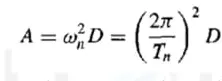
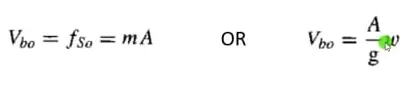
- The quantity A has units of acceleration and is related to the peak value of base shear Vb0 (just another name for the peak value of the equivalent static force fs0):