Steady Vs Unsteady flow over a cylinder
Title: Steady VS Unsteady flow over cylinder
Aim:
- To simulate the flow over a cylinder
- To explain the phenomenon of Karman vortex street
- To simulate the flow with the steady and unsteady case and calculate the Strouhal Number for Re= 100
- To calculate the coefficient of drag and lift over a cylinder by setting the Reynolds number to 10,100,1000,10000 & 100000. (with steady solver)
- To discuss the effect of Reynolds number on the coefficient of drag.
Introduction:
Phenomenon of Karman vortex street:
Karman vortex street is a repeating pattern of swirling vortices, caused by a process vortex shedding,
which is responsible for the unsteady separation of flow of a fluid around the blunt bodies.
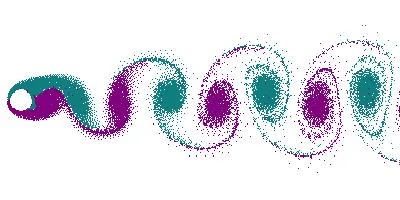
Fig: Karman vortex street
Formula:
This formula will generally hold true for the range 40 < Red < 150

where:

- f = vortex shedding frequency.
- d = diameter of the cylinder
- U = flow velocity.
- St=Strouhal number
Vortex Shedding:
It is an oscillating flow that takes place when a fluid such as air or water flows past a bluff
body at certain velocities , depending on the size and shape of body.
Simulation Procedure:
GEOMETRY
Dimensions of Geometry:
Diameter of cylinder wall= 2m
Dimensions=10D*30D
Fig: Geometry
MESH GENERATION
Fig: Mesh Generation
Mesh Element size=0.2m
PART - 1 :- Simulating the flow with the steady and unsteady case and calculate the Strouhal Number for Re= 100.
CASE - A :-Steady flow with Re 100.
We are simulating the flow with the reynolds number of 100 so we need to caliculate the flow velocity required to carried out so from the equation we had ,
Re = ( [ ρ*u*D ] / μ )
We knew Re = 100 , ρ = 1 , D = 2 , μ = 0.05. From the above values we get the Flow velocity as 2.5 (m/s).
So we run the simulation and capture the velocity, pressure contours along with the Drag Coefficient , Lift Coefficient and for having to identify the vortex shedding we need to first add the monitor point at the particular distance so that it helps in getting the vortex shedding frequencies. Here we are using the material as User manual because we are adding the values of the density and dynamic viscosity values manually.And flow type as laminar.
Results :
Fig: Residual Graph Fig: Coefficient of Drag
Fig: Coefficient of lift
Fig: Velocity Contour Fig: Velocity Plane
CASE - B : Unsteady flow with Re = 100.
So we run the simulation to capture the velocity, pressure contours along with the Drag Coefficient , Lift Coefficient and for having to identify the vortex shedding we need to first add the monitor point at the particular distance so that it helps in getting the vortex shedding frequencies. Here we are using the material as User manual because we are adding the values of the density and dynamic viscosity values manually.And Viscous type as laminar. Here we are going to use Turbulent.
Fig: Residual Graph Fig: Coefficient of drag
Fig: Lift Coefficient Fig: Vertex average of velocity magnitude
Here the flow gets converge 55 iterations this makes the flow into steady frequency state.
Fig: Velocity Contour
we can find the strouhal number from the frequency plot,
Sr = ( [0.4 * 2] / 2.5 ) = 0.32
PART 2:-Calculating the coefficient of drag and lift over a cylinder with Steady Solver
Range of Re - 10,100,1000,10000,100000.
CASE 1 :-Steady flow Re 10.
Fig: Drag Coefficient Fig: Lift Coefficient
Fig: Velocity Contour Fig: Pressure Contour
CASE 2 : Steady flow Re 100.
Fig: Drag Coefficient Fig: Lift Coefficient
Fig: Velocity Contour Fig: Pressure Contour
CASE 3 :- Steady flow Re 1000
Fig: Drag Coefficient Fig: Lift Coefficient
Fig: Velocity Contour Fig: Pressure Contour
CASE 4 :- Steady flow Re 10000
Fig: Drag Coefficient Fig: Lift Coefficient
Fig: Velocity Contour Fig: Pressure Contour
CASE 5 :- Steady flow Re 100000
Fig: Drag Coefficient Fig: Lift Coefficient
Fig: Velocity Contour Fig: Pressure Contour
Vortex Shedding with different Reynolds number:
Fig: Vortex Shedding with RE-10 Fig: Vortex Shedding with RE-100
Fig: Vortex Shedding with RE-1000 Fig: Vortex Shedding with RE-10000
Fig: Vortex Shedding with RE-100000
Drag Coefficient :
In fluid dynamics, the drag coefficient is a dimensionless quantity that is used to quantify the Drag or resistance of an object in a fluid environment, such as air or water. It is used in the Drag equation in which a lower drag coefficient indicates the object will have less aerodynamics or hydrodynamics drag. The drag coefficient is always associated with a particular surface area.
The drag coefficient of any object comprises the effects of the two basic contributors to Fluid Dynamic drag: Skin Friction and form drag. The drag coefficient of a lifting airfoil or Hydrofoil also includes the effects of Lift inducted drag. The drag coefficient of a complete structure such as an aircraft also includes the effects of interference drag.
Cd = ( D * 2) / ( ρ * A * V^2 )
Where,
D = Drag Force
ρ = Density
A = Area of Sphere
V = Flow Velocity
Calculation of Drag Coefficient :
1. Re = 10 ,
Cd = ( 0.2 * 2) / ( 1 * 12.57 * 0.25^2 ) ---> = 0.4/0.78 = 0.5128
2. Re = 100 ,
Cd = ( 15 * 2 ) / ( 1 * 12.57 * 2.5^2 ) = (30)/(78.56) = 0.3818
3. Re = 1000 ,
Cd = ( 300 * 2 ) / ( 1 * 12.57 * 25^2 ) = 600/7856.2 = 0.0763
4. Re = 10000 ,
Cd = ( 2800 * 2 ) / ( 1 * 12.57 * 250^2 ) = 5600/785625 = 0.00712
5. Re = 100000 ,
Cd = ( 2750000 * 2 ) / ( 1 * 12.57 * 2500^2 ) = 0.070
Lift Coefficient :- The lift coefficient (CL) is a dimensionless coefficent that relates the lift generated by a lifting body to the Fluid density around the body, the fluid velocity and an associated reference area. A lifting body is a foil or a complete foil-bearing body such as a fixed wing aircraft. CL is a function of the angle of the body to the flow, its Reynolds number and its mach number. The section lift coefficient cl refers to the dynamic lift characteristics of a two dimensional foil section, with the reference area replaced by the foil chord.
Cl = ( 2 * L ) / ( ρ * A * V^2 )
Where ,
L = Lift Force
ρ = Density
A = Area of sphere
V = Flow Velocity
Calculation of Lift Coefficient :
1. Re = 10 ,
Cl = ( 2 * 0 ) / (1 * 12.57 * 0.0625 ) = 0
2. Re = 100 ,
Cl = ( 2 * 0.02 ) / ( 12.57 * 6.25 ) = 0.0005
3. Re = 1000 ,
Cl = ( 2 * 3 ) / ( 12.57 * 625 ) = 0.007637
4. Re = 10000 ,
Cl = ( 2 * 18000 ) / ( 12.57 * 62500 ) = 0.0458
5. Re = 100000 ,
Cl = ( 2 * 2000000 ) / ( 12.57 * 6250000 ) = 0.05091
The values of the Drag force and Lift force are taken from the plotting of the solution separately.
Summary of Results:
Conclusions
- The flow over the cylinder was successfully simulated for both steady and transient cases with reynold number 100 and the phenomena of von karman vortex street is easily observed.
- The pressure rise at the front side of the cylinder, boundary layer formation, flow separation, vortex formation, vortex propogation were clearly observed with the help of contours and animations.
- The strouhal number was observed 0.32 at reynold 100.
- Six different simuations has been run successfully to observe the behaviour of drag coefficients with respect to the reynold numbers.
- At a reynold number 10 we observe that there is no vortex shedding happening while in other cases we easily observed through the different graphs and contours that vertex shedding are happening.
- All the above cases results are also validated through the data available in the literature.
Preferred Material: Composite Material like Carbon Epoxy material which enhances smooth flow
over cylindrical bodies, also it is lighter and more stiff than aluminium.
References:
https://www.sciencedirect.com/science/article/pii/S2214241X15001054
http://www.eng.fsu.edu/~shih/succeed/cylinder/cylinder.htm
https://en.wikipedia.org/wiki/K%C3%A1rm%C3%A1n_vortex_street