Steady Vs Unsteady flow over a cylinder
Numerical Simulation of Flow past a Steady and Unsteady flow past a Cylinder and study of the Karman Vortex Street Phenomenon
1.Introduction
One of the most interesting phenomena in the laminar flow regime is the Karman Vortex Street formation. This phenomenon called Vortex Shedding is a type of unsteady oscillatory flow which occurs at a particular Reynold’s Number and leaves a wake of multiple vortices shedded periodically from the body. If the frequency of vortex shedding is in the audible range, then the body appears to be “singing”. This is the reason why sometimes telephone wires appear to hum when wind blows and car antennas vibrate at certain frequencies.
2. Problem Setup
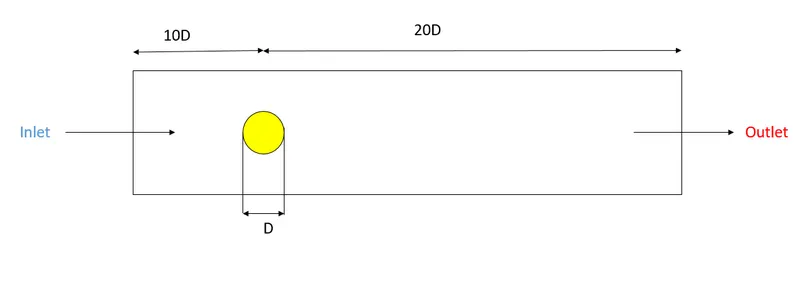 |
Fig 1. Problem Setup
We take a Rectangular Domain and define a cylindrical zone. The inlet is located at a distance of 10 diameters from the centre of the cylinder and the outlet is located at a distance of 20 diameters from it. The width of the computational domain is 20 times the cylinder diameter
The equations involved are :
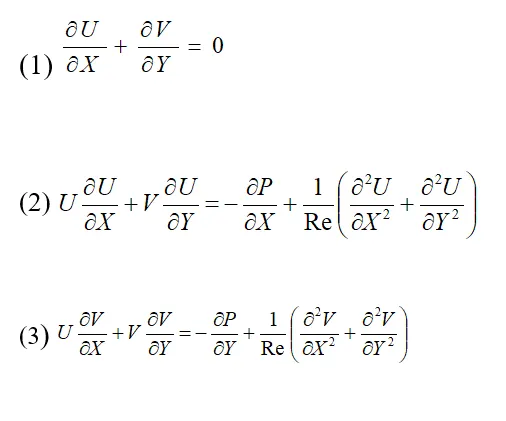
Where Re is the Reynold's Number
We also define a quantity called the Strouhal Number (St) as follows :
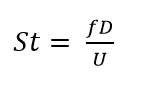
where f = frequency of vortex shedding , D = Diameter of Cylinder and u = Free Stream Velocity
The Diameter is taken to be 2m and the free stream velocity is taken as 1 m/s.
First we examine the case for Re = 100 for steady and unsteady flow and calculate the Strouhal Number.
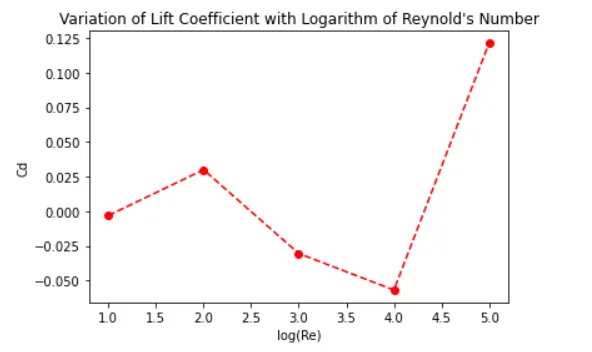
Then we calculate the following Cases for Coefficient of Drag and Lift for the following cases z:
| Reynolds Number | 10 | 100 | 1000 | 10000 | 1000000 |
| Kinematic Viscosity | 0.2 | 0.02 | 0.002 | 0.0002 | 0.00002 |
| Density | 1 | 1 | 1 | 1 | 1 |
3. Meshing
The Geometry was created in the SpaceClaim Software.
 |
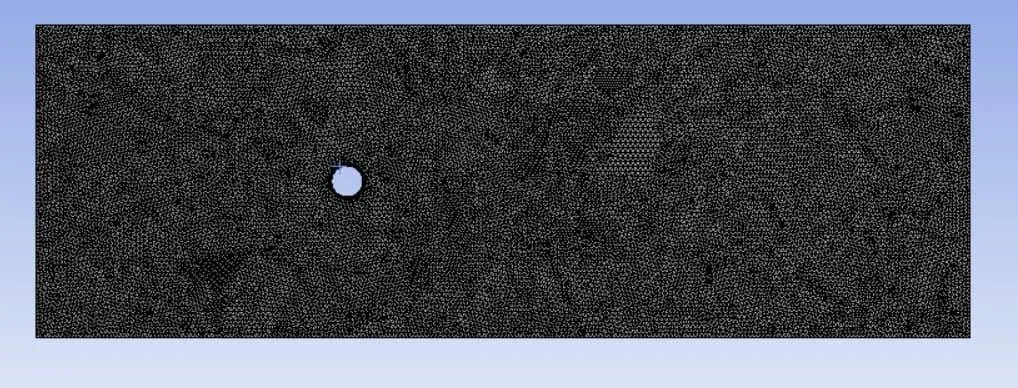 |
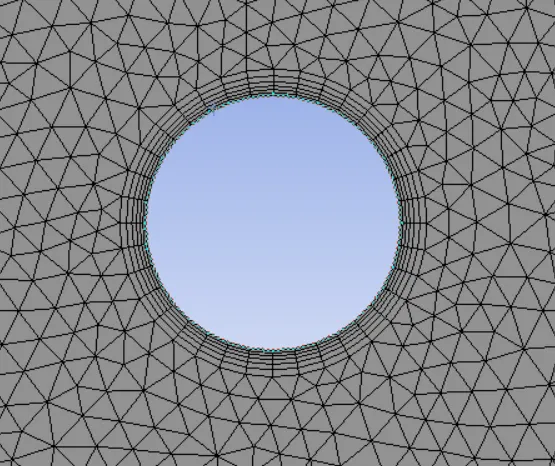
A Triangular Dominant Mesh with Element Size 0.25 m was used. We used Edge Fitted Meshing and Inflation with six layers and growth rate 1.2 to resolve the boundary layer around the cylinder as a result the Mesh became more fine in the area of the boundary layer. The SIMPLE Algorithm was used to numerically solve the problem. Flow is assumed to be laminar.
4. Problem A : Investigation for Re = 100
4.1 Steady Solver
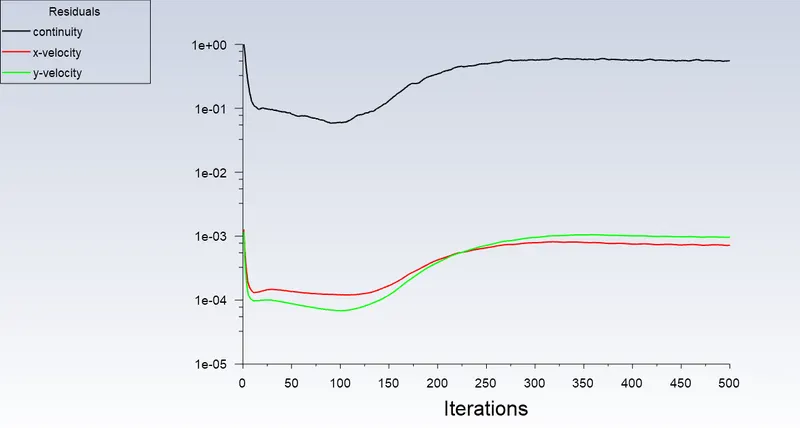
The Solver is run for 500 iterations
 |
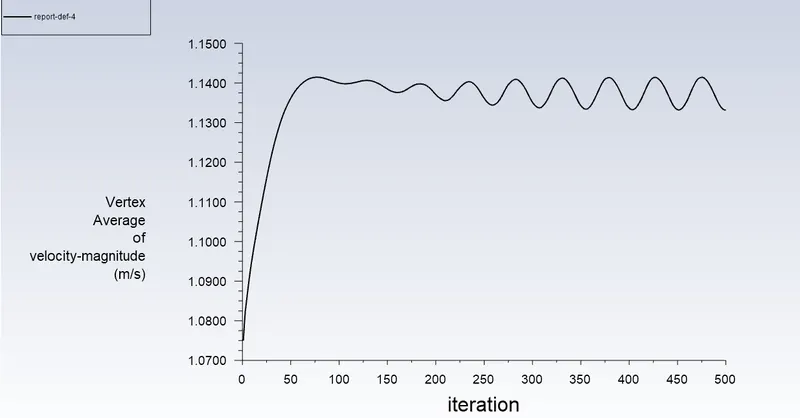 |
(a) Residual Plots (b) Vertex Point average for point located 4 Diameters away from the centre along y axis [ Coordinate (0,2D)]
We can see that the residual plots have reached a steady value and after about 60 iterations the velocity fluctuations start to appear in the picture thus simulating the real physics of the problem.
Thus we can conclude that the flow has converged
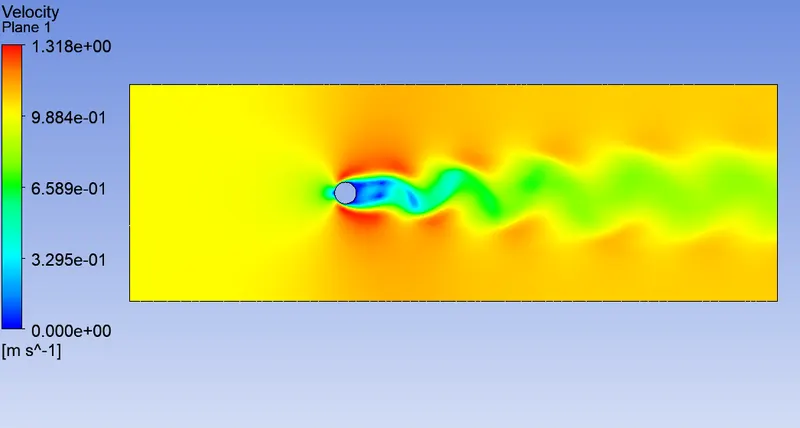 |
Fig.Velocity Contour Plot Showing Vortex Street Formation
4.1.2 Unsteady Solver
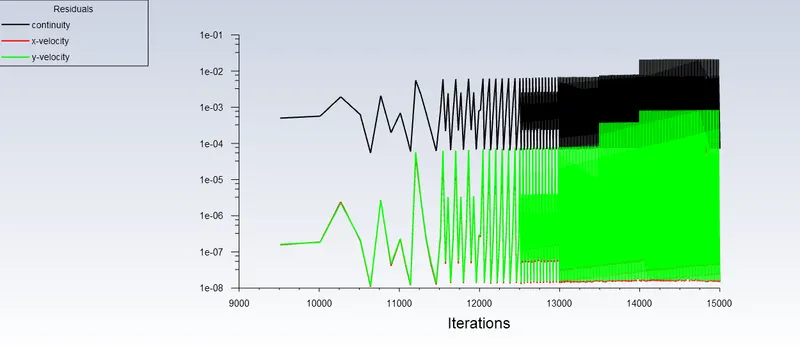 |
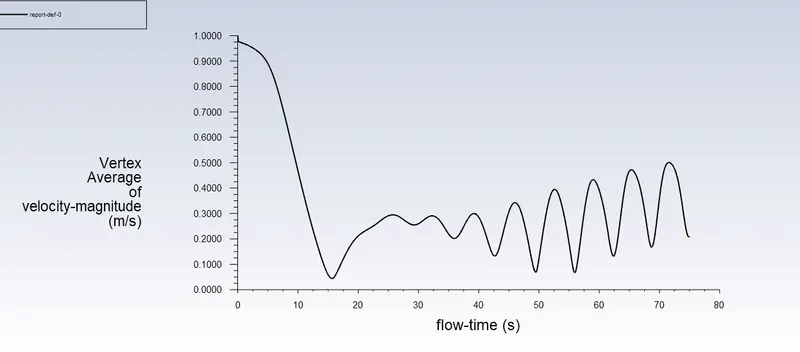 |
Fig. (a) Residual Plots (b) Variation of Flow velocity with time for a point (3D,0)
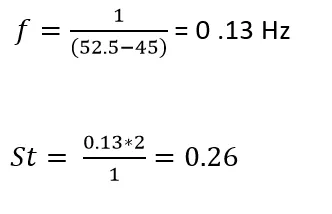
we take the peaks at 45s and 52.5 s to calculate shedding freqeuncy and Strouhal Number as :
5. Problem B: Variation of Drag and Lift Coefficients with Reynolds Number
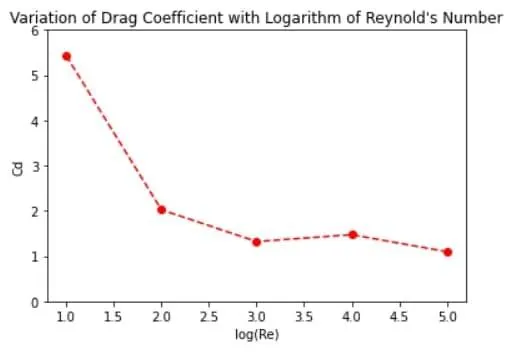 |
 |
6. Validation
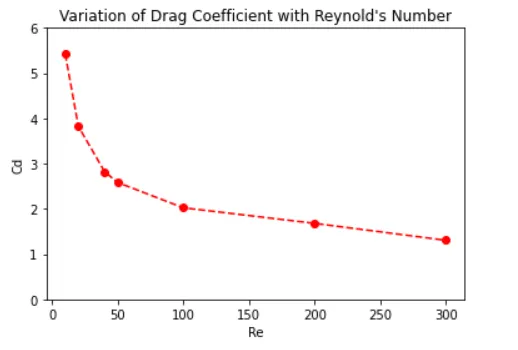
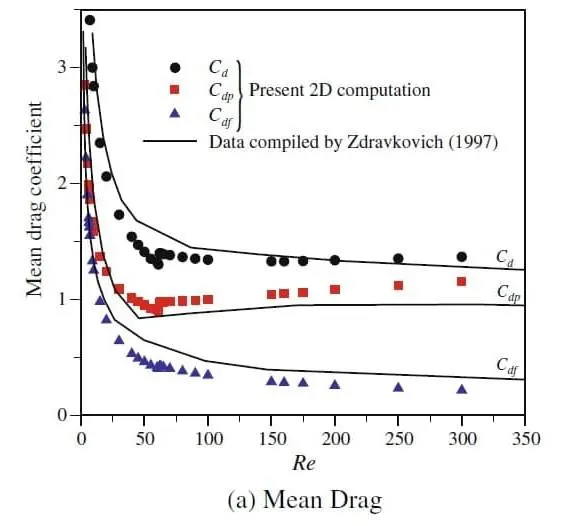
We compare our Results for Variation od Drag Coefficient with the research paper provided in references
 |
 |
8.Results
1. Strouhal Number is computed to be 0.26
2. Coefficient of Drag Decreases with Increasing Reynolds Number
9.References
[1]B.N. Rajani, A. Kandasamy, Sekhar Majumdar, Numerical simulation of laminar flow past a circular cylinder,
Applied Mathematical Modelling, Volume 33, Issue 3,2009,Pages 1228-1247,ISSN 0307-04X,https://doi.org/10.1016/j.apm.2008.01.017.
(http://www.sciencedirect.com/science/article/pii/S0307904X08000243)