Sketch a G+1 residential plan according to Vaastu Shastra and Calculation of Loads as per IS code
Aim:
- a) To prepare a G+1 Residential Building according to Vaastu Shastra
- b) To list the names of the structural drawing required to be provided at the site for construction
Introduction:
Vaastu shastra:
- Vaastu shastra is the ancient Indian science of architecture and acts as a guideline to design your home in a way that enhances positive energy.
- Our nature is abundant with powerhouses of energy sources like the sun, wind, moon, water, earth, and fire.
- Effects of sunrays, the flow of winds, pull of earth’s magnetic field, and other such cosmic energies
- A good home needs to radiate the right kind of energy.
- A person dwelling in a house comes under the influence of a specific energy field.
- Architectural changes are not possible for a ready-to-move-in house.
Ideal directions:
- Preferable direction for entrance is north, east can be preferred.
- Northwest is ideal for living rooms.
- Idols are placed in the northeast
- Southeast is ideal for kitchen
- Southwest is ideal for storage.
Significance of four directions:
- Four cardinal directions are north, south, east, and west.
- Four intercardinal directions are north-east, north-west, south-east, and south-west.
- Each direction signifies an aspect of life and is governed by various gods.
- North - wealth
- South - Dharma
- West and east - overall prosperity
The basic principle of Vaastu shastra:
- Shape: Rooms should preferably be square or rectangular.
- Room basics: The room should be airy, well-lit, bright, and clean.
- Home center: Centre of the house should be a space.
- Stairs and furniture: Heavy furniture should be kept in the southwest direction.
- Water: Avoid keeping paints and water features in the bedroom.
- Dining table: The dining space should be near the kitchen and not near the main door.
- Mirror placement: Mirror facing the bed is strictly not allowed. Mirrors in the bedroom need to be placed in such a way that the bed cannot be seen.
- Auspicious directions as per Vaastu shastra:
- Kitchen: South-east is the best, northeast to be avoided.
- Staircase: South-west is the best, northeast to be avoided.
- Toilet: North-west is the best, northeast to be avoided.
- Master bedroom: Southwest is preferred.
- Guest room: North-west is preferred.
- Living room: North-west is preferred.
- Overhead tanks: West is the best
- Underground tanks: Northeast is preferred, Southwest to be avoided.
- Gateway (entrance) of the house:
- Positive energy can be attached to the right entrance of the house.
- The main entrance is not only the entry point for the family but also for energy.
- The main door should be stronger and bigger than the other doors in the house and made of superior quality wood such as teak wood.
- The main door should not be dark because good energy is associated with bright and cheery places.
- Garbage bags, unwanted things, and shoes should be kept away from the main door.
- The main door should open inward and avoid creaky sounds.
- The main door should be constructed in a way to ensure that when you step out, you face the north, east, or northeast direction.
- Avoid painting the main door black and placing animal statues near the door.
Living room:
- The living room should be clutter-free.
- The living room should face east, north, or northeast.
- Heavy furniture should be kept in the west or southwest direction of the living room.
- Electronic appliances should be installed in the southeast section of the living room.
- If planning for a mirror in this room, ensure you place it on the north wall.
- An aquarium on the north or east wall for prosperity.
- A bright picture of the sunrise on the southern wall.
- Shades of yellow, green, beige, or blue on walls infuse liveliness and vibrancy.
Bedroom:
- Bedrooms in the southwest direction bring good health and prosperity.
- Avoid bedrooms in the northeast and southeast directions.
- The bed should be placed in the southwest corner of the bedroom with the head facing west.
- Avoid keeping a mirror or television in front of the bed.
- Avoid keeping paintings depicting water or a fountain as it could cause emotional outbursts.
- Use aromatic oils to create an oasis of calm.
- Never sleep with your head in the no over handing over handing beams.
- Use solid wooden beds instead of hollow wrought iron.
- Paint the bedroom walls in neutral or earthy shades that radiate positive energy.
Pooja room:
- East or northeast part of your home is perfect for meditation, yoga, and spiritual pursuits.
- Facing east when you meditate will increase positivity.
- Create a sacred altar and decorate it with candles or incense sticks.
Kitchen:
- Keep the water sink away from the gas stove.
- The fridge needs to be placed in the southwest corner.
- Never let your kitchen face a washroom wall or share a common wall with it.
Study room:
- Select a square or rectangle shape for the study table.
- Don’t place the table facing a blank wall or window.
- Placing the table in the northeast, east, or west direction is ideal.
- Hanging bookshelves are best avoided.
Courtyard:
- Brahmasthan is a unique feature of ancient architecture based on Vaastu Shastra.
- It is the center of your residence and the holiest and most powerful zone.
- In a traditional home in Kerala, the courtyard is always at the center of the house.
- This part should be perfect and clutter-free
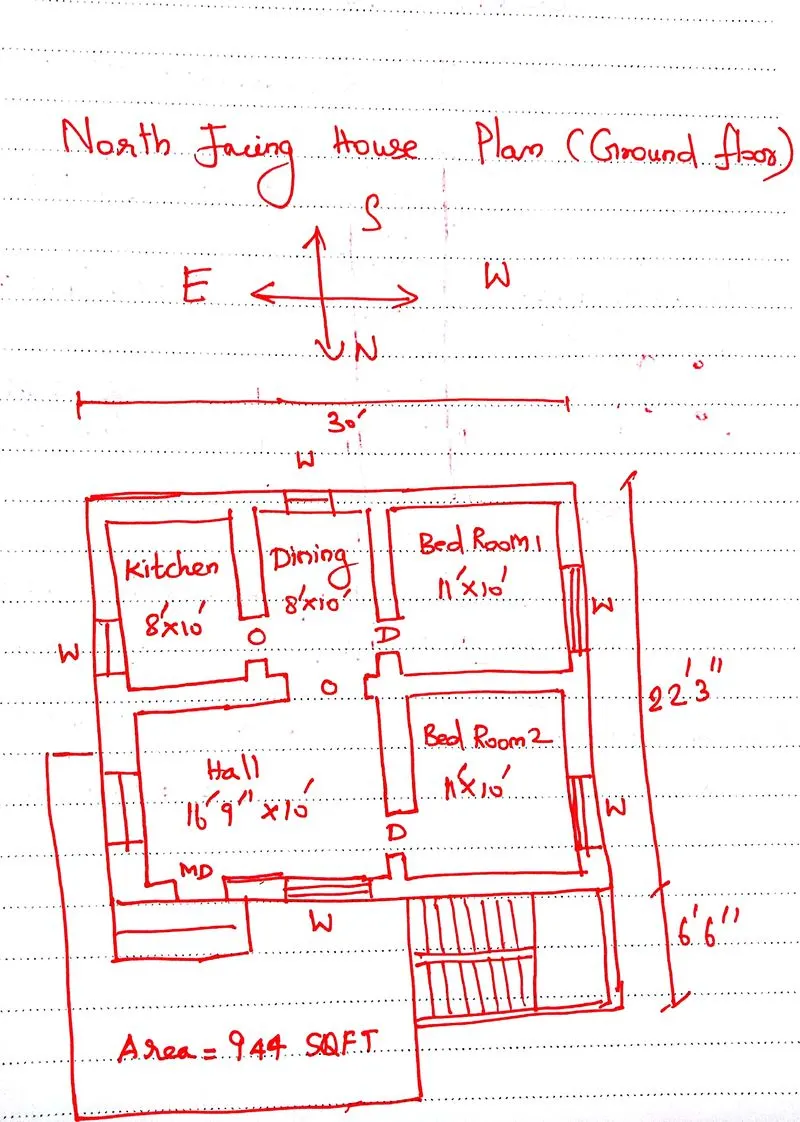
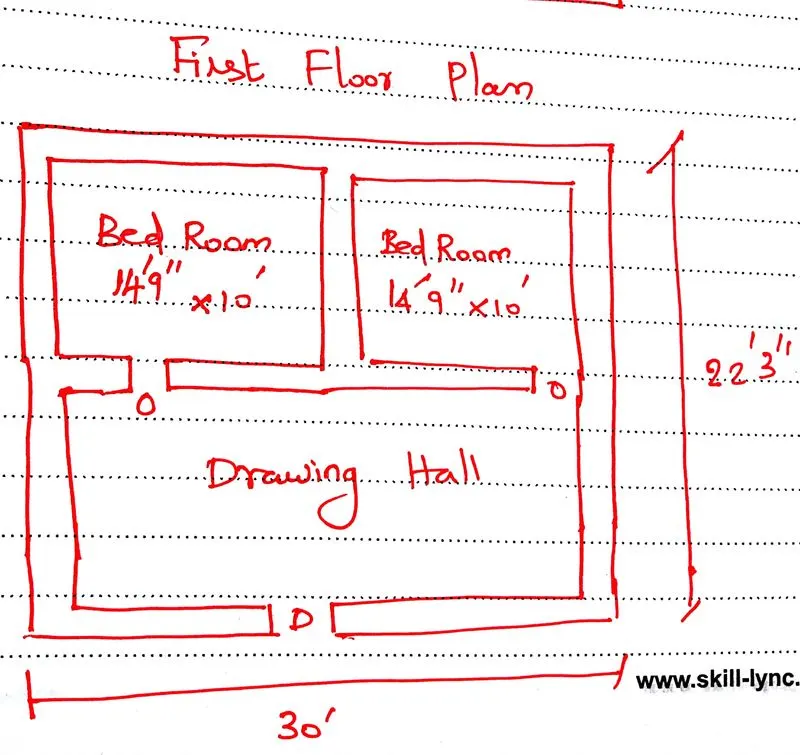
a) Plan details:
b) Important structural drawings for a project:
Centre line drawing:
Centre line drawing provides the grid formation by dividing the plan into a number of grids. It is the very first structural layout diagram prepared by the engineer. It is called center line drawing. It helps in marking the buildings, columns, footing, and other structural elements. Based on the center line diagram, excavation of soil for the footing is done. The dimension of columns and grids are also shown.
Structural detailing for Footings and Columns:
This structural diagram shows both column and pedestal details with the markings and dimensions. Thickness, column numberings, footing dimensions, and details, and PCC details in all the directions are shown. The footing should not be overlapped and it should be replanned if needed. The concentric and eccentric column footing has to be done as per the requirement.
Column schedule with reinforcement details:
This shows the reinforcement details such as the diameter of bars, covers, spacing, location, and stirrups. The footing section consists of the thickness of sand filling, PCC thickness, PCC extension, reinforcement details such as crank, and a number of column ties. The sectional elevation is to be shown for all grouped columns. The typical column and footing structural rebars details have to show.
Plinth beam layout with reinforcement details:
This reinforcing layout has to show the plinth-level beam details connected with columns. The size of the plinth beam, the diameter of the bars, thickness, grid-to-grid dimension, crank details, and column dimensions should be shown. The size of the plinth beam used should be mentioned.
First-floor slab layout with reinforcement details:
These reinforcement details have to show the details of the sunken slab and 10 inches below the floor level. It will be provided in bathroom areas. The thickness and respective dimensions of the slabs are to be shown.
Lift pit and headroom reinforcement details:
It will be provided with RC elements and plain cement concrete as footing and waterproofing areas should be shown. If a lift is provided a beam should be provided at the roof slab level and a lintel beam below the roof. This layout is a mandated one. Linter beam is to be shown with all structural arrangements.
Aim: To select the various sizes of the structural elements by assumption and estimate the working loads as per Indian Standards.
Procedure and Calculation:
Assumed dimensions of structural members:
Column = 300mm x 300mm
Beam = 200mm x 300mm
Thickness of slab = 150mm
Wall height = 3.5m = 3500mm
Thickness of exterior wall = 230mm
Thickness of interior wall = 150mm
Riser (R) = 300mm
Thread (T) = 150mm
Depth of waist slab = 250mm
Depth of landing slab = 200mm
Dead load Calculation:
Unit of RCC = 25kN/m3
Unit weight of brickwork = 20kN/m3
Self-weight of column = 0.30 x 0.30 x 3.5 x 25 = 7.875 kN
Self-weight of beam = 0.2 x 0.3 x 25 = 1.5 kN
Self-weight of slab = 0.15 x 25 = 3.75 kN/m2
Self-weight of exterior wall = 0.23 x 3.5 x 20 = 16.1 kN/m
Self-weight of interior wall = 0.15 x 3.5 x 20 = 10.5 kN/m
Self-weight of ceiling = 0.25 kN/m2 (as per IS 875 part 1)
Self-weight of roofing = 0.83 kN/m2 (as per IS 875 part 1)
Floor finish = 1 kN/m2
Self-weight of staircase:
Inclined length = Square √Square (1502 + 3002)` = 335mm
Self-weight of waist slab = (0.335/300) x 0.25 x 25= 6.97 kN/m
Self-weight of steps = 0.5 x 0.15 x 25 = 1.875 kN/m
Self-weight landing slab = 0.2 x 25 = 5 kN/m2
Live load: as per IS 875 Part II
Kitchen = 2 kN/m2
Living room = 2 kN/m2
Toilet and bathroom =1 kN/m2
Staircase = 3 kN/m2
Store room = 3 kN/m2
Balconies = 3 kN/m2
Bedroom = 2 kN/m2
As the building height is 7.5 m<10m, there is no necessity to consider the wind load.
Result:
G+1 Residential plan has been sketched and Working loadings are calculated.