Sketch a G+1 residential plan according to Vaastu Shastra and Calculation of Loads as per IS code
Sketch a G+1 floor residential plan, according to Vaastu Shastra, and list down the names of the structural drawings required to be provided to the site for construction.
Also, assume the sizes of the structural elements (Column, Beam, Slab, etc.,) and accordingly calculate the individual corresponding loads from the members as per IS code.
G+1 FLOOR RESIDENTIAL PLAN ACCORDING TO VAASTU SHASTRA AND TO CALCULATE INDIVIDUAL CORRESPONDING LOADS FROM THE MEMBERS AS PER IS CODE
Aim : To draw a G+1 floor residential plan according to the Vaastu Shastra and to list down the names of structural drawings required to be provided to the site for construction.
To assume the size of structural elements (Column, Beam, Slab, etc,) and to calculate the loads from the members as per IS code.
Indian codes and standards used for the design :
IS456:2000; Revised 2016 for reinforced concrete structures.
IS857:1987; Revised 2018 (part I) for the dead load.
IS857:1987; Revised 2008 (part II) for live load.
IS857:1987; Revised 2015 (Part III) for wind load.
IS1893:2016; (PartI) for seismic load.
IS13920:1993 for seismic detailing.
Introduction :
Vaastu shastra is the ancient science of architecture and acts as a guideline to design a home in a way that enhances positive energy.
A good home needs to radiate the right kind of energy. A person dwelling in a house comes under the influence of a specific energy field which in turn influences him.
Vaastu shastra and ancient science propound such theories based on direction, architecture, astronomy, and even astrology.
Therefore, it is very crucial to understand the link between the healing act of Vaastu and our homes in spreading positivity and good vibes.
Basic principles of Vaastu shastra :
Shape : Rooms should be preferably square or rectangle.
Room basics : Rooms should be airy, well lit, bright and clean.
Home center : Centre of the house should be a space.
Stairs and furniture : Heavy furniture should be kept in a southwest direction.
Water : Avoid keeping plants and water features in the bedroom.
Dining table : The dining space should be near the kitchen and not near the main door.
Mirror placement : Mirror-facing beds are strictly not allowed. Mirrors in the bedroom should be placed in such a way that the bed cannot be seen.
Introduction to loads and Structural components :
Structural loads are forces applied to the structural components and are important considerations in the design of buildings
1. Loads cause stresses, deformations and displacements in the structure.
2. Assessment of these is carried out by structural analysis.
3. Excess load may cause structural failure.
4. Building codes require structures to be built to safely resist all the forces during their service life.
4. Structural loads are split according to their originating cause into dead load and live load, particularly in safety calculations.
5. To meet the requirements that are, higher design strength than maximum loads, building codes prescribe that for structural design, loads are increased by load factors.
6. These load factors are roughly a ratio of theoretical design strength to maximum load exected in service life.
Procedure :
G+1 floors residential plan is given below.
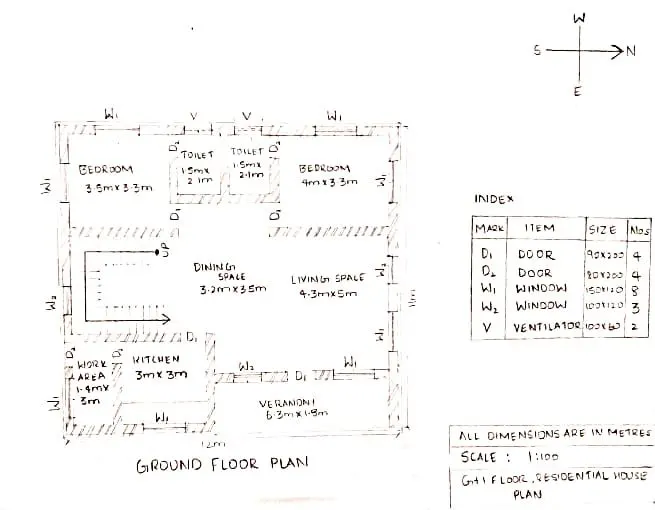
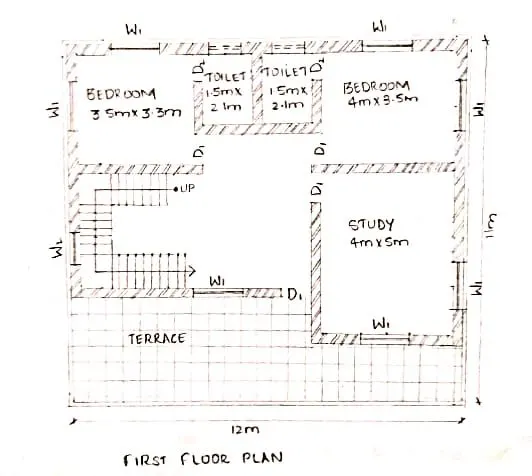
Structural drawings that are to be delivered to the site for construction include :
1. Centerline drawing
2. Footing and column layout with reinforcement details.
3. Column schedule with reinforcement details.
4. Plinth beam layout with reinforcement details.
5. First-floor beam layout with reinforcement details.
6. First-floor slab layout with reinforcement details.
The above-mentioned drawings will assist the site engineer to carry out the construction process in a systematic manner.
Dead load calculation as per IS857:1987(PartI) :
1. Column :
Assume the size of the column as 400mmx300mm
Let the height of the column be 3.6m
So, total volume of column = 0.4x0.3x3.6 = 0.432`m^3`.
Unit weight of concrete = 25kN/`m^3`.
Hence, the dead load of the column = 25x0.432 = 10.8kN per floor.
2. Beam :
Assume the cross-section of the beam as 300mmx450mm.
So the area of cross section = 0.3x0.45 = 0.135`m^2`.
Unit weight of concrete = 25kN/`m^3`.
Hence, the dead load of beam = 25x0.135 = 3.375kN/m.
3. Slab :
Assume the thickness of the slab as 200mm.
Considering an area of the slab as 1`m^2`.
Unit weight of concrete = 25kN/`m^3`.
Hence, the dead load of slab = 25x0.2x1 = 5kN
4. Wall :
The thickness of the wall is 300mm.
The height of the wall is 3.6m.
Unit weight of brick masonry is 20kN/`m^3`.
Hence, the dead load of wall = 20x3.6x0.3 = 21.6kN/m (for ground floor).
Live load calculation as per IS857:1987 (Part II)
For residential buildings, live load values are given as follows:
Dwelling house Uniformly distributed load (UDL), (kN/`m^2`) Concentrated load (kN)
1. All rooms and kitchen 2.0 1.8
2. Toilet and bathrooms 2.0 -
3. Corridors, passages, staircases including the tire escapes and storerooms 3.0 4.5
4. Balconies 3.0 1.5 per meter run concentrated at the outer edge.
Wind load calculation as per IS857:1987 (Part III)
According to the code, it is necessary to calculate the wind load only if the height of the building exceeds 10m. Here, the height of the building is 7.2m, which is less than 10m. Hence there is no need of calculating the wind load.
Result :
The plan is prepared by the Vaastu Shastra concept considering all the principles and considerations of Vaastu Shastra.
The load calculations are done as per IS code considerations
1. Dead load calculated as per the code, IS857:1987 (Part I) is obtained as follows :
The dead load of the column = 10.8kN per floor.
The dead load of the beam = 3.375kN/m.
The dead load of the slab = 5kN.
The dead load of the wall = 21.6kN/m.
2. Live load for a residential building is obtained from Table 1: Imposed Loads for different occupancies; of IS857:1987 (Part II)
3. Wind load is calculated as per the code IS857:1987 (Part III). Since the height of the building does not exceed 10m, it is not calculated.