Simulink models of Doorbell and Thermistor operated fan
AIM :
1. To make a Simulink model of doorbell using solenoid block.
Condition - the switch is closed for 2 seconds and then released.
2. To make simulink model which uses a thermistor to sense the temperature of a heater and turns on/off the fan as per the required conditions.
Condition - Fan turns ON above 25° C, OFF otherwise.
PROCEDURE :
Study 1 :
- The solenoid blockset is added to the blank model screen.
Solenoid is the generic term for a coil of wire used as an electromagnet. The device creates a magnetic field from electric current and uses the magnetic field to create linear motion. Common applications of solenoids are to power a switch, like the starter in an automobile, or a valve, such as in a sprinkler system. - A battery is connected for voltage supply.
- A switch is placed in between the battery and the solenoid to cater for the provided conditions.
Here, an SPST switch is used. There are different types of switches available as per requirements. - A seperate input signal is provided for the closing/opening of the switch. The switch gets closed if the external control signal is greater than the threshold value of the switch.
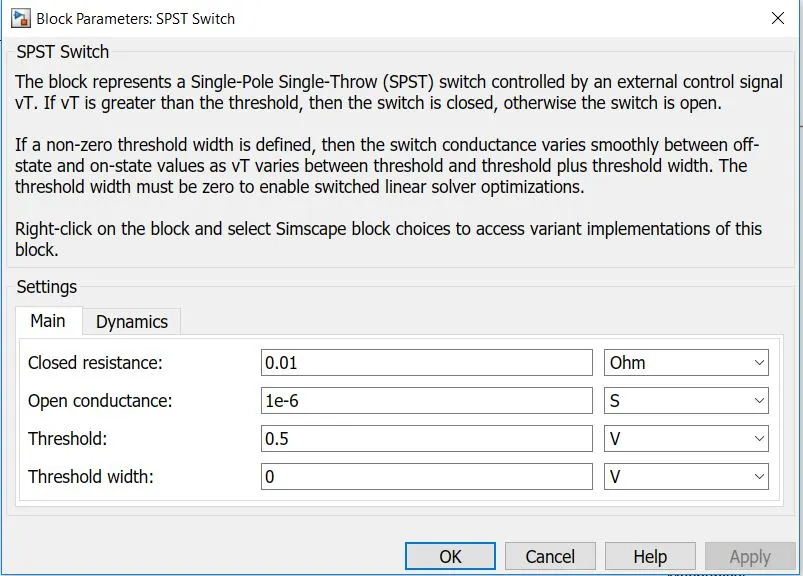
- The external signal for the switch is provided with a Pulse Generator block with period 4 sec and pulse width = 50% of time period.
- To sense the movement of the plunger, an Ideal Translational motion sensor is connected to it.
- Now, to observe this movement over the simulation period, a Scope block is connected.
- Signal convertors such as Simulink-PS and PS-Simulink convertors are provided for proper connections.
- Proper reference blocks are connected along with solver configurations for proper evaluation of the mathematical model.
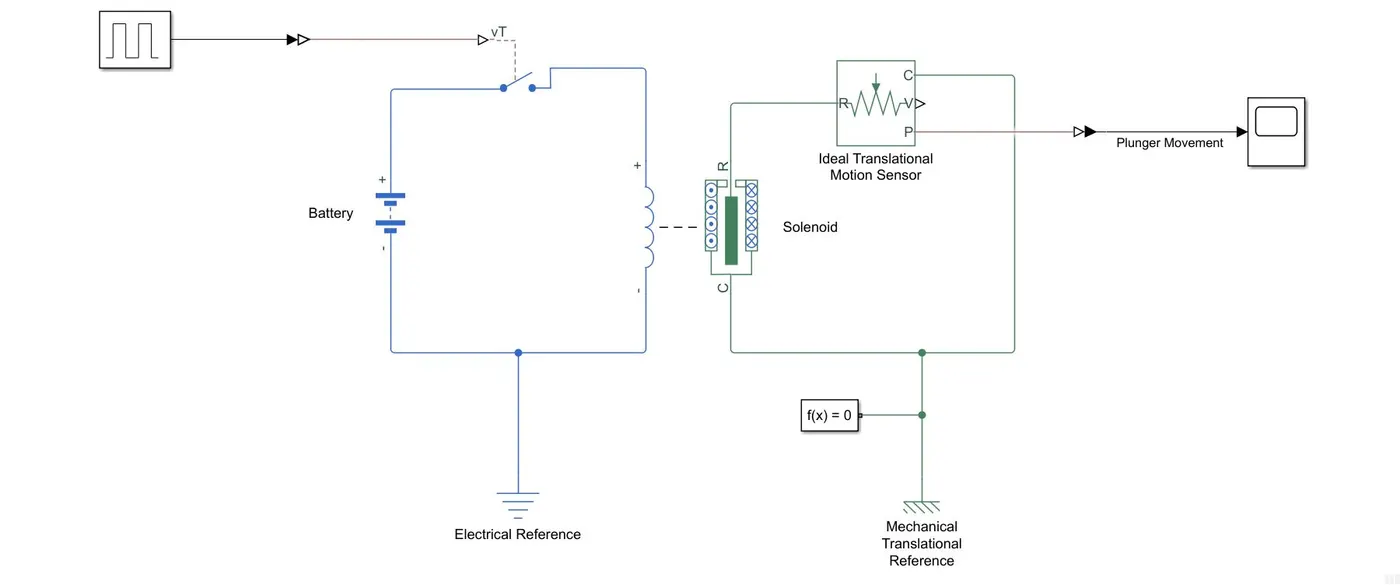
- The model is now ready to run. The results are visualised in the scope.
Result/Output :
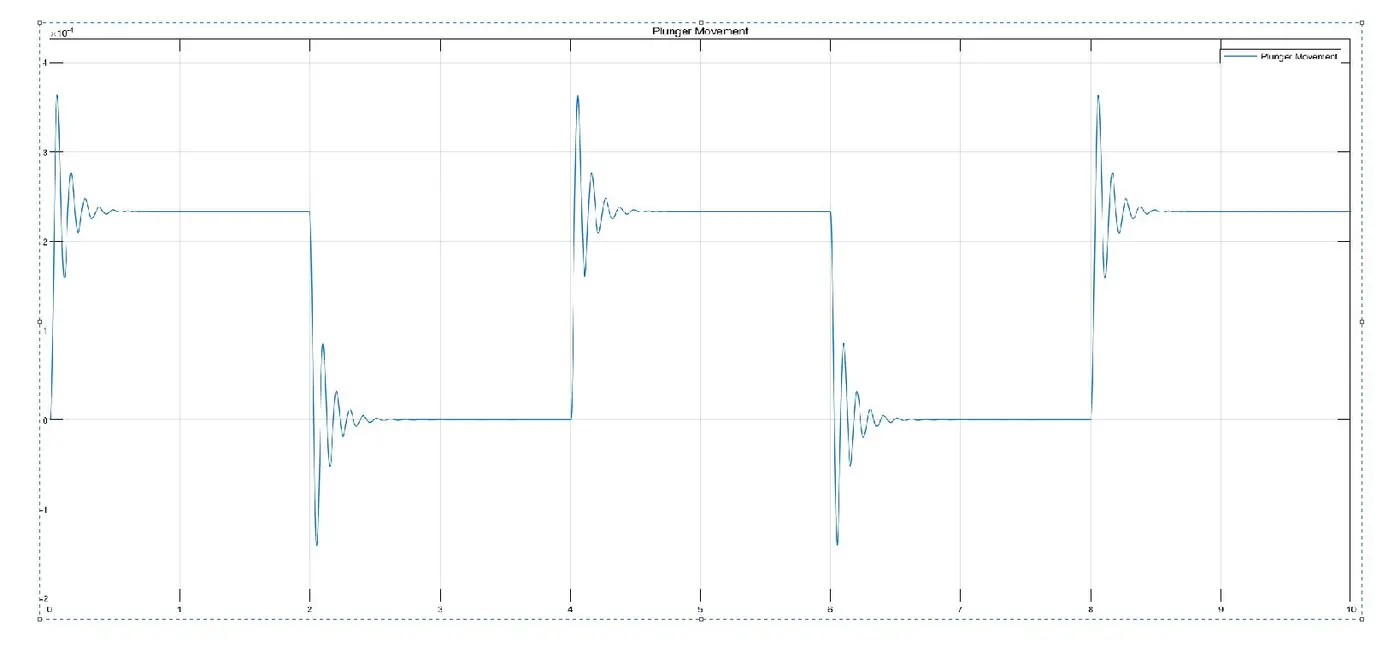
- Since the damping is set to 1, the plunger movement is quickly coming to rest as in critical damping.
- By changing the mechanical properties of the solenoid, different results can be obtained.
- Please refer to the mentioned link for the model file -
https://drive.google.com/file/d/11OhpUvJnz8NGbJLUnfPhpaKZIkbBB9sP/view?usp=sharing
Study 2 :
- The NTC thermistor block is added in the blank model screen.
- A thermistor is a type of resistor whose resistance is dependent on temperature.
With NTC thermistors, resistance decreases as temperature rises. An NTC is commonly used as a temperature sensor, or in series with a circuit as an inrush current limiter. With PTC thermistors, resistance increases as temperature rises. PTC thermistors are commonly installed in series with a circuit, and used to protect against overcurrent conditions, as resettable fuses. - The required conditional input is generated using a Signal Builder block.
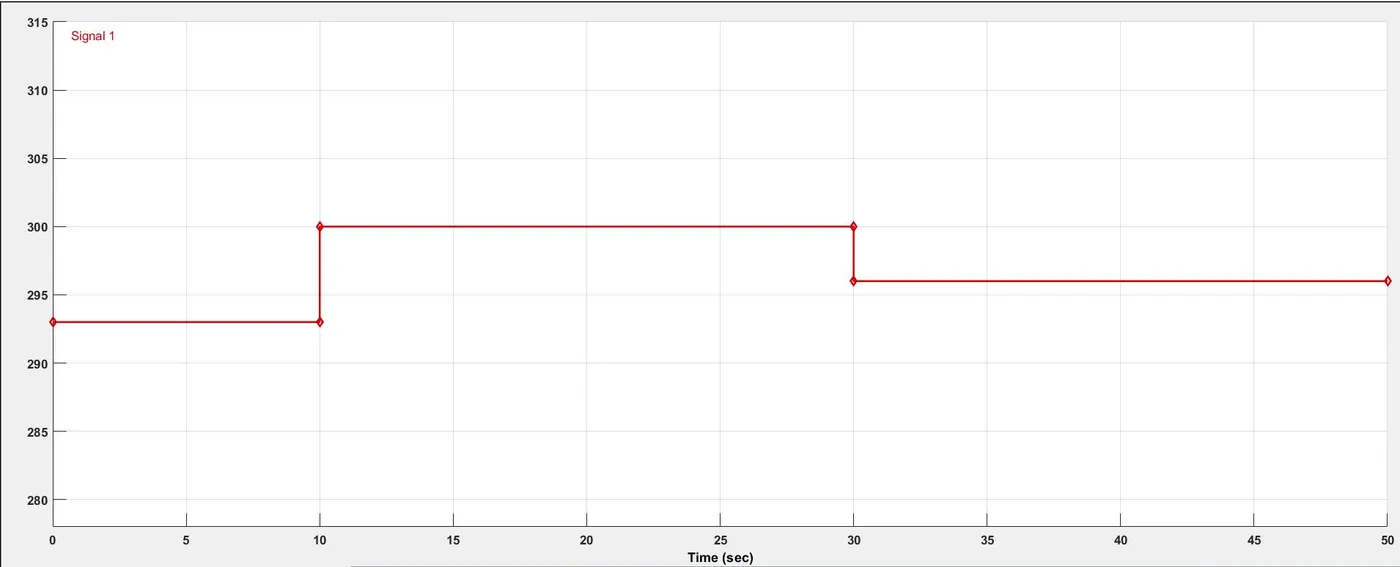
- This input is given to the thermal port of the thermistor through a Controlled Temperature Source block. A thermal reference is provided alongside.
- A resistor is added in the loop. Since the voltage across the thermistor falls with temperature, the voltage drop across the resistor increases correspondingly.
- To sense this resistor voltage drop, a voltage sensor is introduced parallely, the output of which is given to the switch.
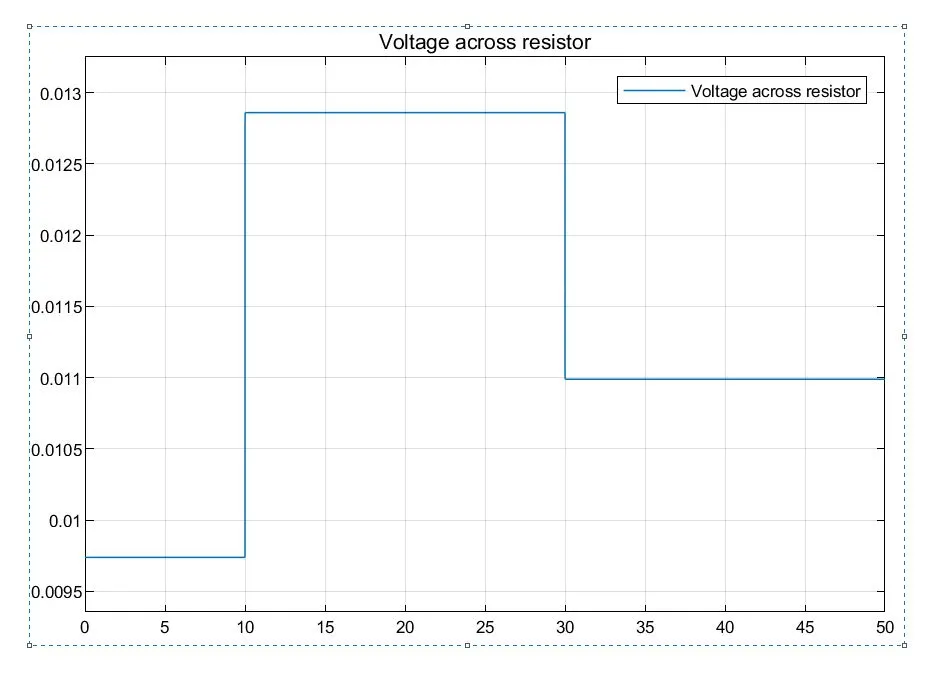
- Now, in order to customize this switch according to the given condition, a separate similar model is created with a constant input 25° C i.e. 298K and the voltage drop is measured across the resistor.
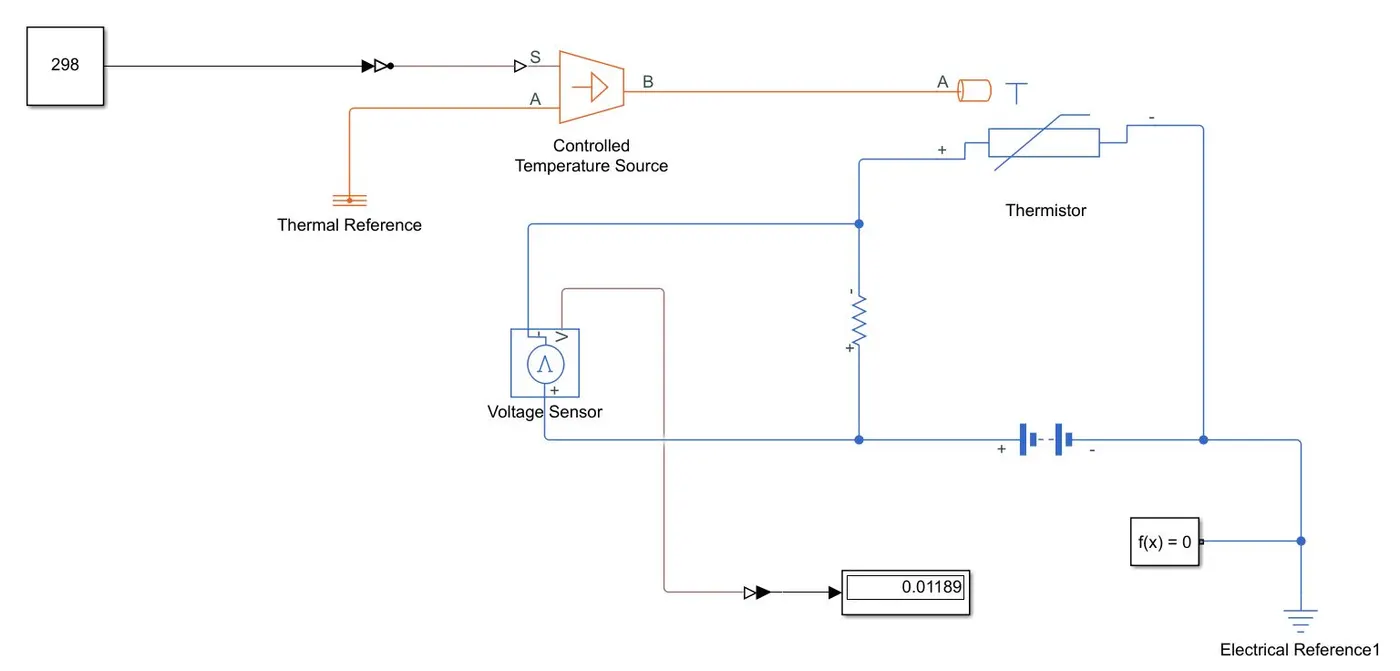
- This value is added as a threshold value for triggering the switch.
- Now in the main model, this switch acts as a trigger device for the DC motor which is powered by a separate battery.
- Accurate references and solver configuration are provided for proper simulation.
- By specifying the stop time, the simulation is executed, and the output is visualized.
Result/Output :
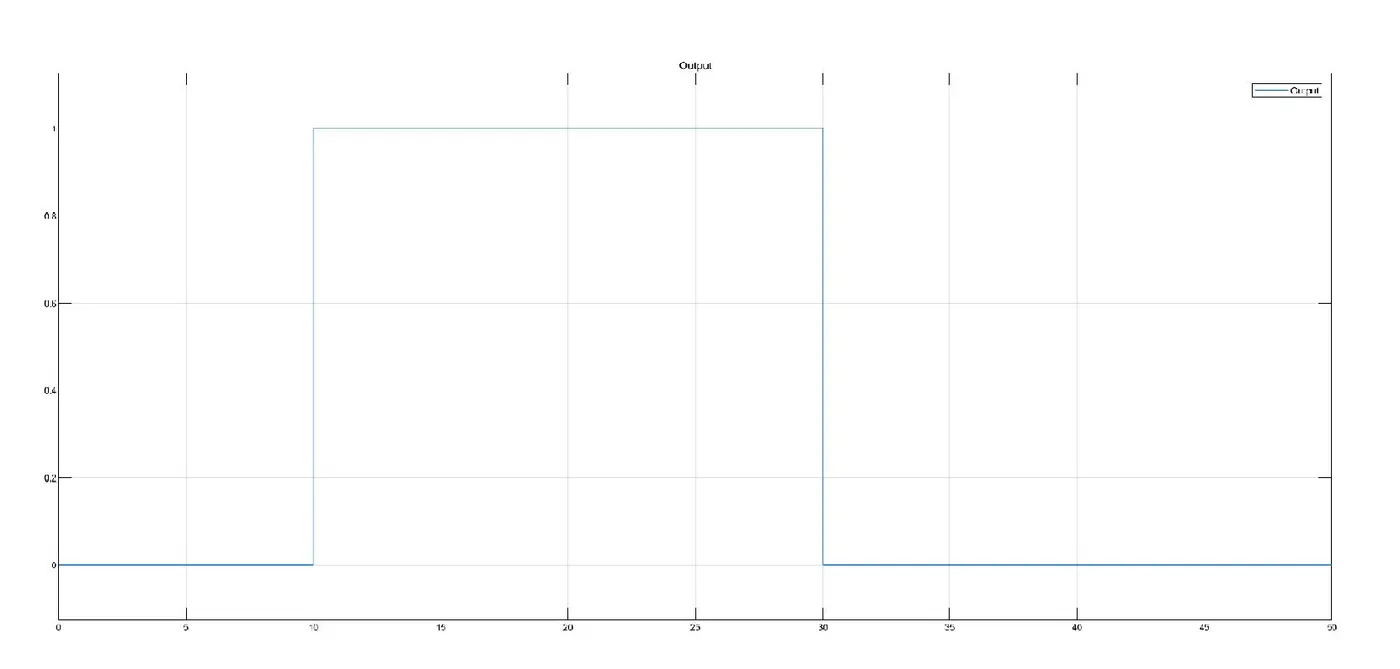
- Please refer to the mentioned link for the model file -
https://drive.google.com/file/d/1jYVU8w-RolGkZ3jJ-a4QFhx_9rlw8knz/view?usp=sharing
CONCLUSION :
Simulink models of a Door-Bell and a thermistor controlled fan are created and simulated.