Simulation of Washing Machine and Gear Transmission Control Logic Using Simulink State Flow
Aim: To implement control logic of a Washing Machine and Gear Shift logic using Stateflow.
Objective:
- Generate a Simulink model to Washing Machine at various state conditions.
- Generate a Simulink model to Shift the Gear according to input speed.
GENERATE A SIMULINK MODEL TO WASHING MACHINE AT VARIOUS STAGES.
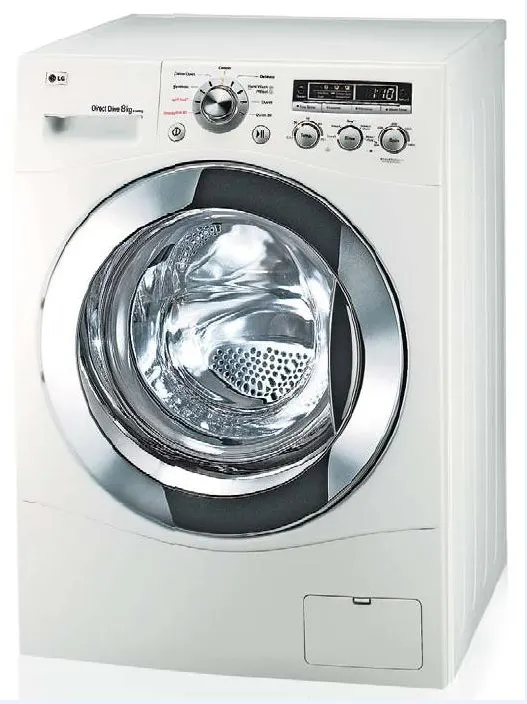
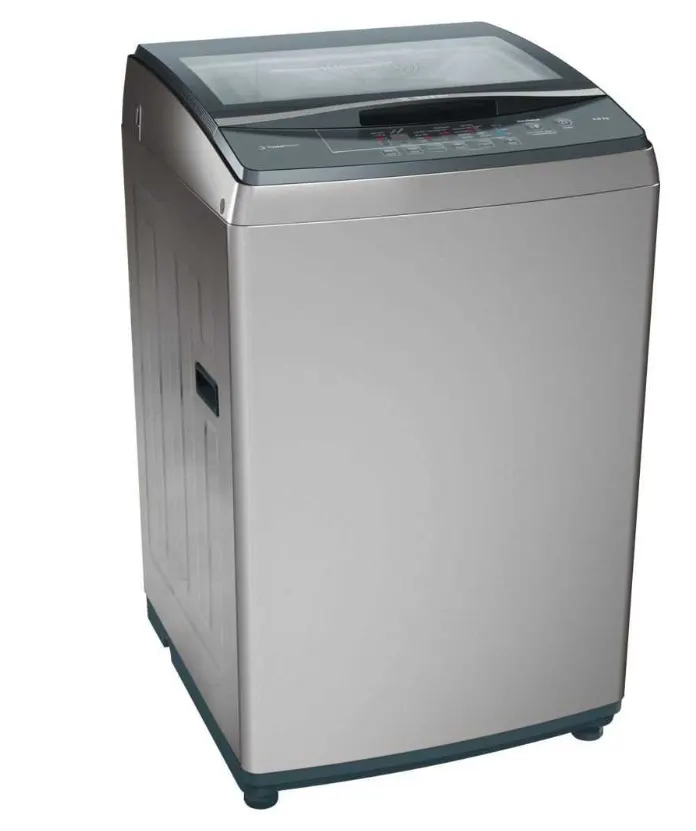
Introduction: A washing machine (laundry machine, clothes washer, or washer) is a home appliance used to wash laundry. The term is mostly applied to machines that use water as opposed to dry cleaning(which uses alternative cleaning fluids and is performed by specialist businesses) or ulstrasonic cleaners. The user adds laundry detergent, which is sold in liquid or powder form, to the wash water.
Front Load Top Load
History:
Washing by hand:
Laundering by hand involves soaking, beating, scrubbing, and rinsing dirty textiles. Before indoor plumbing, the maids, washerwome (laundress), or housewife also had to carry all the water used for washing, boiling, and rinsing the laundry; according to an 1886 calculation, some women in the United States fetched water eight to ten times every day from a pump,well, or spring for these purposes. Water for the laundry would be hand carried, heated on a fire for washing, then poured into the tub. That made the warm soapy water precious; it would be reused, first to wash the least soiled clothing, then to wash progressively dirtier laundry.
Removal of soap and water from the clothing after washing was a separate process. First, soap would be rinsed out with clear water. After rinsing, the soaking wet clothing would be formed into a roll and twisted by hand to extract water. The entire process often occupied an entire day of hard work, plus drying and ironing.
In fact, according to global health expert Hans Rosling, nearly 5 billion of the world's population of 7 billion (as of about 10 years ago) still hand-wash their clothes.
Early Machines:
The first English patent under the category of washing machines was issued in 1691. A drawing of an early washing machine appeared in the January 1752 issue of The Gentleman's Magazine, a British publication. Jacob Christian Schaffer's washing machine design was published 1767 in Germany. In 1782, Henry Sidgier issued a British patent for a rotating drum washer, and in the 1790s Edward Beetham sold numerous "patent washing mills" in England. One of the first innovations in washing machine technology was the use of enclosed containers or basins that had grooves, fingers, or paddles to help with the scrubbing and rubbing of the clothes. The person using the washer would use a stick to press and rotate the clothes along the textured sides of the basin or container, agitating the clothes to remove dirt and mud. This crude agitator technology was hand-powered, but still more effective than actually hand-washing the clothes.
More advancements were made to washing machine technology in the form of the rotative drum design. Basically, these early design patents consisted of a drum washer that was hand-cranked to make the wooden drums rotate. While the technology was simple enough, it was a milestone in the history of washing machines, as it introduced the idea of "powered" washing drums. As metal drums started to replace the traditional wooden drums, it allowed for the drum to turn above an open fire or an enclosed fire chamber, raising the water temperature for more effective washes.
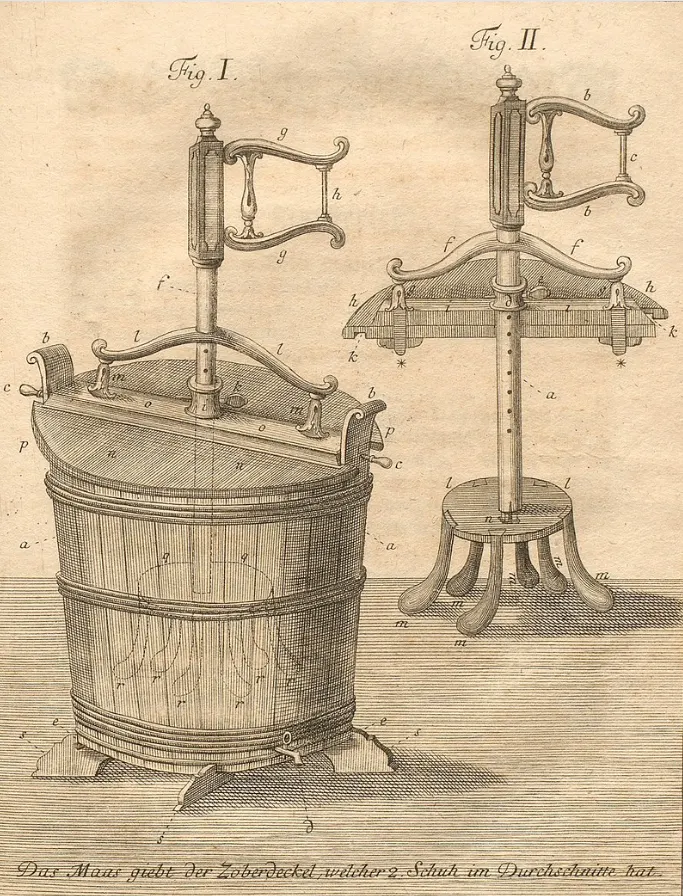
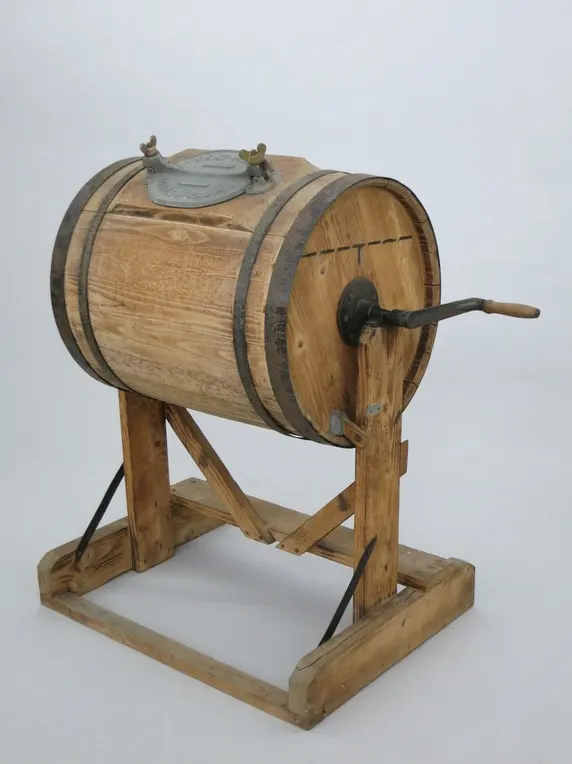
A 1776 illustration of Schaffer's washing machine Simple crank-operated washing machine
Operations Performed:
- Soaking - 200sec (0-200sec)
- Washing - 100sec (200-300sec)
- Rinsing - 20sec (300-320sec)
- Drying - 50sec (320-370sec)
- Power OFF - After Drying (>370sec)
Blocks Used:
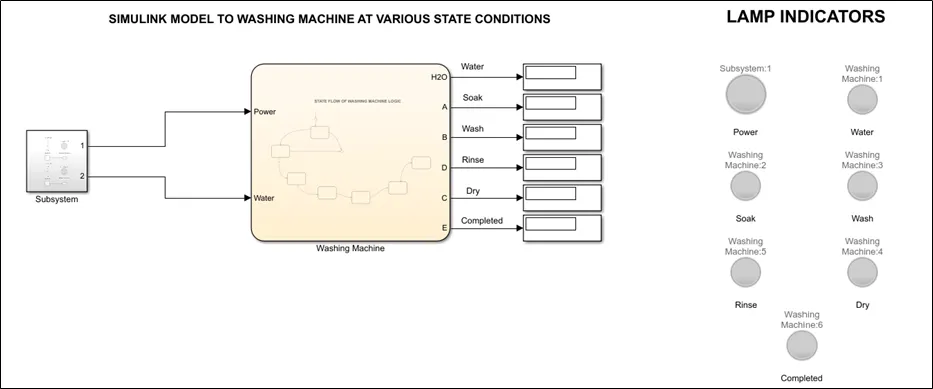
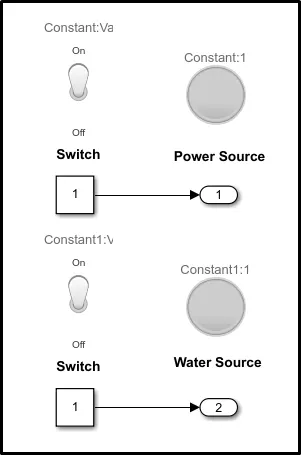
- Constant: Power and Water supply.
- Toggle Switch: Determine the output.
- Lamp: Indicates the output signals.
- State flow: Control logic.
- Display: Display the outputs of states.
SIMULINK MODEL:
MAIN SYSTEM:
SUBSYSTEM:
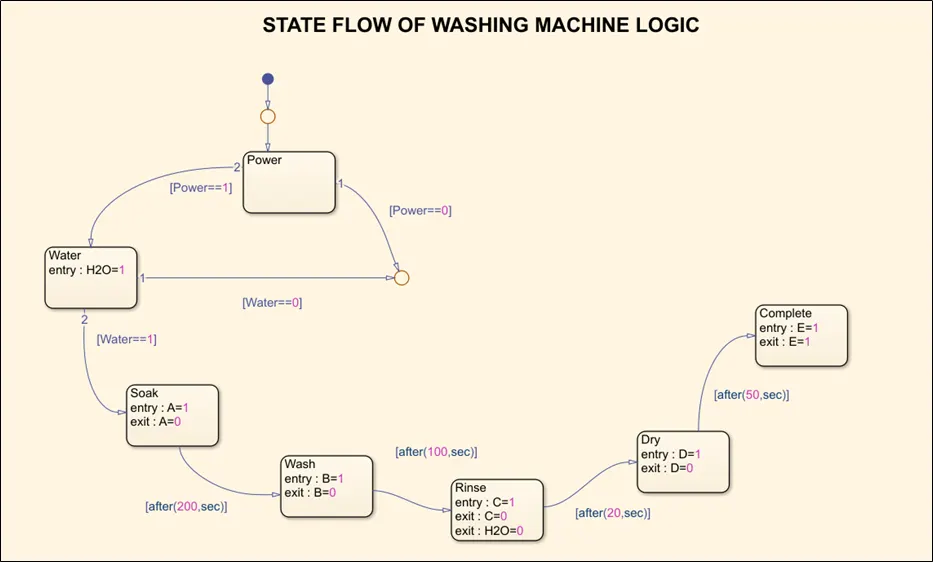
STATEFLOW MODEL:
Flow Process:
- The power and water supply are defined by constant values '0' and '1' (OFF and ON respectively).
- Then the toggle switch and lamp activates accordingly to the inputs.
- Then the signals get into the stateflow logic, if Power and Water are '1' then only washing machine start the process, if the power and water are '1' and '0' respectively washing machine will not start the process according to the given inputs.
- Then with the given input to Soaking process link time 200sec, then Power and Water gets ON and Soaking process will continue.
- Meanwhile after completion of Soaking process, Washing process gets starts to the given time 100sec and continues upto end of 300sec.
- After 300sec, as per given inputs Rinsing will gets start for 20sec, after 320sec Drying process will start along with water supply will get cutoff.
- After 370sec the complete lamp indicated that all process are completed.
- According to the given inputs Lamp and Display gives the outputs.
CONDITION 1 - Both Water and Power Supply ON:
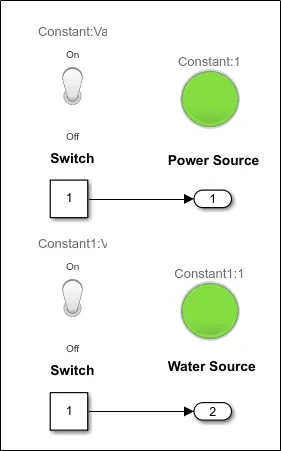
In this process both water and Power supply gets on as per given inputs, after that Washing machine logic gets activated.
Soaking State:
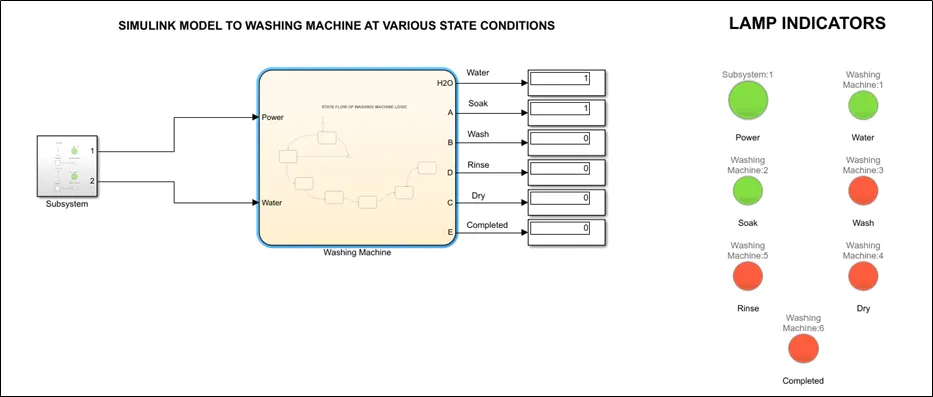
As the system gets activated the soaking process starts which is being continued till upto 200sec meanwhile Power, water and Soak lamp gets ON once the process starts and soak output display indicates '1' (ON).
Washing State:
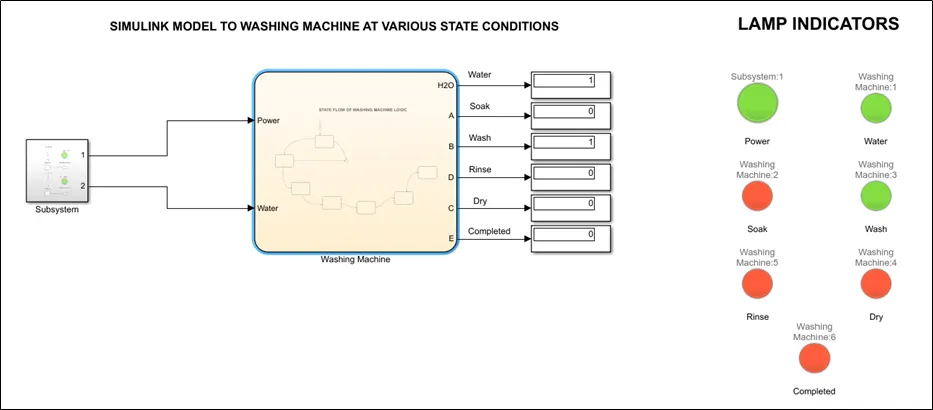
After 200sec, the washing process gets initiated and which being continued till upto 300sec meanwhile Power, water and Wash lamp gets ON once the process starts and Wash output display indicates '1' (ON).
Rinsing State:
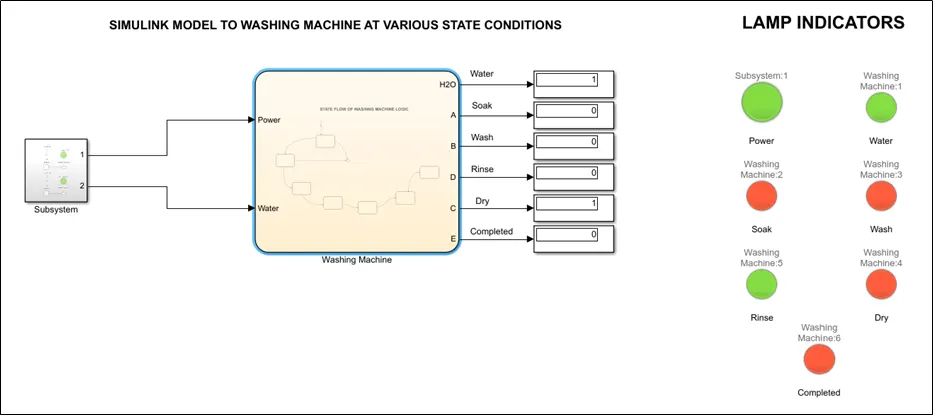
After 300sec, the rinsing process gets initiated and which being continued till upto 320sec meanwhile Power, water and Rinse lamp gets ON once the process starts and Rinse output display indicates '1' (ON).
Drying State:
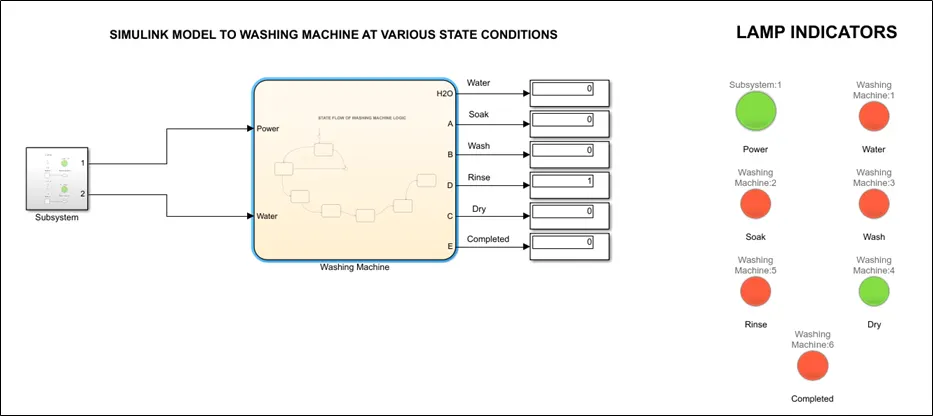
After 320 sec the drying process gets initiated which is being continued till upto 370sec, and once the rinsing stage is crossed the water supply is cutoff because for drying water is not required.
Completed State:
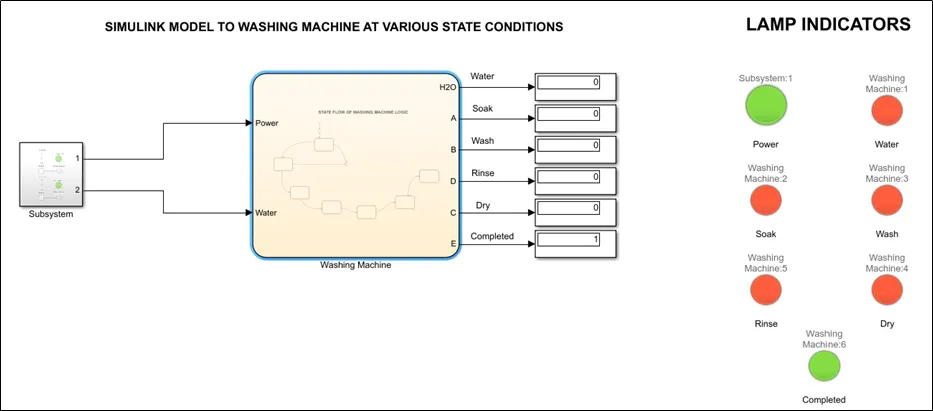
After all the process are Completed the washing machine will not take any more water or power to wash the clothes until the user unloads the washed clothes and loads the clothes to be washed. So the finish lamp indicates that the washing cycle is complete.
Result: The washing machine ran successfully by completing all the process as per user defined time duration.
CONDITION 2 - No Water Supply:
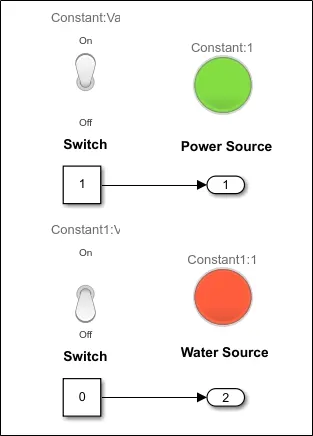
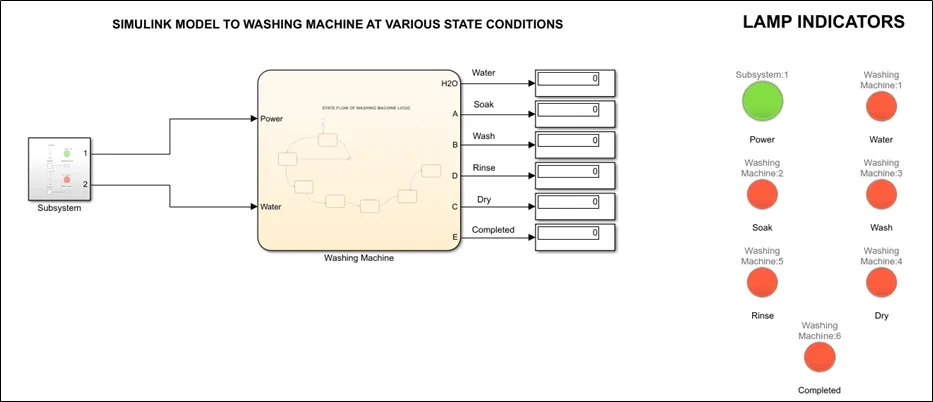
In this process ony water supply is provided and water supply is turned OFF, as the water supply is turned OFF the washing machine didn't start the process. Only power supply lamp is blinking.
Result: As the water supply is turned OFF the washing machine didn't start the process.
CONDITION 3 - No Power and Water Supply:
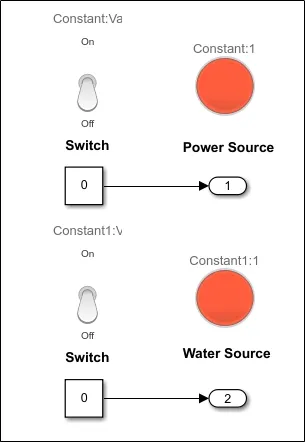
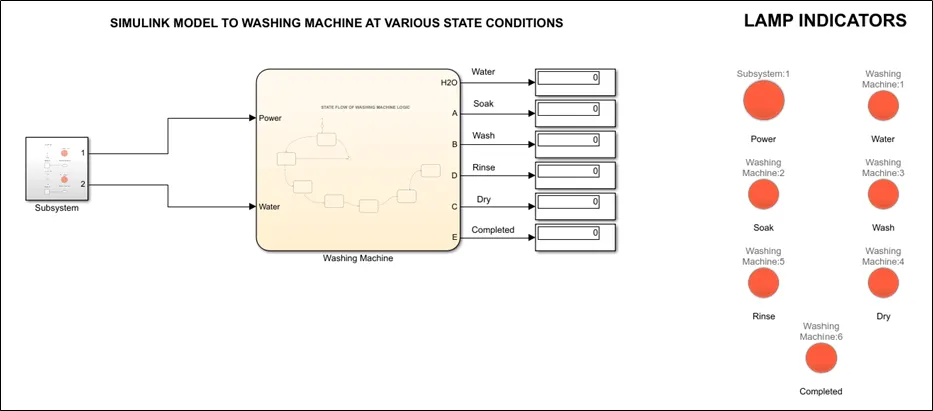
In this process both water and power supply OFF.
Result: As both the supplies are turned OFF the washing machine will not function.
GENERATE A SIMULINK MODEL TO SHIFT GEAR ACCORDING TO INPUT SPEED.
Introduction:
An automatic transmission, also called auto, self-shifting transmission, n-speed automatic (where n represents its number of forward gear ratios), or AT, is a type of motor vehicle transmission that automatically changes the gear ratio as the vehicle moves, meaning that the driver does not have to shift the gears manually.
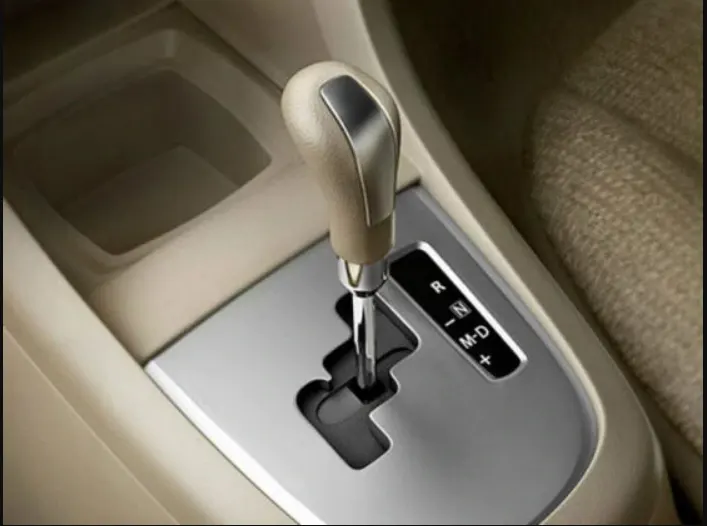
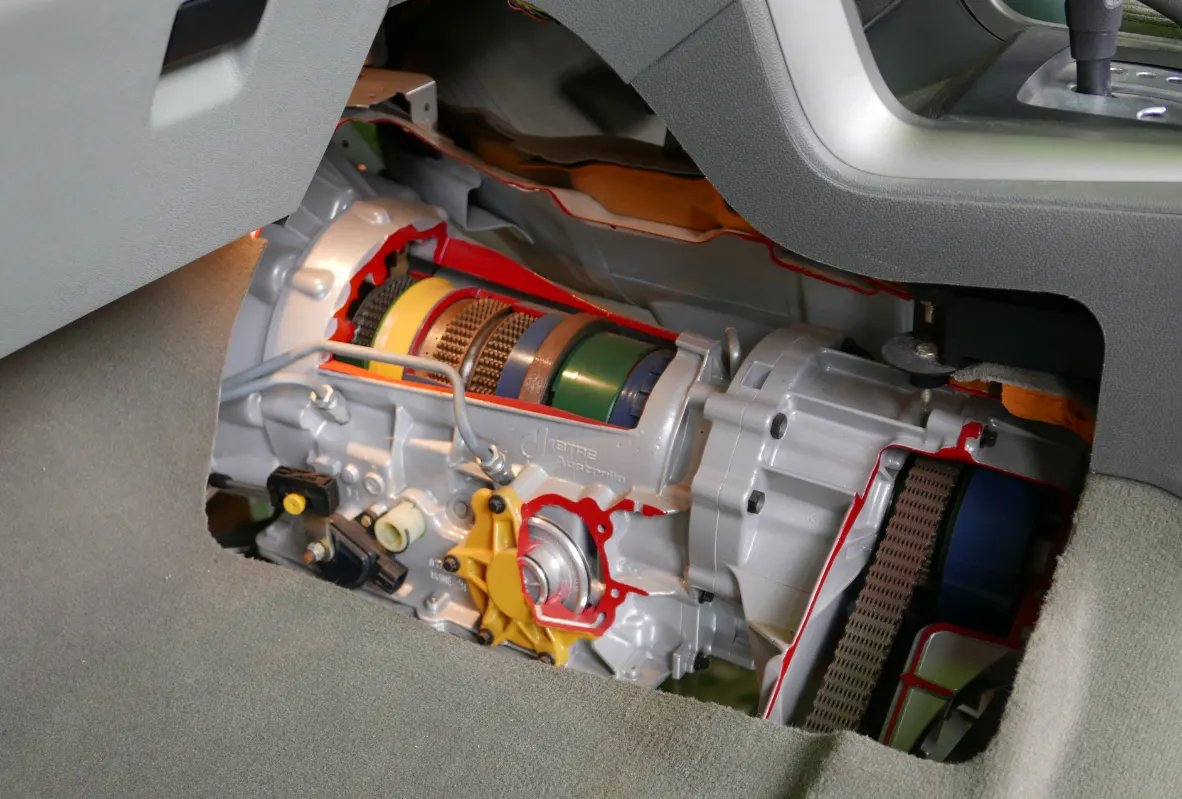
In this model we are simulating automatic gear shifting w.r.t the input speed given by the driver. An automatic transimission uses sensors to determine when it should shift gears, and changes them using internal oil pressure. The system uses a fluid coupling in place of friction clutch, and accomplishes gear changes by hydraulically locking or unlocking a system of planetary gears. As we push the throttle to speed up, the fluid moves the turbine faster to send more power through the transmission.
Operations Performed:
- 1st Gear - (0-15 Kmph)
- 2nd Gear - (16-25 Kmph)
- 3rd Gear - (26-40 Kmph)
- 4th Gear - (41-60 Kmph)
- 5th Gear - (>60 Kmph)
Blocks Used:
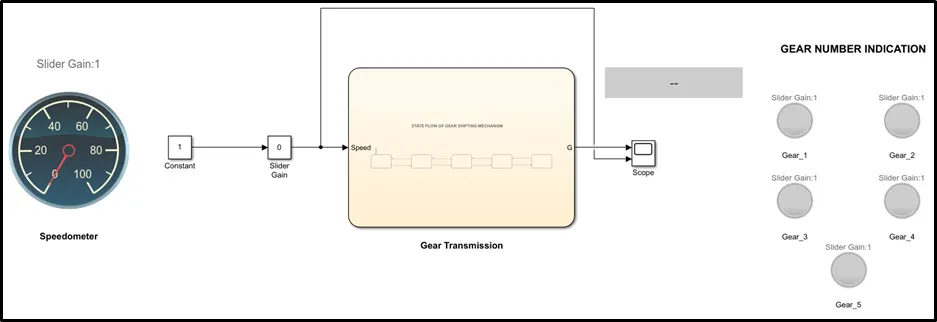
- Constant : To multiply with the slider gain.
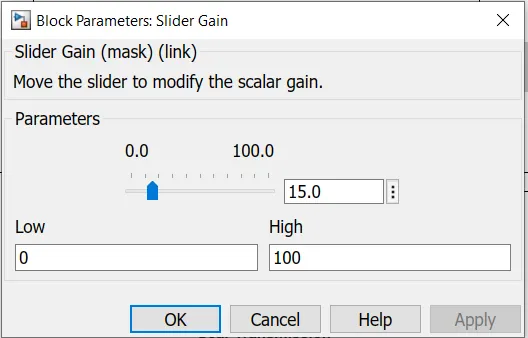
- Slider gain : To act as throttle to increase the speed.
- Lamp : To indicates the gear number.
- State flow : Shifting logic.
- Scope : To view the plot of Speed Vs Gear shift.
- Custom Gauge: Speedometer of the vehicle.
Simulink Model:
Stateflow Model:
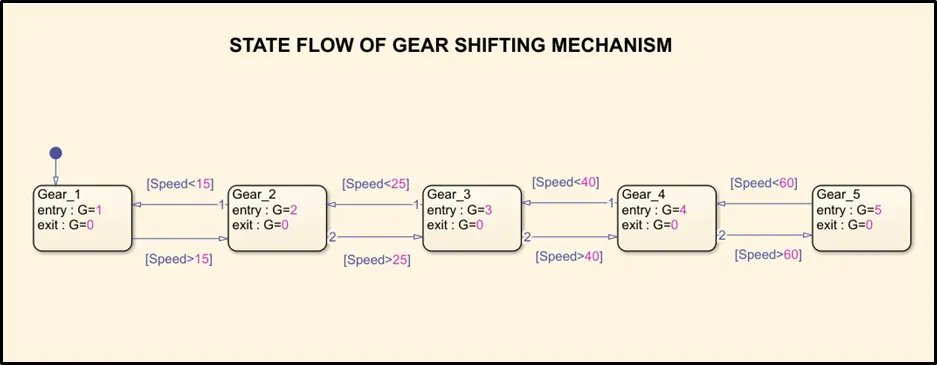
Flow Process:
- Initially the slider value will be '0'
- When we increase the speed the output is given to the state flow chart where it checks the input speed and displays the gear number.
- Here for the simulation purpose we have considered the vehicle top speed it 100 Kmph.
- When the speed is between (0-15 Kmph) the 1st gear gets activated.
- When the speed is between (16-25 Kmph) the 2nd gear gets activated.
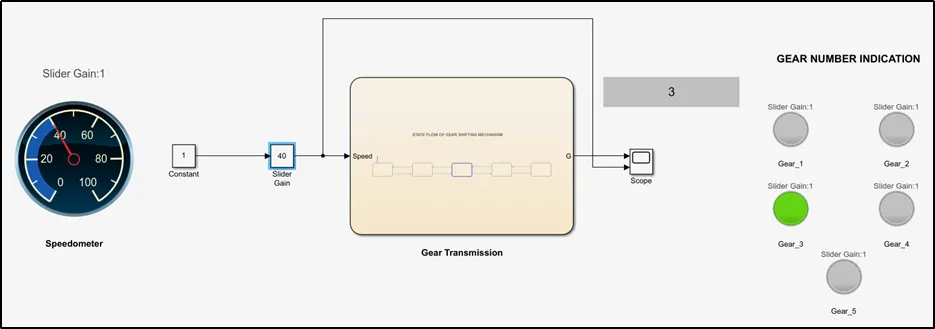
- When the speed is between (26-40 Kmph) the 3rd gear gets activated.
- When the speed is between (41-60 Kmph) the 4th gear gets activated.
- When the speed is between (61-100 Kmph) the 5th gear gets activated.
- As the speed is increased, decreased or vice-versa we can see the changes in the speedometer.
- We can reduce the gear by decreasing the speed of the vehicle.
Results:
1st Gear: The first gets is activated till upto 15Kmph.
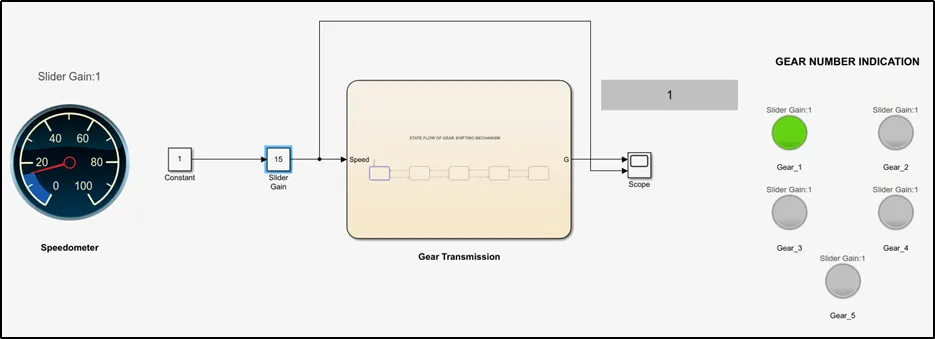
2nd Gear: The second gear get activates from 16-25 Kmph.
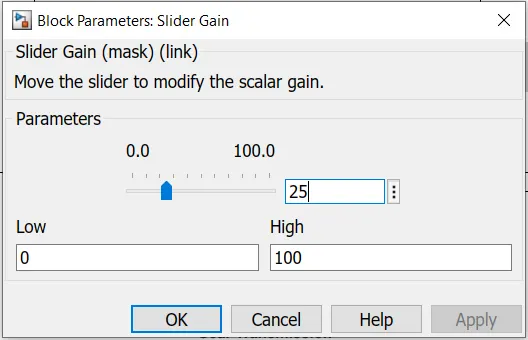
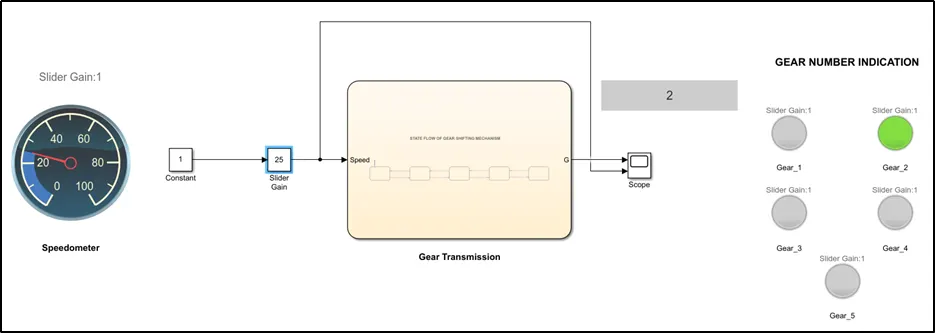
3rd Gear: The third gear get activates from 26-40 Kmph.
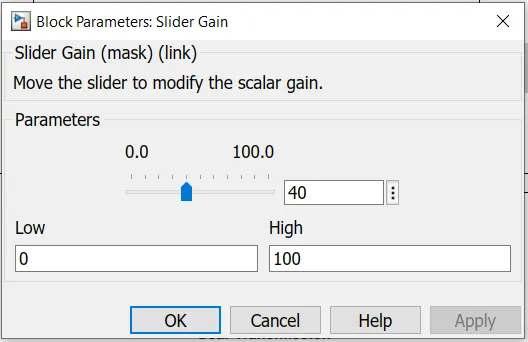
4th Gear: The third gear get activates from 41-60 Kmph.
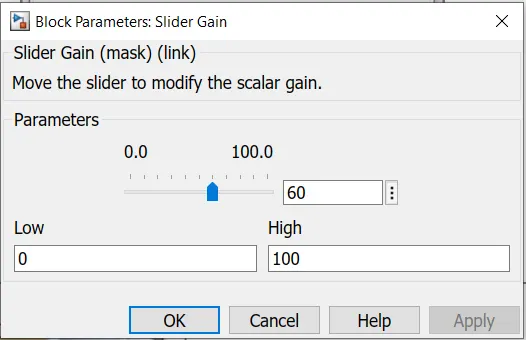
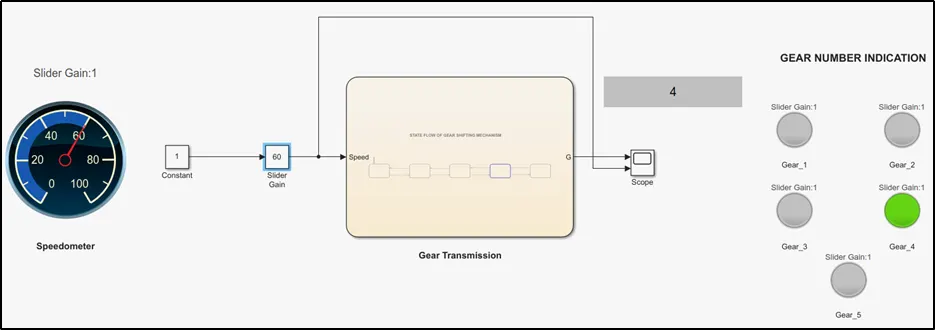
5th Gear: The third gear get activates above 61 Kmph.
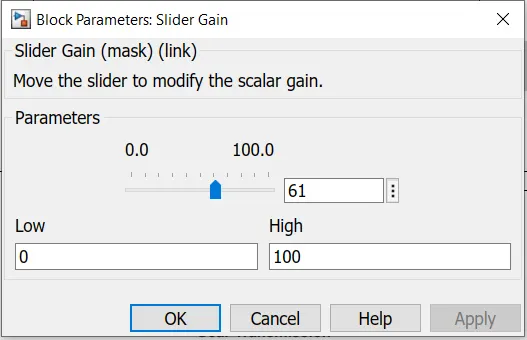
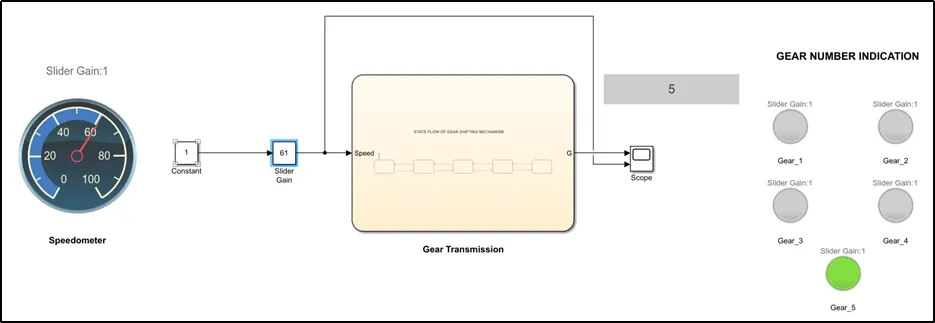
All the gear are activated according to the throttle speed by the driver as input.
Speed Vs Gear Shift:
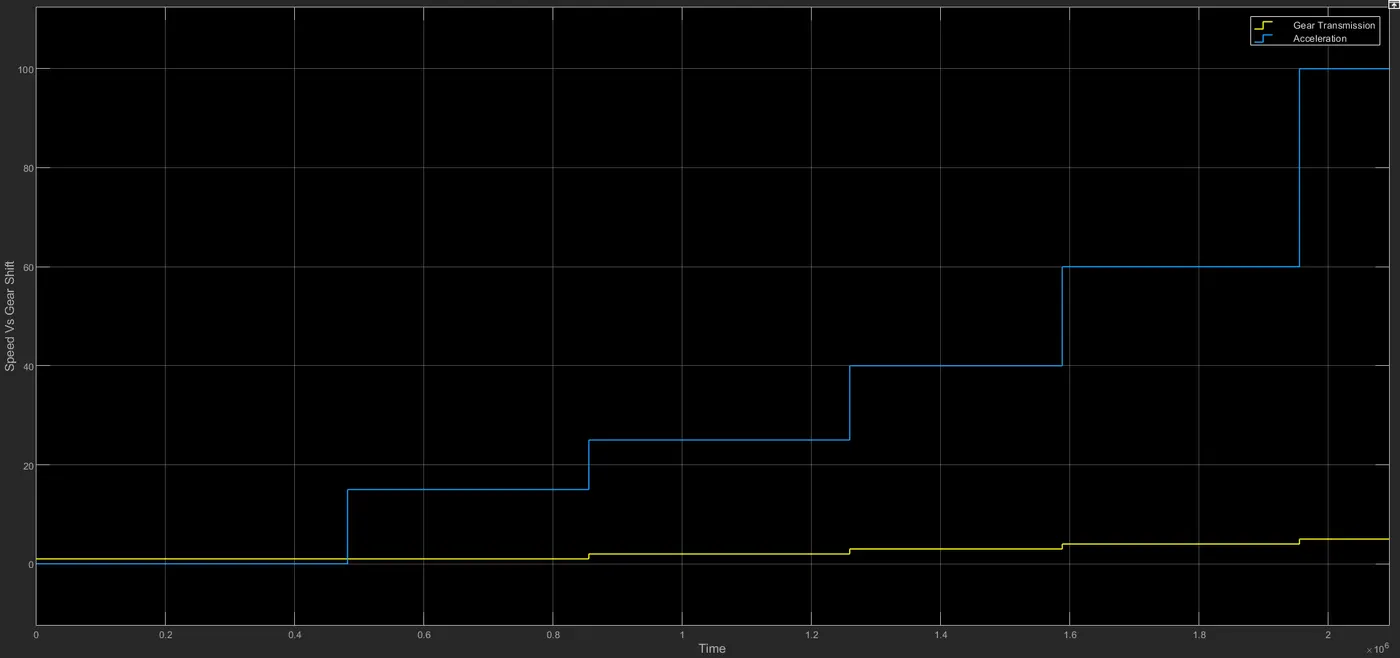
From the above graph we can study that the gears are shifted according to the speed input.
Conclusion: The simulation of Washing Machine and Gear Transmission System was completed successfully and the outputs were generated.