Section Modulus calculation and optimization
Section Modulus Challenge Assignment help video using CATIA
Your Answers
AIM- To increase the section modulus of a given hood by necessary changes
TOOL USED- CATIA V5
MATERIAL USED- STAINLESS STEEL AISI 302
INTRODUCTION- Section modulus is a geometric property for a given cross-section used in the design of beams or flexural members. Other geometric properties used in design include area for tension and shear, radius of gyration for compression, and moment of inertia and polar moment of inertia for stiffness. Any relationship between these properties is highly dependent on the shape in question. Equations for the section moduli of common shapes are given below.

z= Section modulus
I= Area moment of inertia
Y= Distance from neutal axis to the outer most fiber of a material
Area moment of inertia- It signifies the tendency of cross ection to resist bending. Greater its value greater is its tendency to resist bending.It is given by-
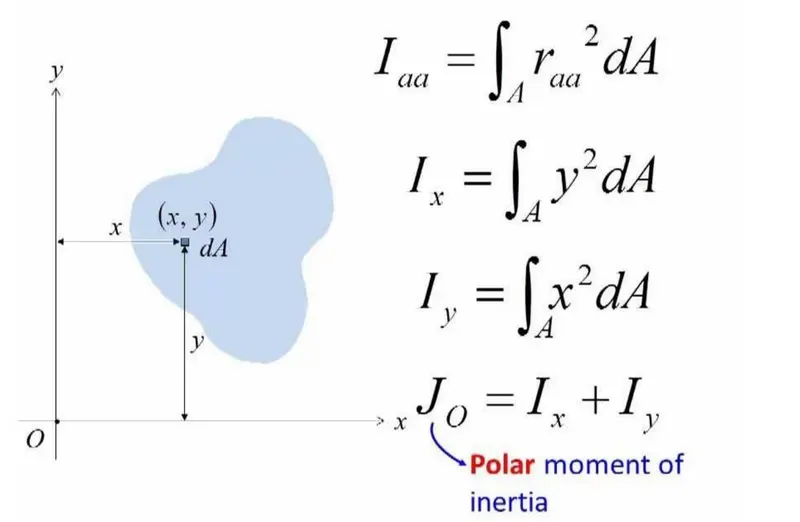
Elastic section modulus: In structural member design, the elastic section modulus is used to determine the bending resistance within the stress-strain curve's elastic limit.The component's failure in the elastic region is taken into consideration.
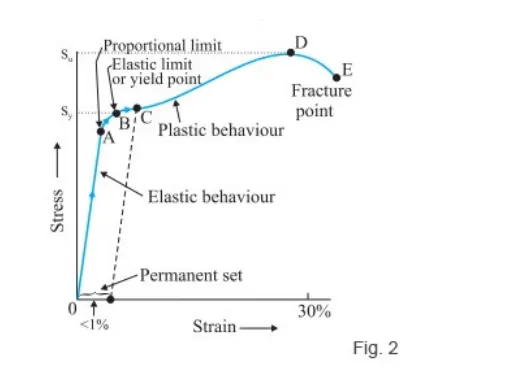
So to keep our desin values within elastic limits we will use minimum value of moment of inertia because from here itself material will start to deform.
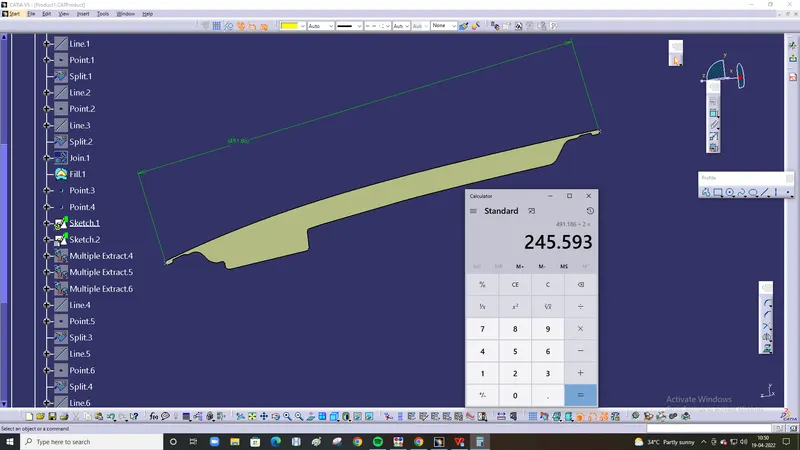
EXISTING HOOD SECTION-
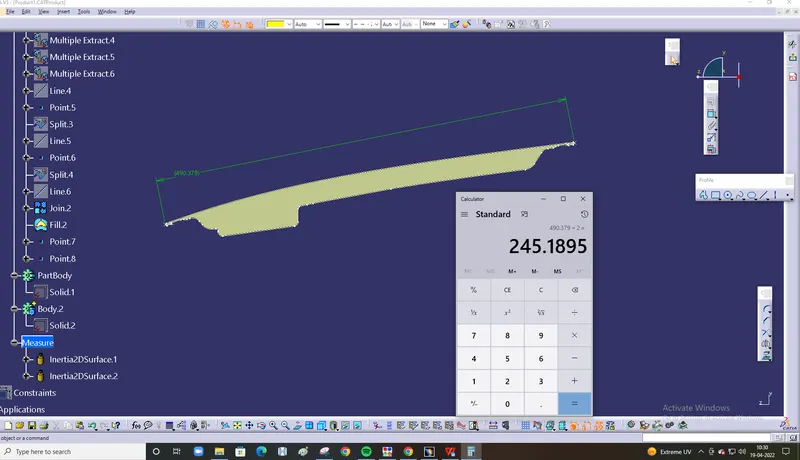
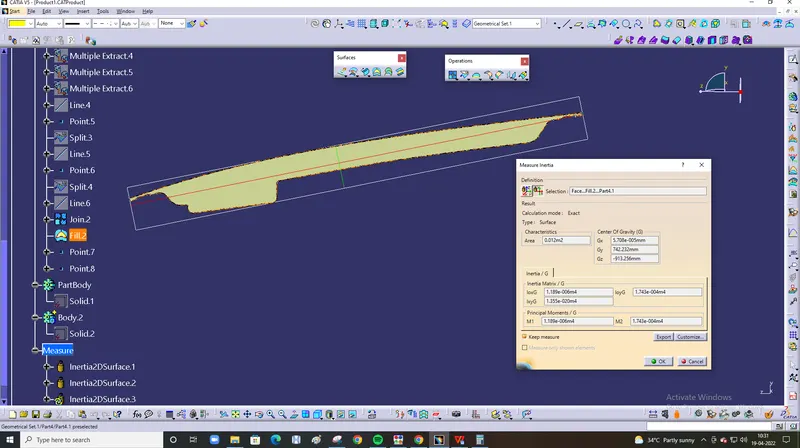
Results obtained are as follows- IMIN = 1.189e-006m4
A= 0.012m2
Y=490MM
From bending equation-σ/y=M/I=E/R S = I/Y S= section modulus.
I= Minimum principle moment of inertia.
y= Distance of the outer most fibre from neutral axis.
So by pluging in these values
S= 2.4265e-7m4
MODIFIED SECTION: Increasing the area and adding more embosses can increase our moment of inertia, as the formula for moment of inertia states that the greater the distance between an area and the neutral axis, the greater its inertia.
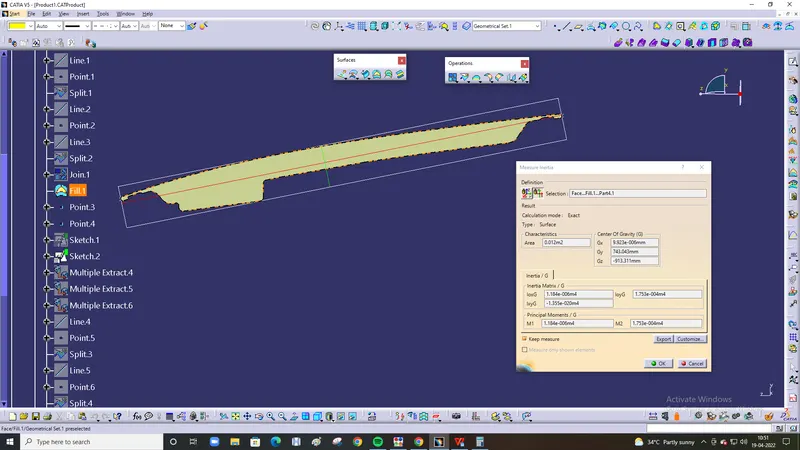
Results-
IMIN =1.184e-006m4
A=0.012m2
Y = 491MM
S= I/Y= 2.4163265e-7m4
FINAL RESULT- Thus stifness of the car hood has been increased by increasing its moment of inertia.