Section Modulus calculation and optimization
Section Modulus Optimization
- Objective: To calculate section modulus for hood assembly and to optimize it by modifying parameters of same.
Section Modulus:
- Section modulus is a geometric property for a given cross-section used in the design of beams or flexural members.
- There are two types of section modulus, the elastic section modulus and the plastic section modulus.
Here, elastic section modulus is defined as
S = I / y,
where, I is the second moment of area (or area moment of inertia) and y is the distance from the neutral axis to any given point.
- It is often reported using y = c, where c is the distance from the neutral axis to the most extreme point.
- It represents the strength of the section.
- Greater the value of Z, greater will be the strength of the section.
- The section modulus depends upon the moment of inertia which again depends not only on the total area of the cross-section but also on the disposition of the area with respect to neutral axis.
Plastic Section Modulus

Section modulus calculation for hood is given below:
Case 1: As shown in the image minimum and maximum values of Moment of Inertia are obtained through simulation.
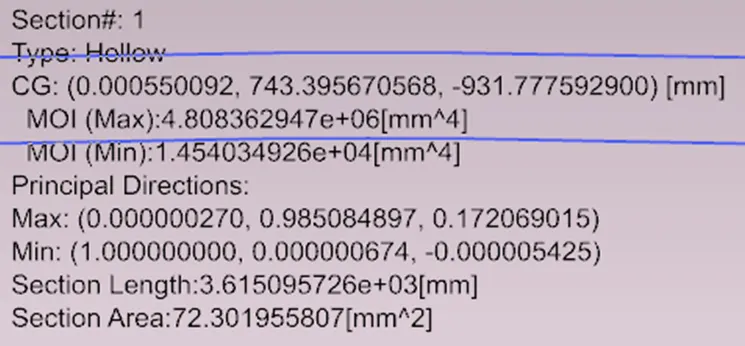
- As shown in image minimum and maximum values of moment of inertia are given.
- Considering minimum value of it.
- Calculations are listed below:
Here, Moment of inertia (I) is: 1.454×10ˆ4 mmˆ4
Now the distance denoted by y is 484/2= 242mm
So, Section Modulus is : 1.454*10^4 / 242= 60.08 mm^3
Now Case 2: Optimized Design
For that the inner panel was given 5 mm offset from it’s initial position.
As image shown below:
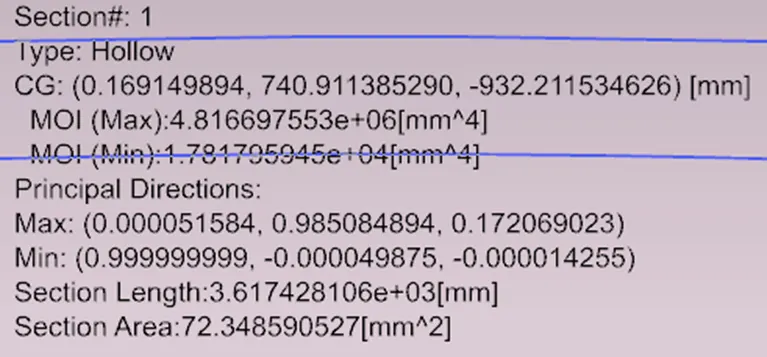
Here, Moment of inertia (I) is: 1.781×10ˆ4 mmˆ4
Now the distance denoted by y is 484/2= 242mm
So, Section Modulus is : 1.781*10^4 / 242= 73.60 mm^3
Conclusion:
- By increasing gap between Inner and outer panel value of MOI and section modulus increased.
- From above analysis we can say that strength of hood is increased.