Section Modulus calculation and optimization
Section Modulus
Section modulus is the ratio of bending to the farthest fiber from the neutral axis, or it is the measure of the strength of the beam. The ratio of the Area Moment of Inertia to the Distance from the Neutral Axis to the Point where the Bending Normal Stress is determined. It is a geometric property used to calculate the bending stresses in a structural member.
Mathematically: It is defined as the ratio of the moment of inertia of a section about its centroidal axis to the distance of the extreme layer from the neutral axis.
Area moment of Inertia:
The area moment of inertia of a beam's cross-sectional area measures the beam's ability to resist bending. The larger the moment of inertia less will be the bend.
Neutral axis: When the beam is subjected to pure bending the topmost fibers of the beam are subjected to maximum compression, while the bottommost fibers of the beams are subjected to maximum tension.
S = I/y
Where,
S = Section Modulus
I = Moment of Inertia
y = distance between the neutral axis and the end of the object
Types of Section Modulus
There are two types of section modulus:
- Elastic Section Modulus
- Plastic Section Modulus
Elastic Section Modulus: Elastic section modulus is calculated when we use the material behavior until the yield point.
Plastic Section Modulus: The plastic section modulus is used for materials where the elastic yield is acceptable and the plastic behavior is considered to be in an acceptable range.
case 1: before optimization
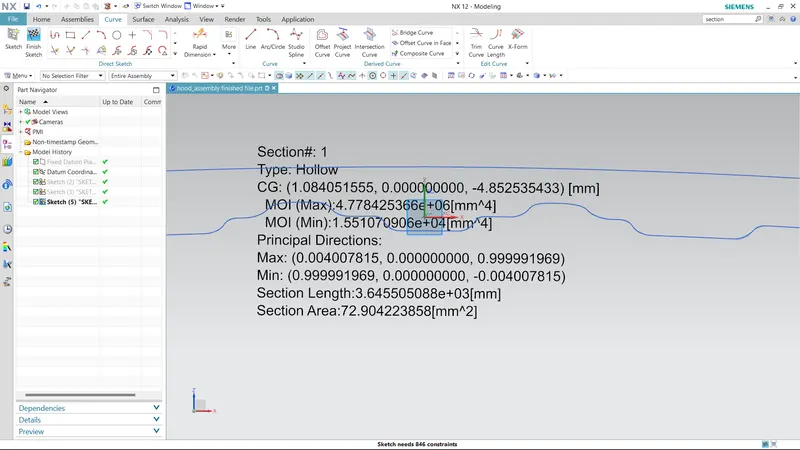
MOI (max) = 4.778425366e+06(mm^4)
MOI (min) = 1.551070906e+04(mm^4)
As per the section modulus equation,
S = I/Y
I = MOI (min) value is considered
Y = Total distance /2, Total distance =880mm
Y = 880 / 2
= 440 mm
Therefore, S = 15510.70906 mm^4/440 mm
S = 35.251 mm^3
case 2: after optimization
1 mm increased from the base offset
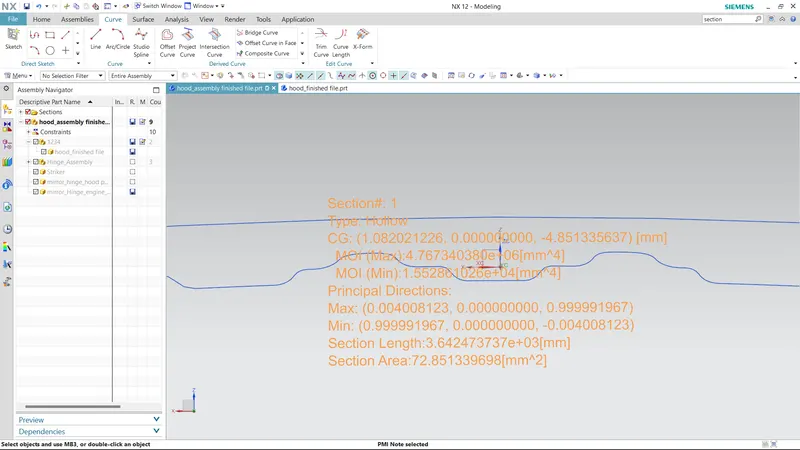
MOI (max) = 4.767340380e+06(mm^4)
MOI (min) = 1.552861026e+04(mm^4)
As per the section modulus equation,
S = I/Y
I = MOI (min) value is considered
Y = Total distance /2, Total distance =880mm
Y = 880 / 2
= 440 mm
Therefore, S = 15528.61026 mm^4/440 mm
S = 35.292 mm^3