Section Modulus calculation and optimization
SECTION MODULUS CALCULATION AND OPTIMISATION
AIM:
Use the Section from Hood design and calculate the section modulus using the formula S =I/y
S = Section Modulus
I = Moment of Inertia
y = distance between the neutral axis and the extreme end of the object
SECTION MODULUS:
The section modulus of the cross-sectional shape is of significant importance in designing of structures. It is a direct measure of the strength of the structure
A structure that has a larger section modulus than another will be stronger and capable of supporting greater loads.
Section modulus (S) = I/y
Where,
I = Moment of inertia in (mm4)
y = Distance between the neutral axis and the extreme end of the object (mm)
MOMENT OF INERTIA:
Moment of inertia is defined as the quantity expressed by the body resisting angular acceleration which is the sum of the product of the mass of every particle with its square of a distance from the axis of rotation
NEUTRAL AXIS:
The neutral axis is an axis in the cross section along which there are no longitudinal stresses or strains. If the section is symmetric, isotropic and is not curved before a bend occurs, then the neutral axis is at the geometric centroid. All fibers on one side of the neutral axis are in a state of tension, while those on the opposite side are in compression.
Now to calculate the section modulus from the hood design:
Take the front section since we are dealing with the frontal crash. For that create a datum plane on the curve and at a halfway distance of the hood.
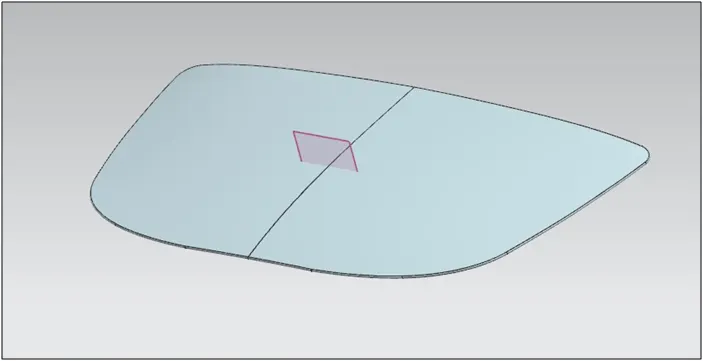
Fig 1. Creation of datum plane
Find the intersection curve between the newly created datum plane and the hood.
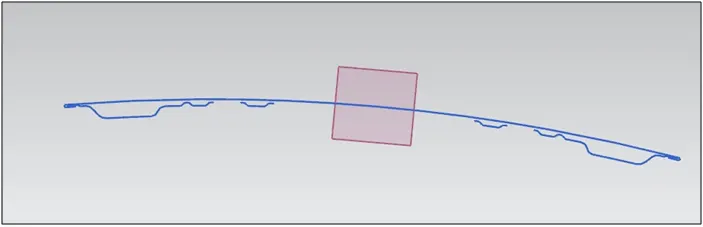
Fig 2. Intersection curve
The intersection curve obtained is 3D curve. We need to convert it into 2D curve so as to edit it. For that the curve is to be projected onto the datum plane.
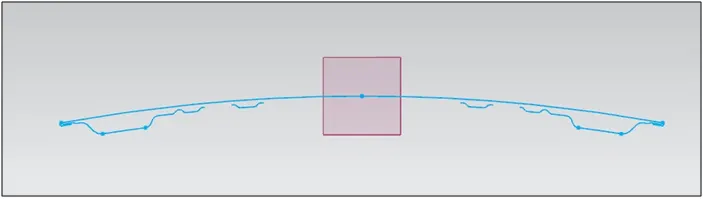
Fig 3. Projected the intersection curve onto the datum plane
The Section is to be made a closed section to calculate the section modulus. Take only the outer line of the outer hood and inner panel.
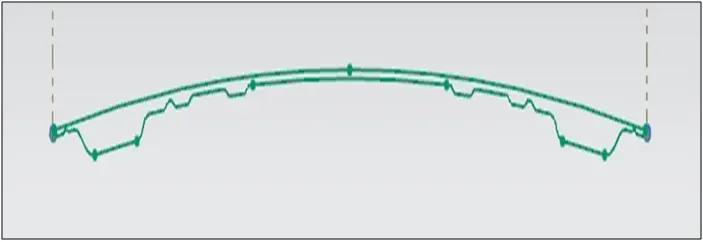
Fig 4. The section is closed with lines and arc
Take a point at both the extreme side of the hood and draw two vertical reference line. Measure the distance between the points. Half of the distance will be y since we are taking the 0-y axis as the neutral axis.
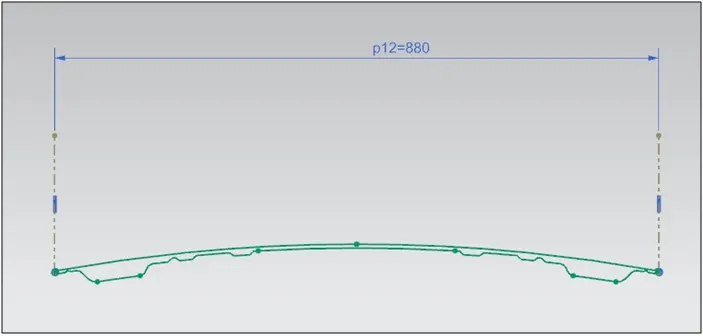
Fig 5. Measured the distance between the extreme ends of the hood
Using the inertia analysis command calculate the moment of inertia of the section.
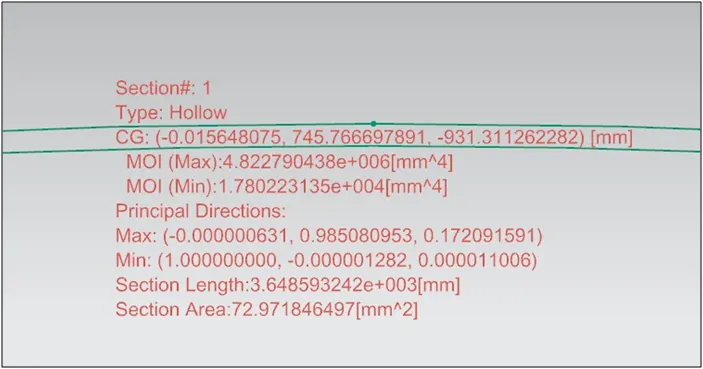
Fig 6. Moment of inertia of the section.
Calculation of Section Modulus:
I (MOI) = 1.78 x 104 mm4
y = 880/2 = 440mm
S = (1.78 x 10⁴)mm4 / 440mm = 40.45mm3
Case 2:
The outer line of the inner panel is offset to 1mm downwards. In other words the depth of the inner panel is increased to notice the changes in the section modulus.
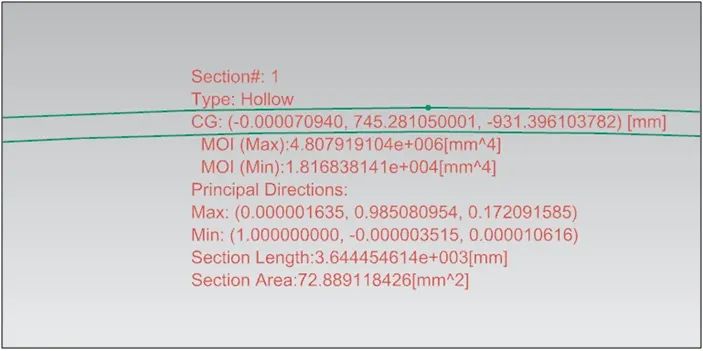
Fig 7. Moment of inertia of the new section
Calculation of Section Modulus:
I (MOI) = 1.81 x 104 mm4
y = 880/2 = 440mm
S = (1.81 x 10⁴)mm4 / 440mm = 41.13mm3
CONCLUSION:
The section modulus of the section was calculated.
When the depth of the section is increased it is noticed that the section modulus increases and hence the load bearing capacity of the section.
*************