Section Modulus calculation and optimization
SECTION MODULUS OF THE HOOD
Aim
To calculate the section modulus of the previously designed hood for analyzing its strength and also optimizing the design to see the difference in the bending strength of the hood. Higher the section modulus of a structure, the more the resistive it becomes to bending.
Section modulus
Section modulus is a geometric property for a given cross-section used in the design of beams or flexural members, it is also referred to as the Polar Modulus or the Torsional Sectional Modulus. Other geometric properties used in design include area for tension and shear, radius of gyration for compression, and moment of inertia and polar moment of inertia for stiffness. Any relationship between these properties is highly dependent on the shape in question. Equations for the section moduli of common shapes are given below. There are two types of section moduli, the elastic section modulus and the plastic section modulus.
S=I/Y
Here,
S = Section modulus (mm^3)
I = Moment of Inertia of the section about the bending axis. (mm^4)
Y = Distance between the neutral axis and extreme end of the object (mm)
Area moment of Inertia:
The area moment of inertia of a beams cross sectional area measures the beam ability to resist bending. The larger the moment of inertia less will be the bend.
Where,
M = Bending moment
I = Area moment of Inertia
E = Youngs modulus
R = Radius of gyration
Neutral axis: When beam is subjected to pure bending the top most fibres of the beam are subjected to maximum compression, while the bottom most fibres of the beams are subjected to maximum tension.
Material Data: Stainless steel AISI 302 – cold rolled
Where yield strength of stainless steel is 520MPa = 520 N/mm^2
Calculation:
CASE 1: Before Optimization
The Hood which was already created is imported and the section inertia analysis is done.
We have to make sure that the curve obtained is a single/closed curve.
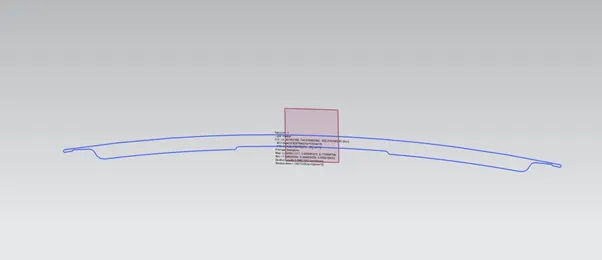
Fig 1.1
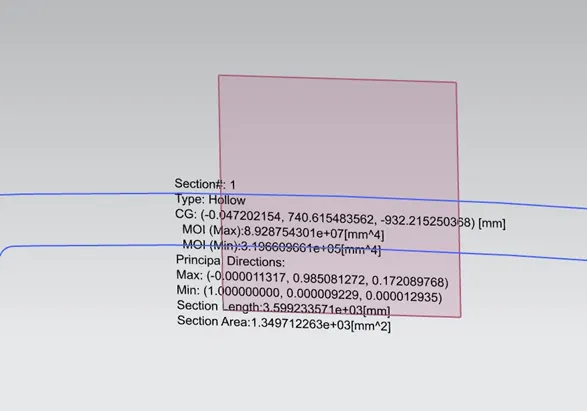
Fig 1.2
MOI (max) = 8.928754301e+07 (mm^4)
MOI (min) = 3.196609661e+05 (mm^4)
As per the section modulus equation,
S = I/Y
I = MOI (min) value is considered
Y = Total distance /2, Total distance =875.5680mm
Y = 875.5680 / 2
= 437.784 mm
Therefore, S = 319660.966 mm^4/437.784 mm
S = 730.179 mm^3
CASE 2: After optimization
The hood inner panel’s curve is offset by 0.5mm outwards and section inertia analysis is done same as case 1 for a closed curve.
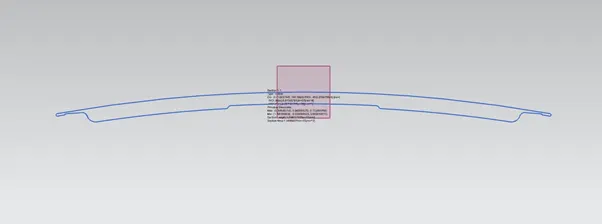
Fig 1.3
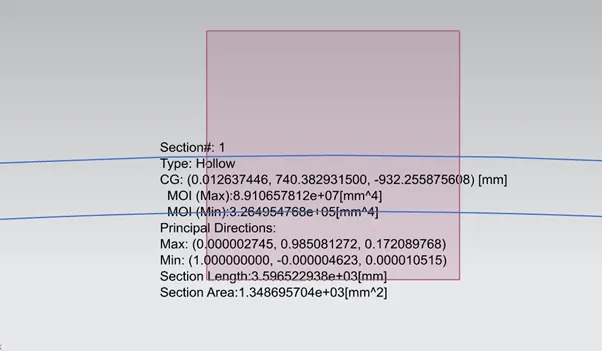
Fig 1.4
MOI (max) = 8.910657812e^07 mm^4
MOI (min) = 3.264954768e^05 mm^4
As per section modulus equation,
S = I / Y
I = MOI (min) value is considered
Y = Total distance /2, Total distance =875.5680mm
Y = 875.5680 / 2
= 437.784 mm
Therefore, S = 326495.4768 mm^4 / 437.784 mm
S = 745.792 mm^3
Conclusion:
Hence when comparing case 1 & case 2,
1. The section modulus value of case 2 is higher than the case 1
2. As we increase the section area, the moment of inertia & section modulus increases which means strength and load material also increase