Section Modulus calculation and optimization
SECTION MODULUS CALULATION AND OPTIMAZATION
AIM:
To increase the section modulus of the hood by necessary changes using NX cad.
SECTION MODULUS:
It is termed as the ratio of the second moment of area and distance from Neutral axis to the extreme fibre. Also, it is the measure of the strength of the given member. The stress in the outermost section of the beam computed with the help of section modulus. It is indicated by S. Section modulus indicates as follows:
S= I/Y
Here, I is ‘’ moment of inertia’’ and y is the distance from the neutral axis and extreme end of the object (mm)
Area Moment of inertia:
The Area moment of inertia of a cross sectional area measures the beam ability to resist bending. The larger moment of inertia less will be the bend.
M = Bending moment
I = Area Moment of inertia
E = Youngs modulus
R= Radius of gyration
Neutral axis: When beam is subjected to pure bending the top most fibre of the beam are subjected to max compression, While the bottom most fibre of the beam are subjected to maximum tension.
Calculations:
CASE1 : Before Optimization
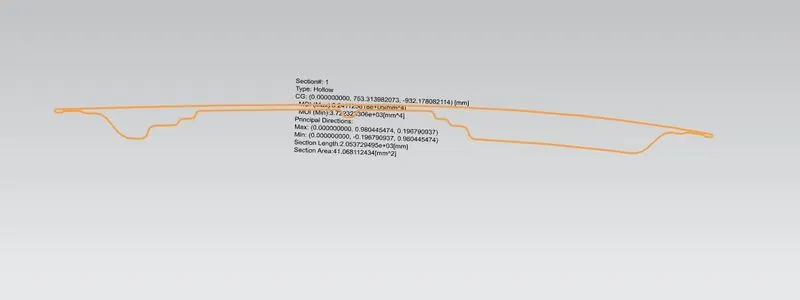
The hood Which was already created is imported and section inertia analysis is done.
We have make sure that the curve obtained a single or close curve.
Figrure1
Figuure1.1
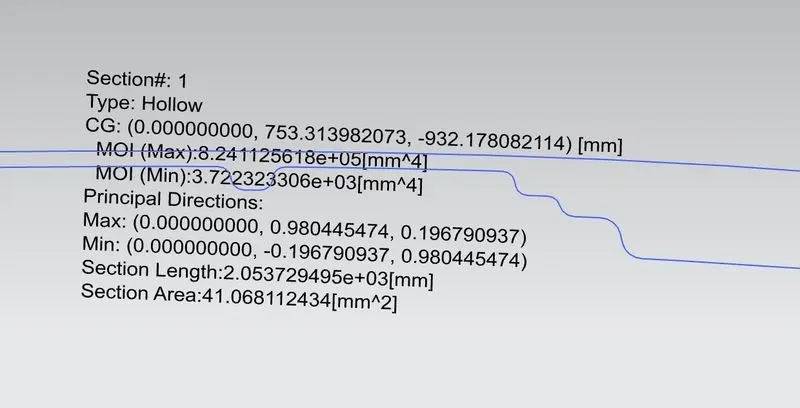
MOI (max) = 8.24112568e +05[mm^4]
MOI (min) = 3.72232306e+03[mm^4]
As per the section modulus equation,
S = I/Y
I = MOI (min) value is considered
Y = Total distance /2, Total distance = 487.25mm
Y = 487.25/2
= 243.625mm
Therefor, S = 3722.32306mm^4/243.625mm
S = 15.31mm^3
CASE 2: After optimization
The hood inner panel’s curve is offset by 0.5mm and section inertia analysis ia done same as case 1 for a closed curve.
Figure2
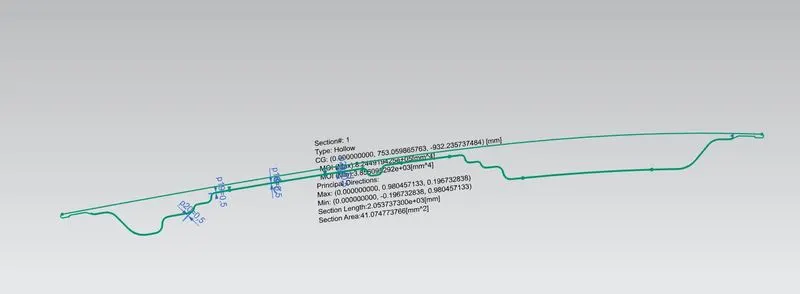
Figure2.1
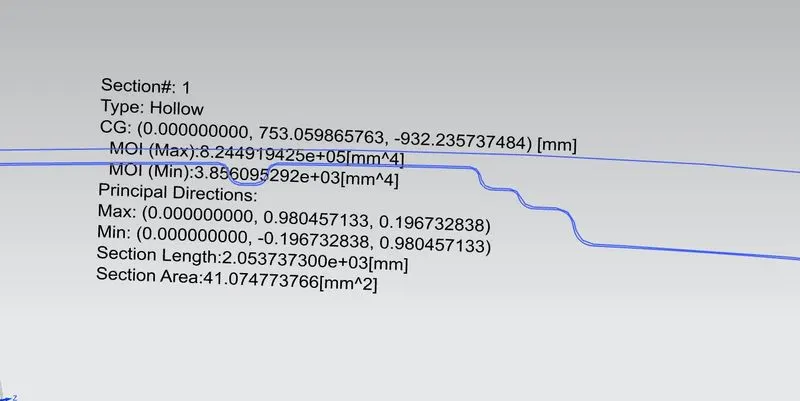
MOI (max) = 8.244919425e +05[mm^4]
MOI (min) = 3.856095292e+03[mm^4]
As per the section modulus equation,
S = I/Y
I = MOI (min) value is considered
Y = Total distance /2, Total distance = 487.25mm
Y = 487.25/2
= 243.625mm
Therefor, S = 3856.095292 mm^4/243.625mm
S = 15.82mm^3
Conclusion:
Resulting by comparing case1 and case2
1.The section modulus value of case 2is higher then the case1
- As we increase the section area the moment of inertia and section modulus increase which means strength and load material also increases. Which is moment of inertia directly proportional to the strength of material.