Section Modulus calculation and optimization
Aim
To calculate the section modulus of the previously designed hood for analyzing its strength and also optimizing the design to see the difference in the bending strength of the hood. Higher the section modulus of a structure, the more the resistive it becomes to bending.
Section modulus
Section modulus is a geometric property for a given cross-section used in the design of beams or flexural members, it is also referred to as the Polar Modulus or the Torsional Sectional Modulus.
S=I/Y
Here,
S = Section modulus
I= Moment of Inertia (Unit mm 4)
Y= Distance from Neutral axis to the extreme end (unit mm)
The Unit of a “section modulus” is (mm3)
In Layman's terms, in this position there is more material from axis to the specific direction, to resist the load which makes less bend amd improves the strength.
Some of the section modulus equations are attached
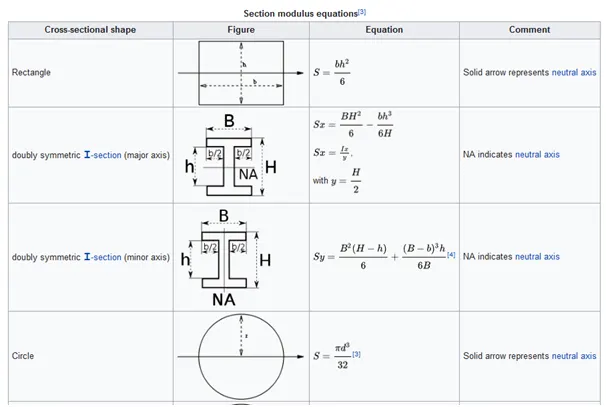
Elastic section modulus
For general design, the elastic section modulus is used, applying up to the yield point for most metals and other common materials.
The elastic section modulus is defined as S = I / y, where I is the second moment of area (or area moment of inertia, not to be confused with moment of inertia) and y is the distance from the neutral axis to any given fibre. It is often reported using y = c, where c is the distance from the neutral axis to the most extreme fibre, as seen in the table below. It is also often used to determine the yield moment (My) such that My = S × σy, where σy is the yield strength of the material.
Case 1:
Section modulus has been calculated for existing hood design and the observations will be as follows:
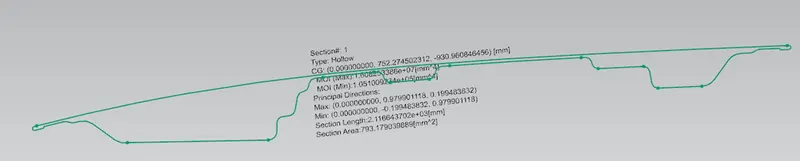
Moment of inertia(min) = 1.0510×10^5×mm^4
Y=485.7599/2=242.8799 mm
S=I/Y
S=1.0510×10^5/242.87= 432.759 mm^3
Case 2 (Hood design optimization)
I've offsetted the lower panel by 0.3 mm and recalculated the section modulus.
The observations will be as follows

Moment of inertia(min) = 1.065×10^5×mm^4
Y=485.7599/2=242.8799 mm
S=I/Y
S=1.065×10^5/242.87= 438.524 mm^3
| S.No | Hood case 1 Existing design | Hood case 2 Offset by 0.3 mm | Result |
| Section Modulus (mm3) | 432.759 mm^3 | 438.524 mm^3 |
The section modulus has been optimised from 438.524-432.759 = 5.765 mm^3 in case 2 (lower panel offsetted by 0.3 mm) |
Conclusion:
So, here the difference can be seen in the moment of inertia and the change in the section modulus can be seen by the change in the design(depth).