Section Modulus calculation and optimization
Section Modulus
The ratio of the moment of inertia about the neutral axis to the section's furthest point from the neutral axis is known as the section modulus.
S stands for the section modulus. S=I/Y,
where I is the moment of inertia and
Y is the distance to outermost boundary from neutral axis, is the formula for the elastic section modulus.
Finding the distance (y) from the centroid (or neutral axis) to the extreme structure of the boundary is necessary to determine S since there is where the largest stress could lead to failure. A beam will be stronger and able to carry heavier loads if it has a bigger section modulus than another beam.
Calculation of Section Modulus
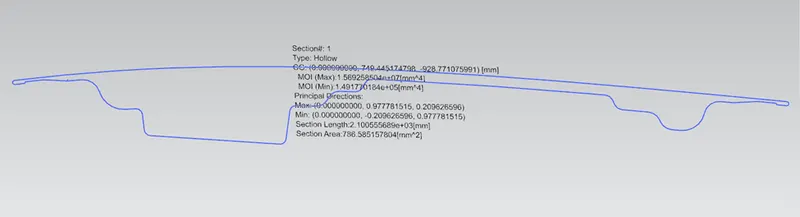
On calculating y which is L/2. Here total section length, L = 486.8275 mm. Hence y = 243.41 mm.
Now, from above diagram min. MOI, I = 1.492e5 mm^4
Therefore, Section Modulus, S = I/y = 612.95 mm^3
Optimization
To increase the strength of the part, there is an emboss created in the sketch and section modulus is calculated for it.

Now, from above diagram min. MOI, I = 1.513e5 mm^4
Section Modulus, S = I/y = 621.58 mm^3
Conclusion -
Hence, we can say that with increase in area, the moment of inertia increases which leads to increase in section modulus of the hood and the strength of hood increases.
To refer the part, you can go to my submitted hood assembly.