Section Modulus calculation and optimization
AIM-
Use the Section from your Hood design and calculate the section modulus using the formula S = I/y
S = Section Modulus
I = Moment of Inertia
y = distance between the neutral axis and the extreme end of the object
Come up with a new section that has improved the section modulus of the previous section and mention what change you made that has increased the strength.
. Moment of inertia is nothing but offering resistance against of moment, bending or twisting, i.e if we applied any external load on the body, how much resistance its offering to tend to deform.
• So, higher the value of moment of inertia, have higher resistance to deform under certain load, hence we can say that moment of inertia directly proportional to the strength of the material, and strength of the material can be calculated with the help of section modulus.
If we vary the neutral axis towards positive or negative side the overall strength of the body will decrease, because when nuetral axis line lies on the middle of the section only have higher strength at particular point, so, here 'Y' value was inversely proportional to section modulus.
Thats why formula represented as above.
By using the same principle i going to calculate the strength of an hood panel.
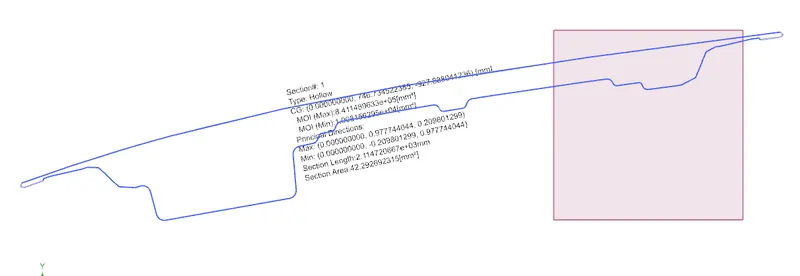
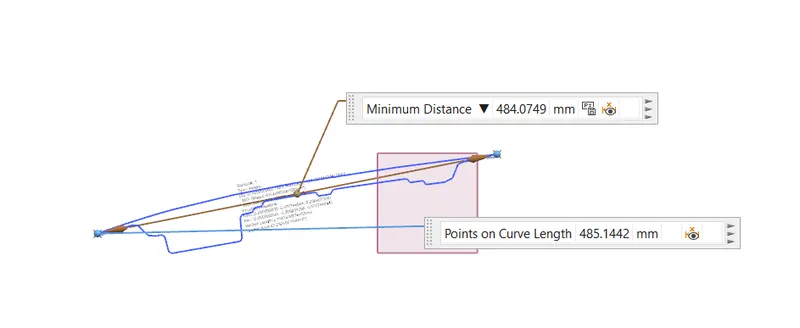
Here the moment of inertia was calculated by using the NX-software obtained values are
I Max :-8.411489633x105mm4
I min:-1.008156295x104 mm4
Total length of 'Y' value was 488.8252mm
So, that neutral axis we need 'Y' value:- Y/2=484.0749/2=242.03745 mm
1)Section modulus (S):- I/Y=8.411489633x105mm4/242.03745 mm
=3.475X10³mm³ (Maximum strength).
2) Section modulus (S):- I/Y=1.008156295x104 mm4/242.03745mm
=0.004165x10³mm³ (minimum strength).
So the strength of an hood varies from 0.04165x10³mm³to 3.475X10³mm³
Now, one more trail is that, here the inner panel curve offsetting outside by 2 mm i.e increasing in cross sectional area, the results shown below.
2nd Result
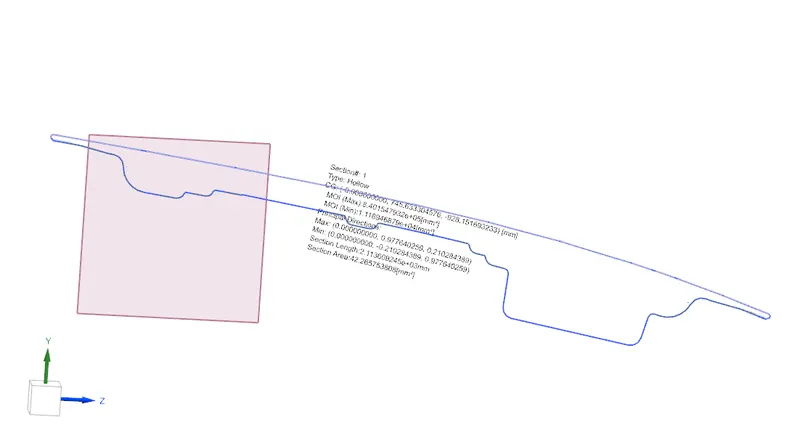
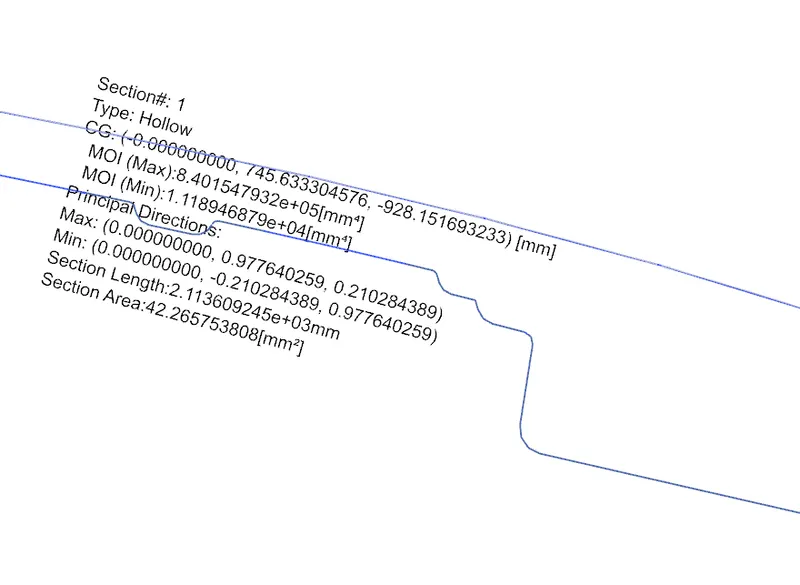
IMAX- 8.401547932X10⁵
I MIN-1.118946879 X 10⁴
Y=484.0749/2=242.03745 mm
1)Section modulus (S):- I/Y=8.401547932x105mm4/242.03745 mm
=3.471X10³mm³ (Maximum strength).
2) Section modulus (S):- I/Y= 1.118946879x104 mm4/242.03745mm
=0.04623x10³mm³ (minimum strength).
So the strength of an hood varies from 0.04623x10³ mm³to 3.471X10³mm³
• So, here when comparing both the hoods there is changes in both MAX and MIN strength values, what i came to know that when i increased sectional area by Imin the value of minimum strength was increased from 0.04165x10³mm³ to 0.04623x10³mm³, Hence with increase in cross sectional area results in increase in strength.
• But, when we seen the value of maximum strength its slightly decreases from 3.475X10³mm³ to 3.471X10³mm³,i think this due to design of hood, here what we want to know that when increase in cross sectional area there will be increase in minimum strength or maximum strength or increase in both.
• So Newton's first law also explains that if higher the mass, the force required to move the object is also high due to offering more resistance in order to move the object, This resistance we called it as a MOMENT OF INERTIA.
• In case of hood also same principle will work, i.e when increase in cross sectional area by Imm the minimum load carrying capacity or strength was increased by approximately 8% percentage what we observed from the above discussion.
• The strength of the material also depends upon the composition of material,thickness and cross sectional area of an object.
CONCLUSION:
The strength of the material is directly proportional to the moment of inertia, hence increase in sectional area there is have increase in overall mass of an object,hence have increase in strength.