Section Modulus calculation and optimization
AIM: Section modulus of the previously designed hood must be calculated, and some modification must be done to increase the section modulus which in turn increase the strength and turns out to be more resistive to bending.
INTRODUCTION:
Section Modulus
- It is the ratio of total moment resisted by the section to the distance from the neutral axis to the outer surface.
- It gives us an idea about how much of load the given structure can take.
- if the section modulus increases the moment of resistance increases and hence its load bearing capacity.
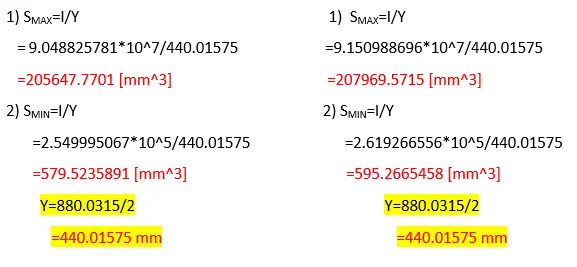
Section modulus can be found using the formula given S = I / Y
where,
S- Section Modulus
I - Moment of inertia value from the inertia analysis
Y - Distance from neutral axis to outermost surface. In this case we will take it from the centre to the outer edge of hemmed outer panel.
PROCEDURE:
CASE 1:
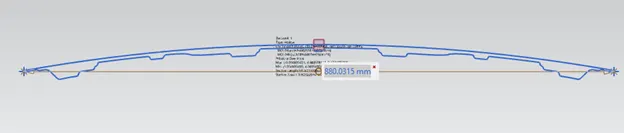
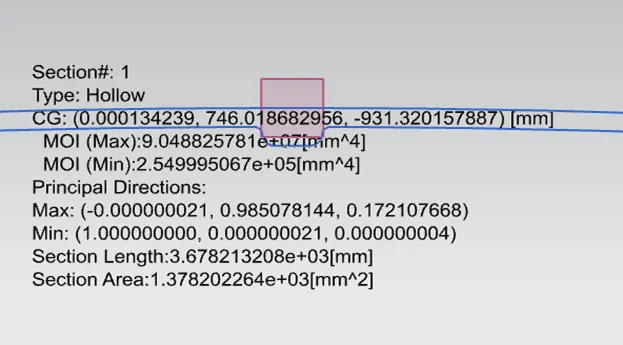
- To the previously designed hood we need to create a intersection curve selecting the outer and inner panel
- Once the intersection curve is projected to the pre-defined plane certain modifications is made to make it into a closed loop.
- Finally carry out the section modulus Analysis
CASE 2:
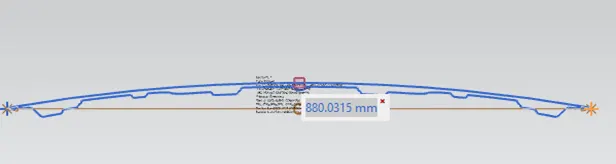
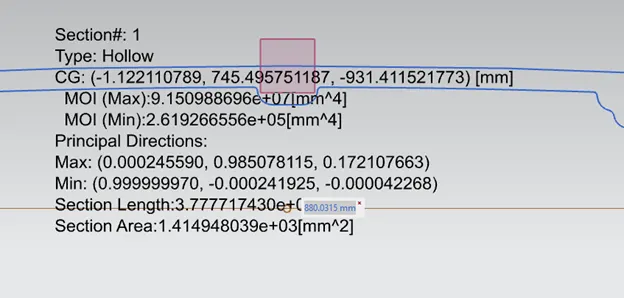
- The modified sketch from Case 1 is copied.
- From the copied sketch the inner panel in offset by 1.1 mm.
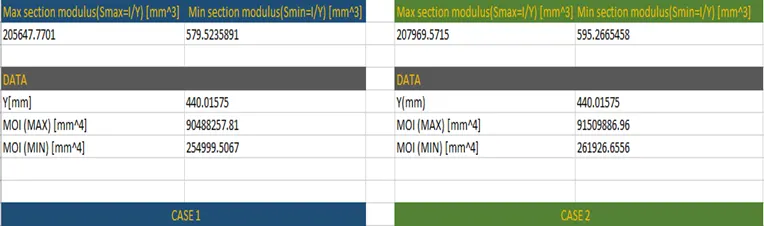
- The section modulus Analysis carried out once again after the modification are done and we can observe that the section modulus has been increased after the increase in the sectional area this this in turn increase the strength and turns out to be more resistive to bending.
RESULT:
It was proved that by increasing the sectional area there was increase in the strength.
Difference after modification
- SMAX=I/Y (case 2) - SMAX=I/Y (case 1)
=207969.5715-205647.7701
= 2321.8014 [mm^3]
- SMIN=I/Y (case 2) - SMIN=I/Y (case 1)
=595.266548 - 579.5235891
=15.743024909 [mm^3]