Section Modulus calculation and optimization
SCETION MODULES CALCULATION AND OPTIMIZATION
OBJECTIVE
The primary objectives of this project are,
- To calculate the Section Modulus of a pre Designed hood
- To learn how to Optimize the Section modulus to better values.
INTRODUCTION
Here in this project we are going to calculate and optimize the section modules of the hood that we are created in the previous project. Before that lets discuss what is section modules and what is moment of inertia
Section modules
The moment carrying capacity of an object is directly dependent on geometrical property (I) and material property (E) of an object ,which is collectively termed as flexural rigidity(EI).Geometry of an object plays an important role in load bearing capacity of an object which is indicated by moment of inertia of a section. Therefore section modulus is the predominant factor which evidences the strength of an object and is defined as the ratio of the moment of inertia of the object about its centroidal axis to the distance of the extreme fibers/end of the object from the neutral axis..
Section modulus is indicated as follows:
S=I/y -----(1)
Here
I - moment of inertia” and
y -is distance from “neutral axis” to extreme end of the structure.
Unit of a “section modulus” is in.(mm3).
Section modulus depends only on the cross section shape of the structure.
For symmetric sections, the value of “section modulus” is for both above and below of centroid of the structure.
An asymmetric section has two values for top and bottom of the fiber due to different distance from centroid to the top and bottom of the material, the maximum “section modulus” is S m ax and the minimum section modulus is S min.
What is moment of inertia ?
Area moment of inertia also known as second area moment or 2nd moment of area is a property of a two-dimensional plane shape where it shows how its points are dispersed in an arbitrary axis in the cross-sectional plane. This property basically characterizes the deflection of the plane shape under some load.
Area moment of inertia is usually denoted by the letter I for an axis in a plane. It is also denoted as J when the axis lies perpendicular to the plane. The dimension unit of second area moment is Length to the power of four which is given as L4. If we take the International System of Units, its unit of dimension is meter to the power of four or m4. If we take the Imperial System of Units it can be inches to the fourth power, in4.
We will come across this concept in the field of structural engineering often. Here the area moment of inertia is said to be the measure of the flexural stiffness of a structure
If we consider the second moment of area for the x-axis then it is given as;
Ix = ∫ y2 dA -------- (2)
where
Ix = Area Moment of Inertia related to the x axis (m4, mm4, inches4)
y = the perpendicular distance from axis x to the element dA (m, mm, inches)
dA = an elemental area (m2, mm2, inches2)
The Moment of Inertia for bending around the y axis can be expressed as
Iy = ∫ x2 dA --------- (3)
where
Iy = Area Moment of Inertia related to the y axis (m4, mm4, inches4)
x = the perpendicular distance from axis y to the element dA (m, mm, inches)
PROCEDURE
Section modulus calculation
For calculating the section modulus First of all we need to creatr the section sketch of the Hood .For that I have created a plain at the center of the hood as it intersects the hood perpendicularly.
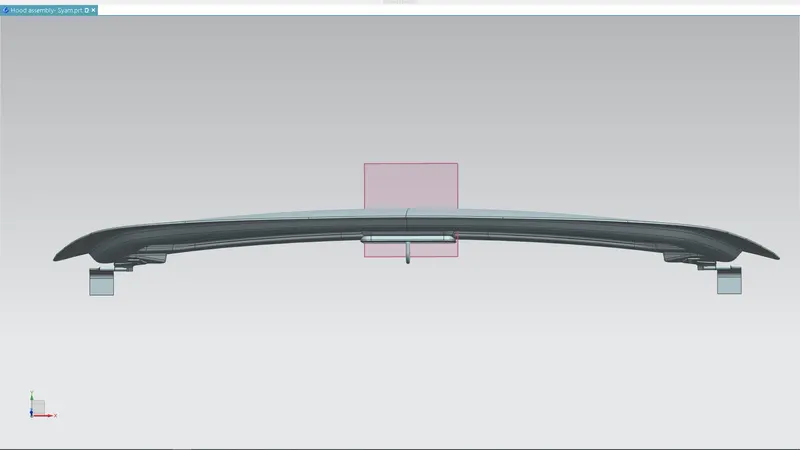
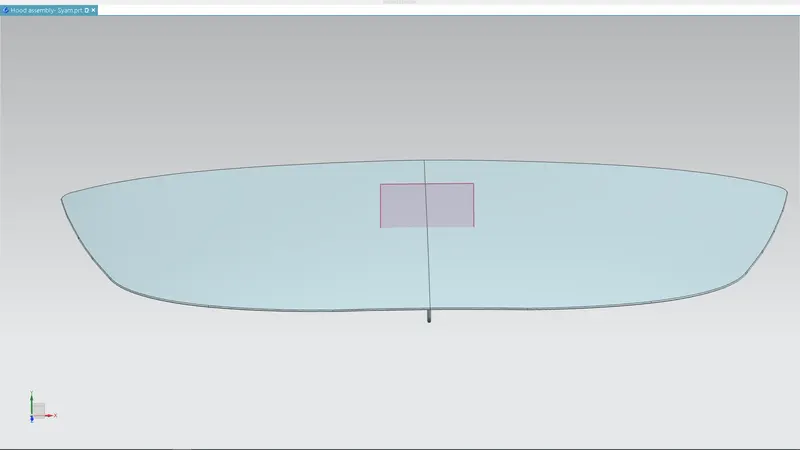
Create the 2D sketch of the section using the intersection curve command.
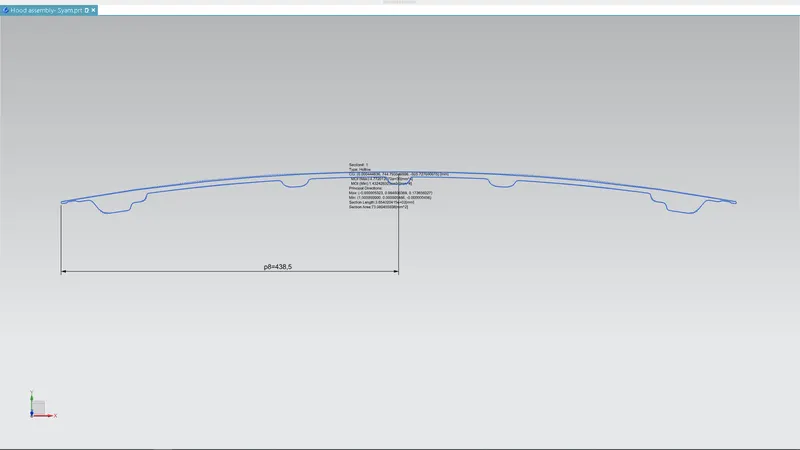
Using the command “ SECTION INERTIA ANALYSIS” find the Moment of inertia of the section. Here we need not to find the Inertia manually.
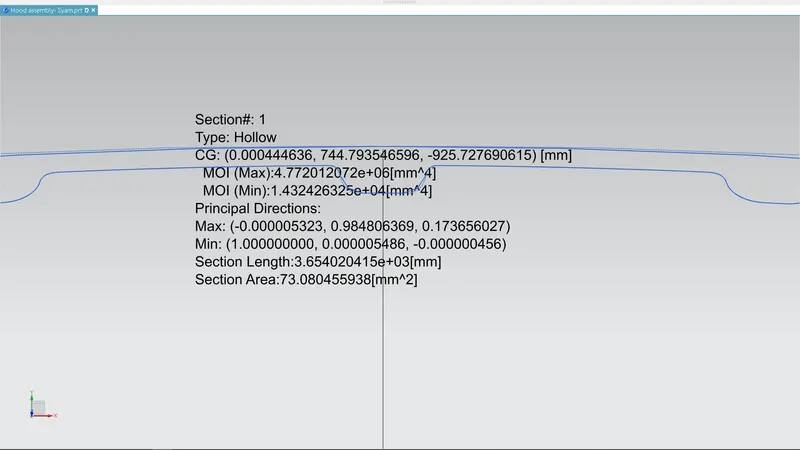
By taking the Y as the distance from center of the hood to one of its extreme edge , calculate the Section modulus using the equation . We are taking the Imin as the moment of inertia. So we have
S = I/y
Where
Imin = 1.432426325e+04[mm4] = 1.432426325*10^4 = 14324.263 mm4
y =438.5 mm
S= I/y = 14324.263 / 438.5
=32.666 mm3
Optimization
From the above equation (2) we under stood that The cross sectional area is directly proportional to the moment of inertia and the there by the section modules.
By increasing the cross sectional area of the hood, it s easily possible to increase the section modules of the hood.
So I have decided to increase the section modules of the Hood by Increasing the depth of the emboss about 0.4 mm as depicted below. While increasing the emboss depth we must consider to maintain
- To maintain the minimum required distance from the engine compartment to the hood inner panel
- To maintain the distance of mastic point from the outer panel in between 4-6 mm
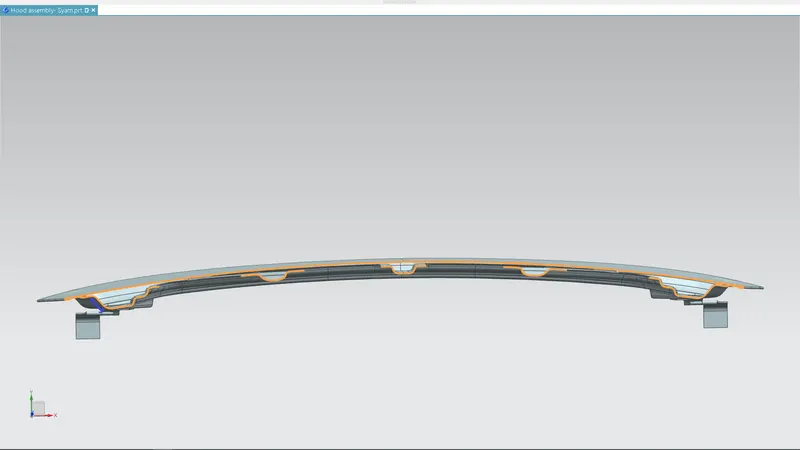
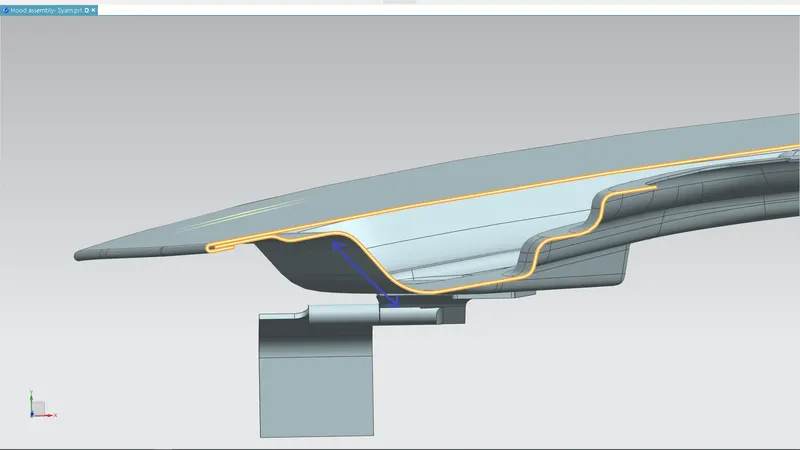
Increasing the depth of emboss by 0.4 mm doesn’t effect those two factors mentioned above. So I have Increased the depth of emboss and again calculated the section modulus
Now
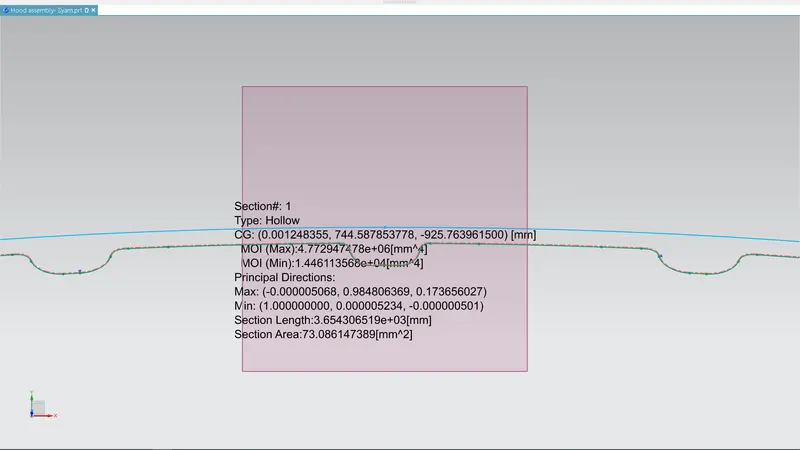
Imin = 1.446113565e+04[mm^4] = 1.446113565 * 10^4 = 14461.135 mm4
Y = 438.5 mm
S= I/y = 14461.135 / 438.5
=32.978 mm3
CONCLUSION
The section modulus of the Hood has been calculated and optimized successfully and there by learned how to optimize the sectiom modulus of a component effectively