Section Modulus calculation and optimization
Aim
To calculate the section modulus of the previously designed hood for analyzing its strength and also optimizing the design to see the difference in the bending strength of the hood. Higher the section modulus of a structure, the more the resistive it becomes to bending.
Section modulus
The section modulus is a crucial geometric property utilized in the design of beams or flexural members. It goes by other names like the Polar Modulus or the Torsional Sectional Modulus. In the design process, various geometric properties come into play, such as area (for tension and shear), radius of gyration (for compression), and moment of inertia, along with polar moment of inertia (for stiffness). The relationships between these properties heavily rely on the specific shape under consideration. Below, you'll find equations for the section moduli of common shapes. Two types of section moduli are recognized: the elastic section modulus and the plastic section modulus. Each plays a significant role in the design and analysis of structures.
S=I/Y
Here,
S = Section modulus
I= Moment of Inertia (Unit mm 4)
Y= Distance from Neutral axis to the extreme end (unit mm)
The Unit of a “section modulus” is (mm3)
First Design Study
The Intersection of the design was taken and then section Inertia Analysis was done-
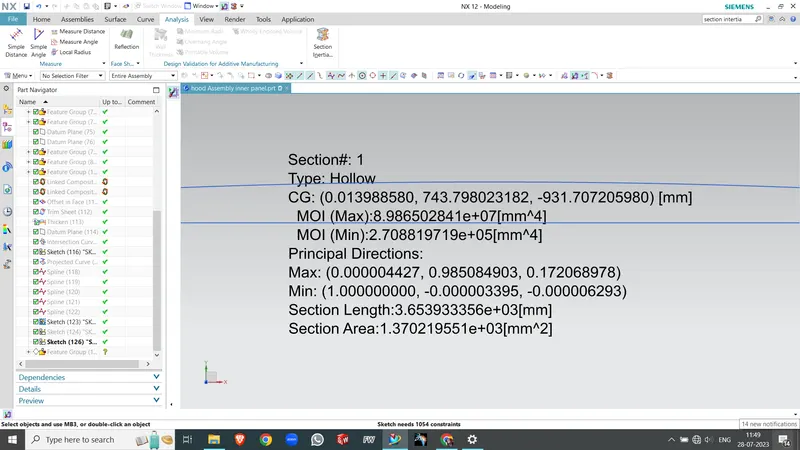
Moment of inertia(max) = 8.986502841×10^7×mm^4
Moment of inertia(min) = 2.7088197×10^5×mm^4
Y=879.6089 mm/2 = 439.80445 mm
S=I/Y
S= 2.7088197×10^5 / 439.80445= 615.914 mm^3
Hood Design Optimization
By increasing the depth of the inner panel by 0.6 mm
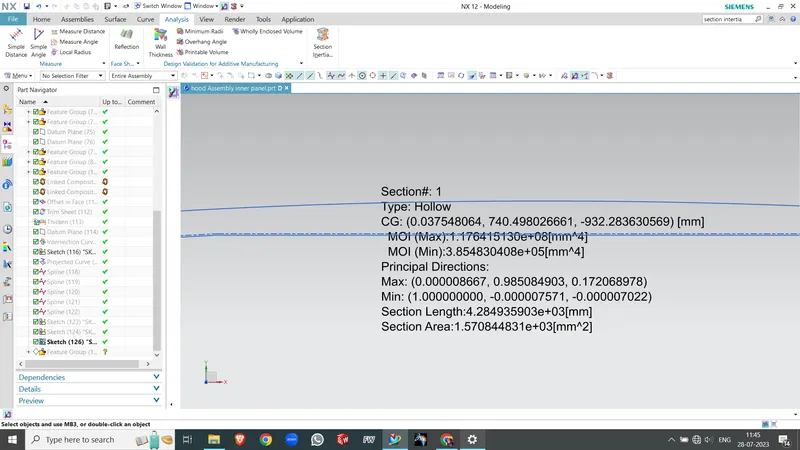
Here,
Moment of inertia(max) = 1.176415130×10^8×mm^4
Moment of inertia(min) = 3.854830408×10^5×mm^4
Y=879.6089 mm/2 = 439.80445 mm
S=I/Y
S=3.854830408×10^5 / 439.80445 = 876.487358871 mm^3
Conclusion
So, here the difference can be seen in the moment of inertia and the change in the section modulus can be seen by the change in the design(depth).