Section Modulus calculation and optimization
Aim
To calculate the section modulus of the hood for analysing its strength and also optimizing the design to see the difference in the bending strength of the hood. Higher the section modulus of a structure, the more the resistive it becomes to bending.
Section modulus
Section modulus is a geometric property for a given cross-section used in the design of beams or flexural members, it is also referred to as the Polar Modulus or the Torsional Sectional Modulus. Other geometric properties used in design include area for tension and shear, radius of gyration for compression, and moment of inertia and polar moment of inertia for stiffness. Any relationship between these properties is highly dependent on the shape in question. Equations for the section moduli of common shapes are given below. There are two types of section moduli, the elastic section modulus and the plastic section modulus.
S=I/Y
Here,
S = Section modulus
I= Moment of Inertia (Unit mm ^4)
Y= Distance from Neutral axis to the extreme end (unit mm)
The Unit of a “section modulus” is (mm^3)
MOMENT OF INERTIA:
Moment of inertia is defined as the quantity expressed by the body resisting angular acceleration which is the sum of the product of the mass of every particle with its square of a distance from the axis of rotation
NEUTRAL AXIS:
The neutral axis is an axis in the cross section along which there are no longitudinal stresses or strains. If the section is symmetric, isotropic and is not curved before a bend occurs, then the neutral axis is at the geometric centroid. All fibres on one side of the neutral axis are in a state of tension, while those on the opposite side are in compression.
eg: When the beam is subjected to pure bending the top most fibers of the beam are subjected to maximum compression, while the bottom most fiber of the beams are subjected to maximum tension.
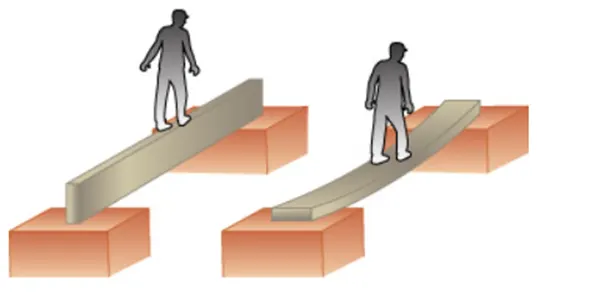
This picture contains the following scene, a Diagram of a beam on its narrow edge supported at both ends. A man is walking on a straight beam. Diagram of a beam resting on its flat side supported at both ends. A man is walking on a straight beam and it's bending in the middle
Usually for calculating the Section Modulus, the most extreme fibre which is the farthest from the neutral axis is considered during the calculations.
The significance of Section Modulus is that it defines the resistance of a body to bending. Higher the value of Section Modulus, the more resistant is the body towards bending.
The procedure for calculating the Section Modulus is as follows:
Case 1: Original cross section of the hood.
Using the Intersection Curve command, the cross section of the hood is obtained
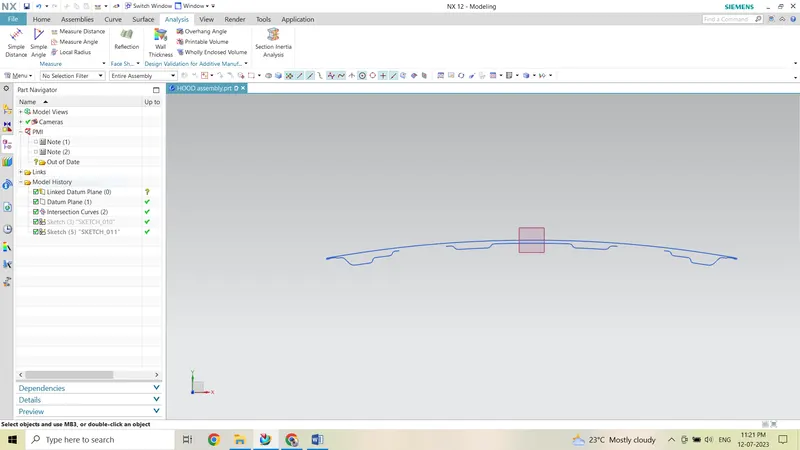
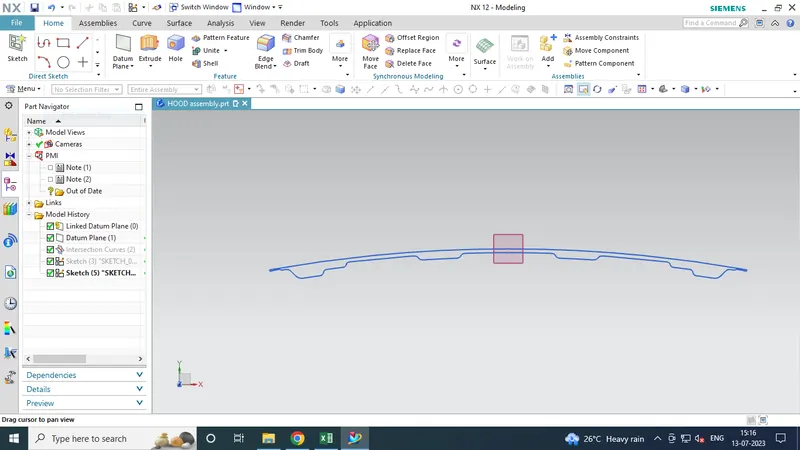
SECTION MODULUS can be find by above case by closing the all curves and making hollow section as given below:
We have to make sure that the curve obtained is a single/closed curve.
Steps to calculate section modulus:-
- Step 1:- Find location of centroid of given cross section.
- Step 2:- Find moment of inertia about neutral axis .
- Step 3:- Find Ymax from neutral axis.
- Step 4:- Find elastic section modulus using the formula provided above.
Moment of inertia is nothing but offering resistance against the moment, bending or twisting. So higher the moment of ineria higher will be its resistance to deform is higher.
Here the sectional modulus of hood design before optimization
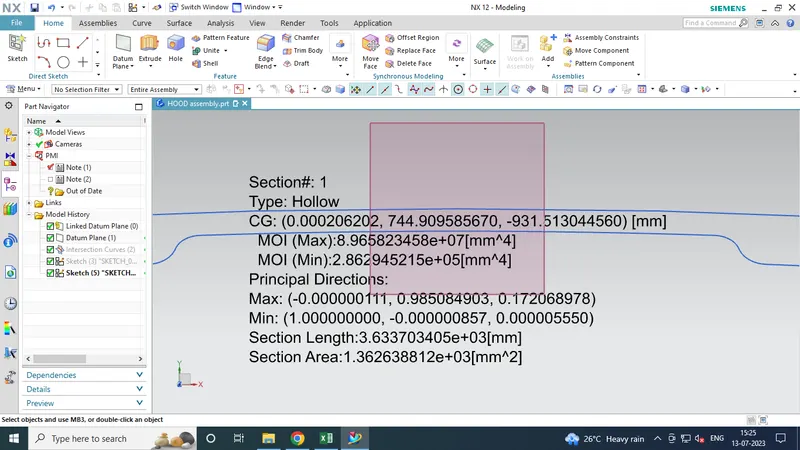
y can be found by measuring extrem ends and divide that distace by 2:
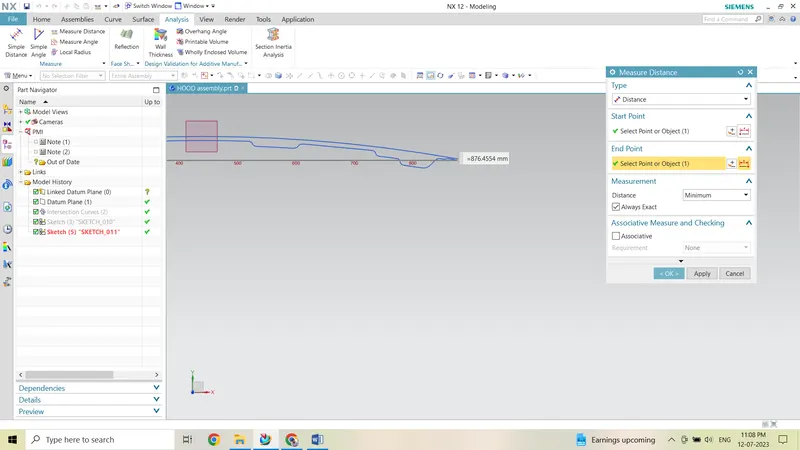
ie, Distance between the neutral axis and the extreme end of the object,y =876.4554/2
=438.23mm.
MOI (max) = 8.965823458e+07 (mm^4)
MOI (min) = 2.862945215e+05 (mm^4)
Section Modulus, S = Moment of Inertia (MOI), I / Distance between the neutral axis and the extreme end of the object(y)
I = MOI (min) value is considered ie, I=2.862945215e+05 (mm^4)
y==876.4554/2 = 438.23mm
S=I/y = 2.862945215e+05 /438.23 = 653.297mm^3
After Optimization:
By increasing the depth of the inner panel by 0.5 mm
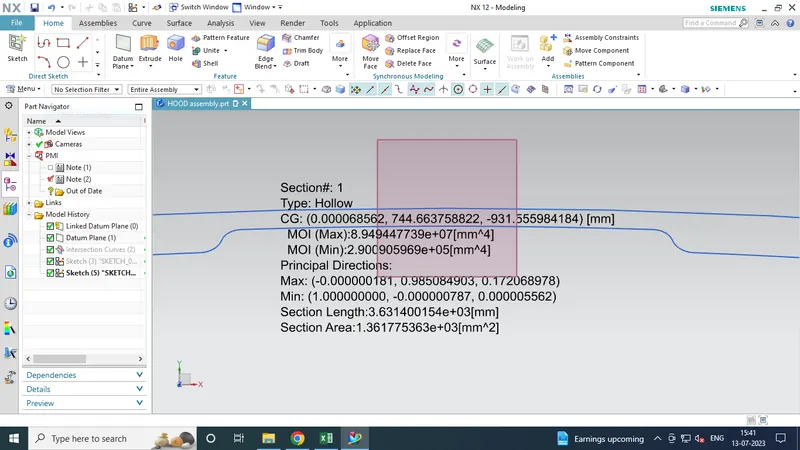
MOI (max) = 8.949447739e+07 (mm^4)
MOI (min) = 2.900905969e+05 (mm^4)
Section Modulus, S = Moment of Inertia (MOI), I / Distance between the neutral axis and the extreme end of the object(y)
I = MOI (min) value is considered ie, I=2.900905969e+05 (mm^4)
y==876.4554/2 = 438.23mm
S=I/y = 2.900905969e+05 /438.23 =661.96 mm^3
Conclusion:-
We have concluded that the more the Inertia value the more the section modulus as both are directly proportional to each other. The more the section modulus, the more the member is resistant to the bending which results in the increased strength of the material.