Section Modulus calculation and optimization
Section Modulus Calculation and Optimization
Objective
The main objective of this project is to learn the basic tools, commands, and the calculation and optimization of the Section Modulus using Siemens NX CAD. The objectives of this project are as follows:
- To understand and learn the basic Graphical User Interface (GUI) of Siemens NX CAD
- To understand and learn the Calculation and Optimization of Section Modulus of Hood Design Using Siemens NX CAD.
Section Modulus
Section modulus is named as the extent of the second preview of an area and distance from N.A (Neutral axis) as far as possible fiber. Similarly, it is the extent of the strength of a given part. The pressing factor in the fringe section of the column is figured with the help of the section modulus. It is appeared by S.
Section modulus has appeared as follows:
S=I/Y
Here, I am the "depiction of inaction" and y is the detachment from the "neutral axis" to the top or lower part of the fiber. There are two sorts of section modulus, the elastic section modulus, and the plastic section modulus. The section moduli of different profiles can moreover be found as mathematical characteristics for ordinary profiles in tables posting properties of such. Section modulus is the numerical property of a given cross-section used in the design of flexural people. Section modulus depends just upon the cross-section condition of the bar or development. For symmetric sections, the value of section modulus is like both above and under the centroid of the cross-section. An upside-down section has two characteristics for the top and lowers part of the centroid, the maximum section modulus (Smax) and minimum section modulus (Smin).
Types of Section Modulus:
- Elastic Section Modulus:
The elastic section modulus is used, applying up to the yield point for most metals and other fundamental materials.
The elastic section modulus is described as S = I/Y, where I is the second moment of area (or area moment of inertia, not to be confused with the moment of inertia) and y is the distance from the neutral axis to some given fiber. It is consistently declared using y = c, where c is the distance from the neutral axis to as far as possible fiber. Moreover, it is consistently used to choose the yielding moment (My) with the ultimate objective that My = S × σy, where σy is the yield strength of the material.
- Plastic Section Modulus:
The plastic section modulus is used for materials where elastic yielding is worthy and plastic behavior is assumed to be a sufficient breaking point. Designs for the most part strive to ultimately stay under as far as possible to keep away from interminable deformations, often looking at as far as possible against intensified forces or stresses.
The plastic section modulus depends on the area of the plastic neutral axis (PNA). The PNA is characterized as the axis that splits the cross-section such that the compression force from the area in compression equals the tension force from the area in tension. So, for sections with constant yielding stress, the area above and under the PNA will be the same, yet this is not necessarily the situation for composite sections.
The plastic section modulus is the sum of the areas of the cross-section on each side of the PNA (which could be the same) increased by the distance from the local centroids of the two areas to the PNA:
Zp=AcycATyT
The Plastic Section Modulus can also be known as the 'First moment of area'.
The plastic section modulus is used to calculate the plastic moment, Mp, or full constraint of a cross-section. The two terms are associated with the yield strength of the material in question, Fy, by Mp=Fy*Z. Plastic section modulus and elastic section modulus are associated with a shape factor which can be signified by 'k', used for a sign of cutoff past the elastic furthest reaches of the material. This could be shown mathematically with the formula:-
k=Z/S
Significance of Section Modulus:
- Section modulus is the important factor for the design of the bar and flexural part
- The higher the worth of section modulus, the higher will be the resistance of part to bending
- It is expected to calculate stresses in beams.
- It is used to calculate the strength of the steel structure
- More the section modulus can withstand more load and is also considered to be more earnestly.
Section Modulus Calculation and Optimization:
- Hood Main Design:
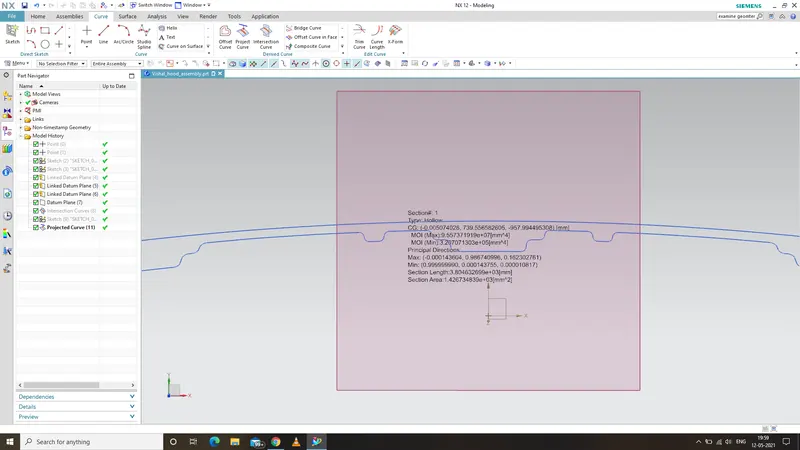
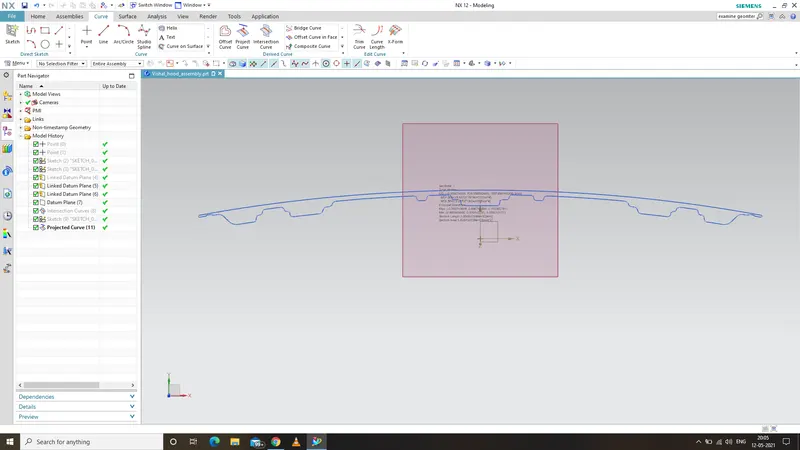
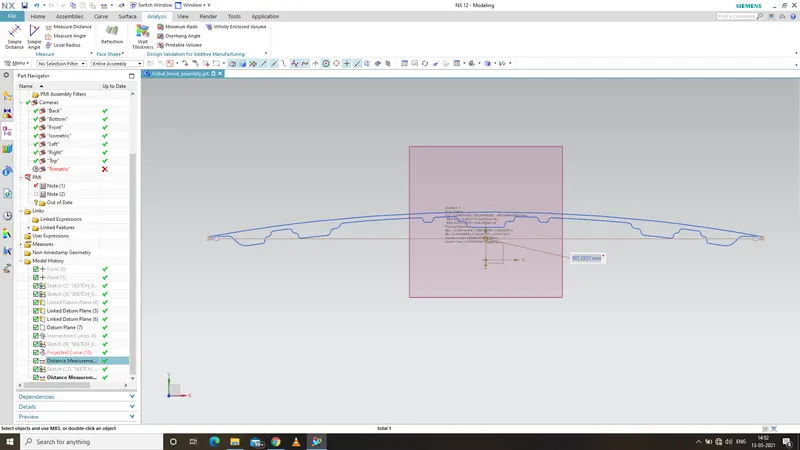
Calculation of Section Modulus of main Hood:
Moment of Inertia (MOI), Imax = 9.557371919 x 10^7 [mm^4]
Moment of Inertia (MOI), Imin = 3.207071303 x 10^5 [mm^4]
Distance between the neutral axis and the extreme end of the object, y = 887.0357 mm / 2 = 443.51785 mm
Section Modulus, S = Moment of Inertia (MOI), I / Distance between the neutral axis and the extreme end of the object (y)
S = I/y
For Maximum (MOI),
S = (9.557371919 x 10^7 mm^4) / (443.51785 mm)
S= 21.5490130081574 x 10^4 mm^3
For Minimum (MOI),
S = (3.207071303 x 10^5 mm^4) / (443.51785 mm)
S= 0.7230985862 x 10^3mm3
- Hood Optimized Design:
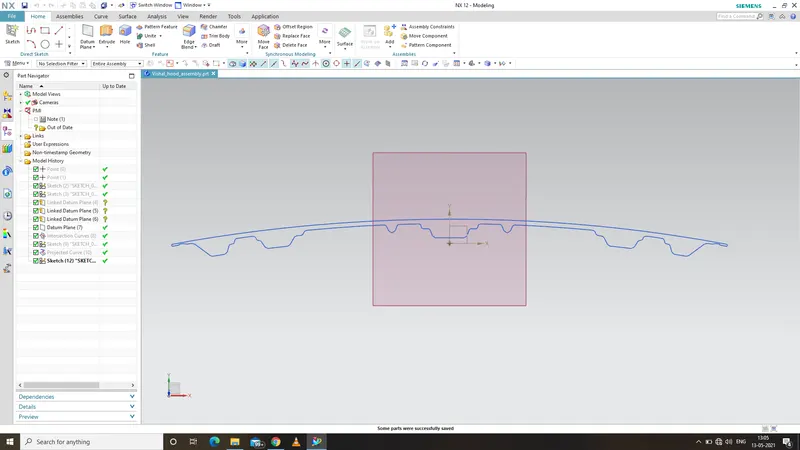
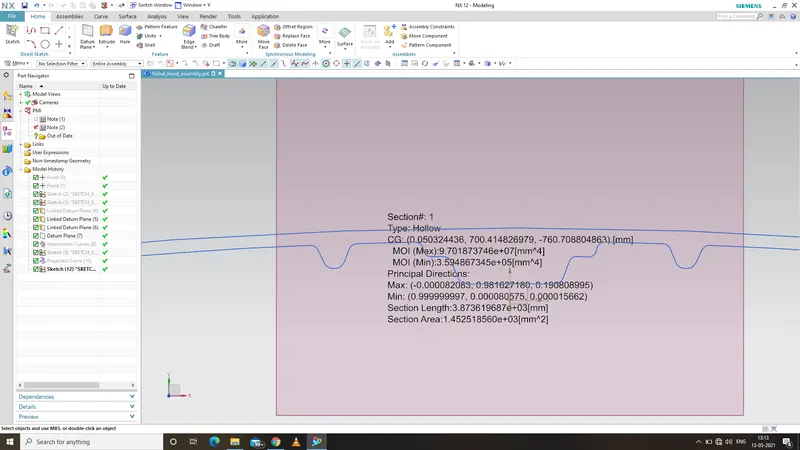
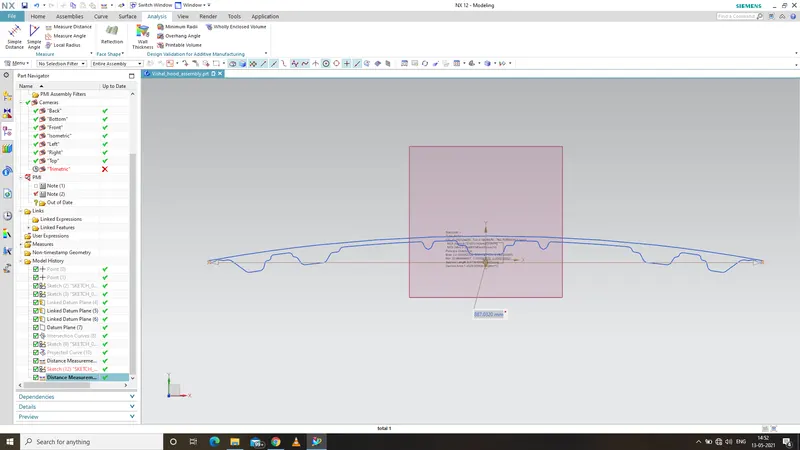
Calculation of Section Modulus of Optimized Hood:
Moment of Inertia (MOI), Imax = 9.701873746 x 10^7 [mm^4]
Moment of Inertia (MOI), Imin = 3.594867345 x 10^5 [mm^4]
Distance between the neutral axis and the extreme end of the object, y = 887.0357 mm / 2 = 443.51785 mm
Section Modulus, S = Moment of Inertia (MOI), I / Distance between the neutral axis and the extreme end of the object (y)
S = I/y
For Maximum (MOI),
S = (9.701873746 x 10^7 mm^4) / (443.51785 mm)
S= 21.87482138 x 10^4 mm^3
For Minimum (MOI),
S = (3.594867345 x 10^5 mm^4) / (443.51785 mm)
S= 0.8105349864 x 10^3
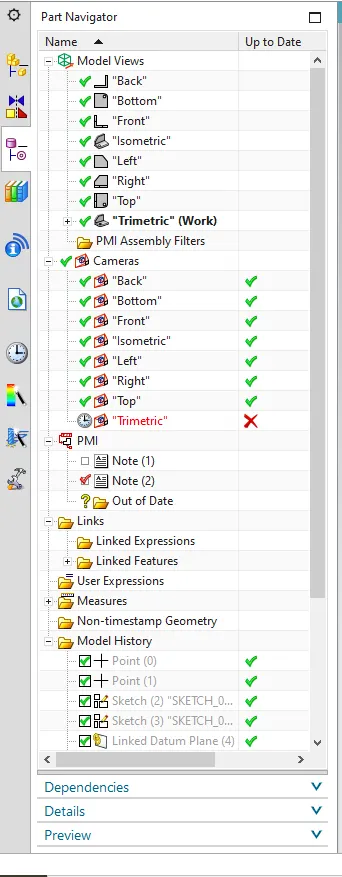
- Part Navigator 1
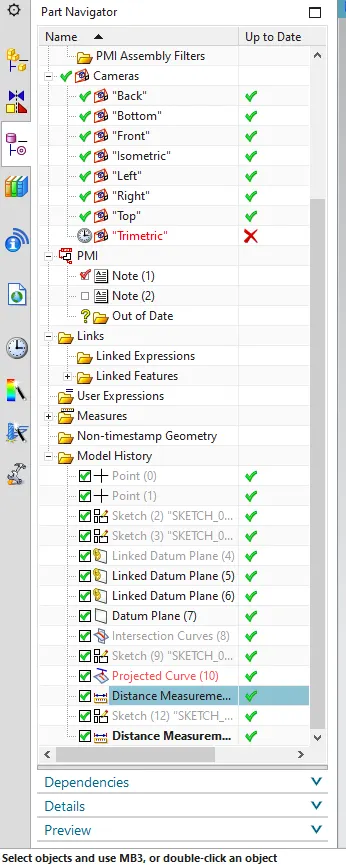
- Part Navigator 2
Conclusion:
Subsequently, the part modulus of the Front Hood of a vehicle was resolved and differentiated, and the improved hood and found the better result. In this manner, I'm gathering that when the sectional space of the hood fabricates the stiffness and resistance of the hood strength will in like manner be expanded.