Section Modulus calculation and optimization
Section Modulus Calculation and Optimization
Introduction:
- Section modulus is a property of cross section of a beam.
- The strength of the beam depends on section modulus.
- From Bending Moment equation, section modulus is directly proportional to the Moment of Inertia. So if the Moment of Inertia is higher section modulus will also be higher.
Bending Moment Equation:
The following assumptions to be made for bending moment equation,
- Material of the beam is perfectly homogeneous.
- Stress induced is directly proportional to the strain and at no place the stress exceeds the elastic limit.
- The value of Modulus of Elasticity (E) is same for the fibres of the beam under compression or under tension.
- The transverse section of the beam, which is plane before bending, remains plane after bending.
- There is no resultant pull or push on the cross-section of the beam.
- The loads are applied in the plane of bending.
- The transverse section of the beam is symmetrical about a line passing through the centre of gravity in the plane of bending.
- The Radius of Curvature of the beam before bending is very large in comparison to its transverse dimensions.
By considering all the above assumptions bending moment equation is derived as
M/I = σ/y = E/R
Where M is Moment of Resistance,
I is Moment of Inertia of the section about neutral axis
E is Young’s modulus of elasticity
R is Radius of curvature
σ is Bending Stress
y is Maximum distance between Neutral axis and end point.
Section Modulus (Z):
Section Modulus from bending moment equation is
Section Modulus, Z = I/y
Section Modulus Calculation:
1. Original Hood Design:
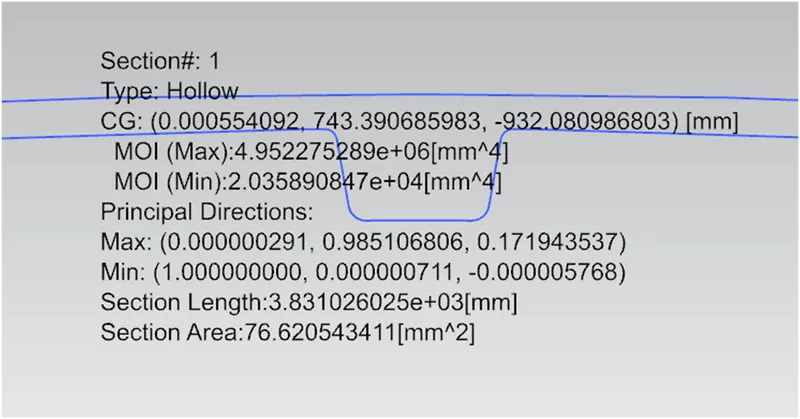
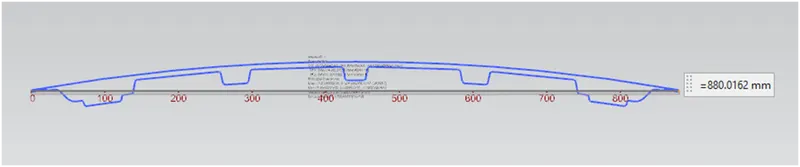
For the original hood design , the moment of Inertia for both minimum and maximum condition has been calculated and maximum distance between neutral axis and end point of the section of the hood also been measured. By using all the above details we can calculate section modulus of the original hood design.
Minimum MOI = 2.03x104 mm4
Distance d1 = 880.02mm, y1 = d/2, y1 = 880.02/2 = 440.01mm
Section Modulus of original hood, Z1 min = 2.03x10⁴/440.01 = 46.13mm3
2. Modified Hood Design:
To increase the section modulus, moment of inertia to be increased. The moment of inertia can be increased by increasing the cross section area. So curve has been offset to 0.5mm to increase cross section area. Now the optimized section modulus can be calculated.
Minimum MOI = 2.06x104 mm4
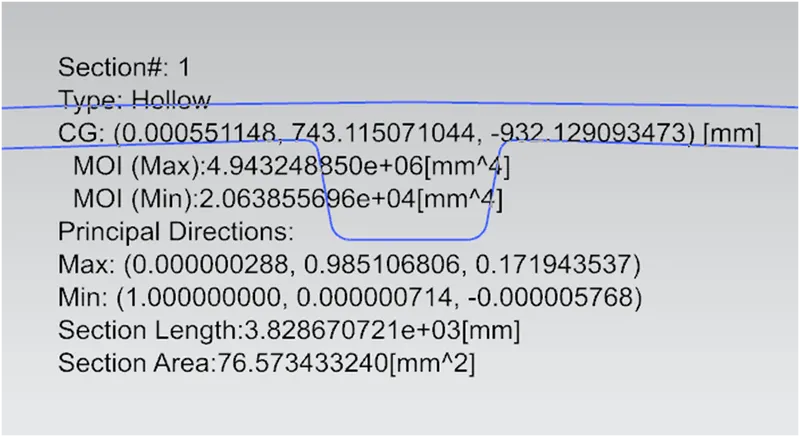
Distance d2 = 880.02mm, y2 = d/2, y2 = 880.02/2 = 440.01mm
Section Modulus of modified hood, Z2 min = 2.06x10⁴/440.01 = 46.82mm3
Conclusion:
By comparing the above two results, Section modulus of the modified hood (46.82mm3) is greater than original hood (46.13mm3) due to increase in cross section. So the strength of the modified hood is higher than the original hood.