Section Modulus calculation and optimization
Section modulus is the ratio of moment of inertia about neutral axis upon the farthest point
of section from neutral axis.
A beam that has a larger section modulus than another will be stronger and capable of
supporting greater loads, The section modulus is denoted by S. To calculate S, the distance
(y) to the extreme structure of boundary from the centroid (or neutral axis) must be found as that is where
the maximum stress could cause failure.
S = I/Y(max)
For general design, the elastic section modulus is used, applying up to the yeild point of most
metals and other common metals.
The elastic section modulus is defined as S= I/Y, where I is the moment of inertia and Y is
the distance from neutral axis to the outer most boundary.
It is often used as Y=c, where c is the distance of boundary from neutral axis. It can also be
defined from yield moment given by equation-
My=S⋅σy
where σyis the yield strength of material.
SIGNIFICANCE OF SECTION MODULUS:
- Section modulus is the important factor for design of beam and flexural member design.
- More the section modulus, more the member is resistant to bending of the beam.
- It is easier to calculate stresses in beam and an exact measure of strength of steel.
- If two beams are made of same material and comparing the “section modulus” of two
beams, the beam with bigger section modulus will be tougher and more capable to
withstand larger loads.
CALCULATION:
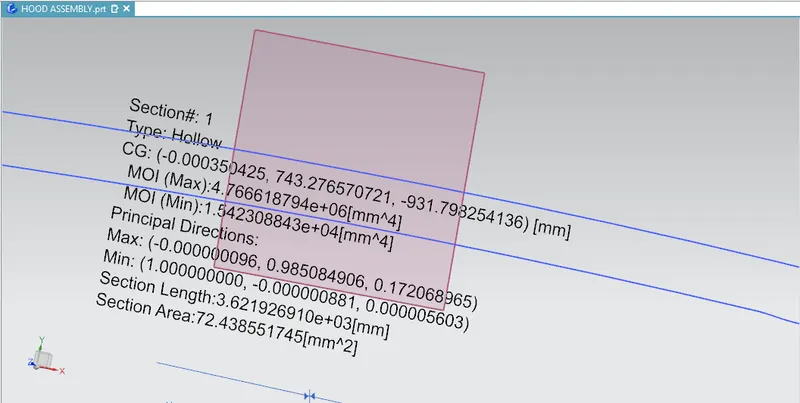
Initial moment of inertia is 1.542308843e+04[mm^4].
To find out section modulus
S=I/Y
Here, I is “moment of inertia” and y is distance from “neutral axis” to top or bottom of fiber.
Unit of a “section modulus” is mm^3
S α I
Y=439.96225 mm
S= 0.0035055481305498e+04 mm^3
MODIFIED SECTION MODULUS:
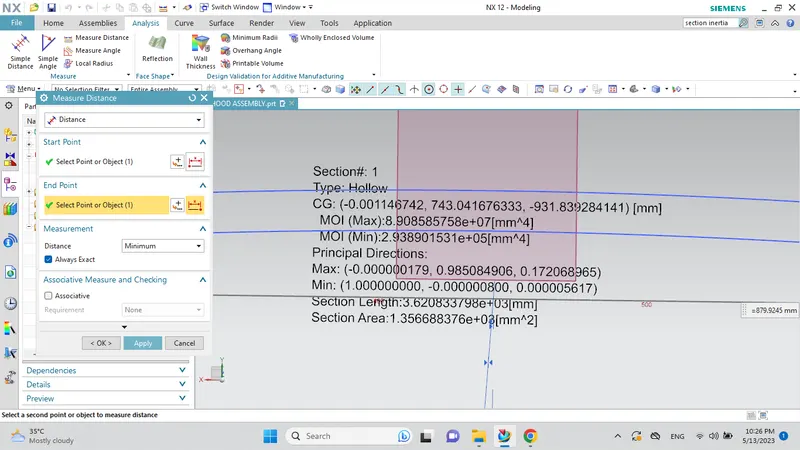
Initial moment of inertia is 2.938901531e+04[mm^4].
To find out section modulus
S=I/Y
Here, I is “moment of inertia” and y is distance from “neutral axis” to top or bottom of fiber.
Unit of a “section modulus” is mm^3
S α I
Y=439.96225 mm
S= 0.0066798947659714e+04 mm^3
Therefore, a small modification in Sectional area, results to variation of section modulus
between initial and and New hood is about 0.0031743466354216e+04 mm^3.