Section Modulus calculation and optimization
AIM: To understand concept of section modulus and its optimisation in car design.
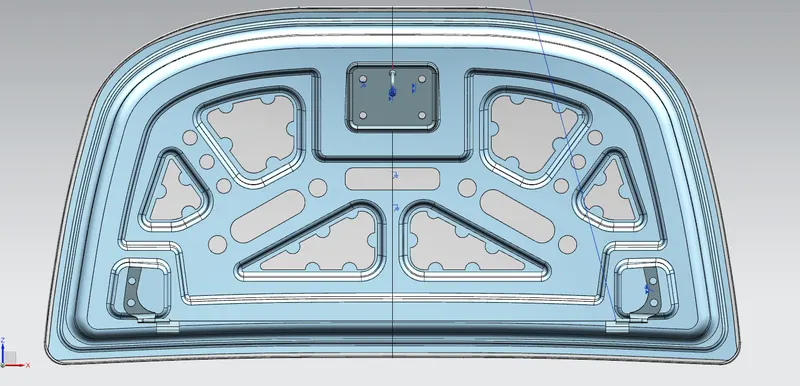
Introduction:
Section modulus is a geometric property that represents a structural member's resistance to bending. In car design, the section modulus is an important parameter that helps determine the strength and stiffness of different parts of the vehicle, such as the chassis, suspension components, and body panels.
In general, higher section modulus values indicate greater strength and stiffness, which are important factors for improving vehicle safety, stability, and handling. For example, a car with a high section modulus chassis will be less likely to deform or buckle in the event of a crash, which can help protect the occupants.
Optimizing the section modulus in car design involves finding the right balance between strength and weight. By using materials with higher strength-to-weight ratios or by using clever design techniques, engineers can reduce the weight of a vehicle without sacrificing its structural integrity.
The hood of a car is an important component that plays a critical role in protecting the engine and other critical components from damage while also contributing to the vehicle's overall aerodynamics and styling.
In terms of section modulus, the hood's strength and stiffness can be optimized by carefully selecting the material and designing its cross-section to achieve the desired section modulus value. A higher section modulus hood will be more resistant to bending and deformation caused by impacts, such as from stones or debris on the road.
For example, a hood with a higher section modulus can be achieved by using materials such as carbon fiber composites, which have a high strength-to-weight ratio. Additionally, the cross-section of the hood can be designed with a higher depth or thickness, which will increase the moment of inertia and therefore increase the section modulus.
Overall, optimizing the section modulus of the hood in car design involves finding the right balance between strength, stiffness, and weight to achieve the desired performance and safety characteristics. By carefully selecting materials and optimizing the design, engineers can create hoods that are both lightweight and strong, providing optimal protection for the engine and other components while also contributing to the vehicle's overall performance and aesthetics.
MOI:
Moment of inertia (MOI) is a geometric property that describes an object's resistance to rotational motion. It is calculated based on the shape and distribution of the object's mass relative to its axis of rotation.
When calculating section modulus, MOI is an important parameter because it is directly proportional to the section modulus value. A higher MOI will result in a higher section modulus, indicating greater strength and stiffness.
However, when designing a component or structure, it is often desirable to minimize the moment of inertia to reduce weight and improve performance. This is particularly true in the automotive industry, where reducing weight can improve fuel efficiency and handling characteristics.
Therefore, when considering the section modulus of a component or structure, engineers will typically choose the lowest acceptable MOI value that meets the required strength and stiffness criteria. This allows them to achieve the desired performance characteristics while minimizing weight and material usage.
It's important to note that the MOI value chosen for a given design will depend on a variety of factors, including the specific loading conditions, the materials being used, and the desired performance criteria. In some cases, it may be necessary to increase the MOI to achieve the required strength and stiffness, while in others, a lower MOI value may be sufficient. Ultimately, the goal is to achieve the optimal balance between weight, strength, and performance to create a safe and efficient design.
The section modulus is a geometric property that describes an object's resistance to bending. It is calculated based on the moment of inertia (MOI) and the distance from the neutral axis to the furthest point on the section. The formula for calculating section modulus is:
Z = (MOI) / (distance from neutral axis)
The moment of inertia can be calculated using various formulas depending on the shape of the section. Here are some common formulas for calculating moment of inertia for different shapes:
- Rectangular section: MOI = (1/12) * b * h^3, where b is the width and h is the height of the section.
- Circular section: MOI = (π/4) * r^4, where r is the radius of the section.
- I-beam section: MOI = (1/12) * b1 * h1^3 + b2 * h2^3 + (h1 + h2) * t^3, where b1 and h1 are the dimensions of the top flange, b2 and h2 are the dimensions of the bottom flange, and t is the thickness of the web.
The section modulus is directly proportional to the moment of inertia and inversely proportional to the distance from the neutral axis. Therefore, increasing the moment of inertia or decreasing the distance from the neutral axis will result in a higher section modulus, indicating greater strength and stiffness.
In general, the section modulus is an important parameter in structural engineering, including in car design, as it helps determine the strength and stiffness of different components and structures. By carefully selecting materials and optimizing the design, engineers can create components and structures with optimal section modulus values to achieve the desired performance and safety characteristics.
DESIGN ANALYSIS OF HOOD AND OUTPUT CALCULATIONS:
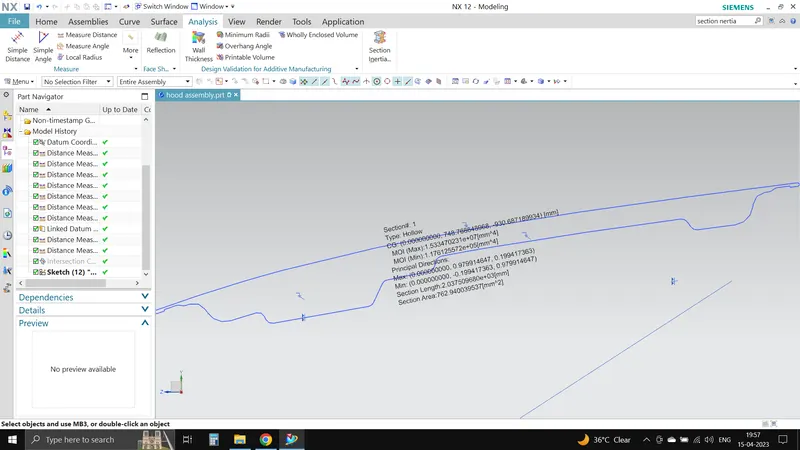
ACTUAL SECTION-
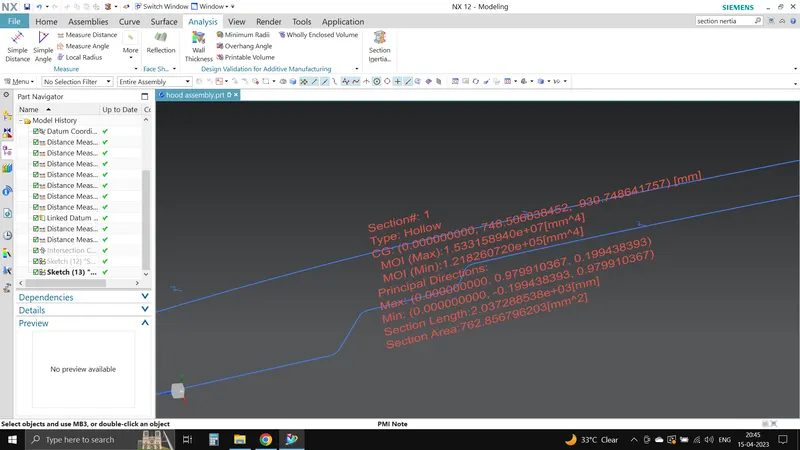
OPTIMISED WITH 0.5mm OFFSET VALUE-
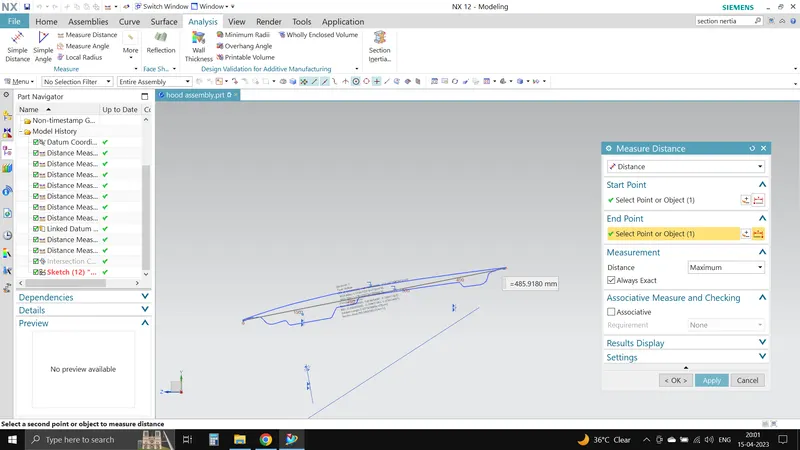
Maximum Distance-
CALCULATIONS:
MOI Actual= 1.17612x 10^5 mm^4
Y= 485.918 mm/2= 242.959mm
Z=M/I ------ 48.40816 mm^3
MOI changed= 1.2182x 10^5 mm^4
Y= 485.918 mm/2= 242.959mm
Z=M/I ------ 50.14014 mm^3
%changed= 3.45% increased in 0.5 mm offsetting lower panel.
SECOND SECTION:
ACTUAL:
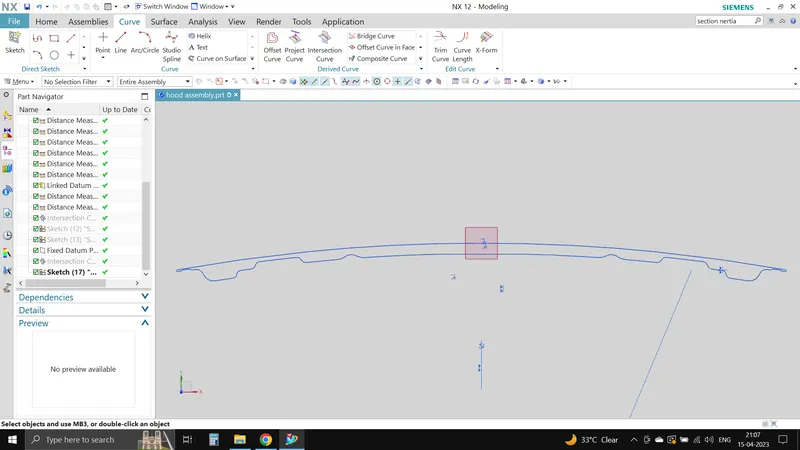
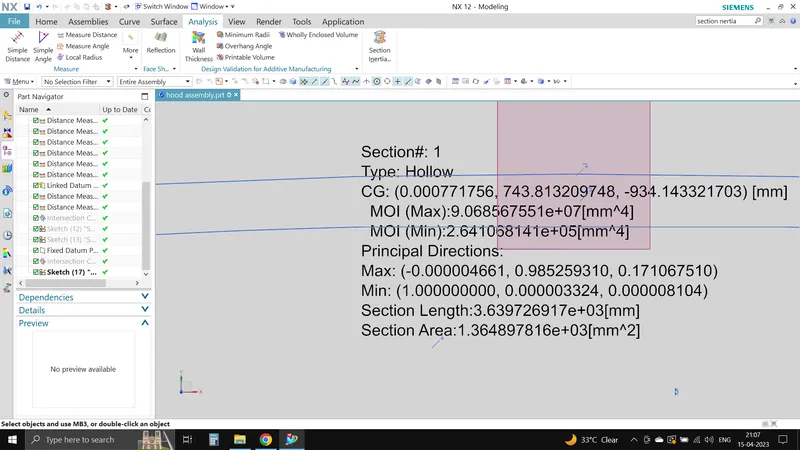
OPTIMISED SECTION AT 0.5mm OFFSET:
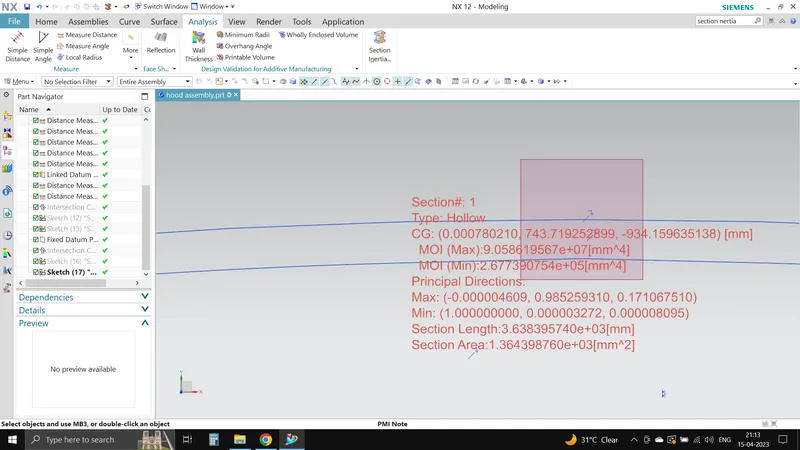
MAX DISTANCE:
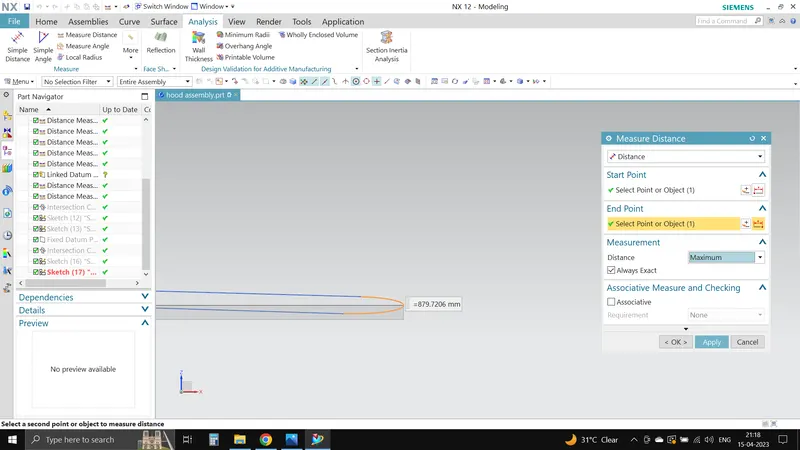
CALCULATIONS:
MOI Actual= 2.641068 x 10^5 mm^4
Y= 879.72 mm/2= 439.86mm
Z=M/I ------ 60.043377 mm^3
MOI changed= 2.67739 x 10^5 mm^4
Y= 879.72 mm/2= 439.86mm
Z=M/I ------60.869140 mm^3
%changed= 1.34 % increased in 0.5 mm offsetting lower panel.
Conclusion:
- Hence, from the above study, it is clear that optimization helps to improve the results in a design as we have increased the Section Modulus of our hood.
- Gain crucial insight about Section Modulus its relationship with bending stress, Moment of inertia and got an idea of how the section modulus changes with respect to change in section area of a body and its effect on the value of section modulus.
- Importance of section modulus when it comes to the selection of right material or right design which will have more strength.
- Factors affecting Section modulus and how to enhance the strength of a model.