Section Modulus calculation and optimization
Section Modulus Calculation and Optimization of the Hood
Objective:
The objective of the project is to find the section modulus of the designed front hood and optimizing it to get an improved section modulus compared to the other section that is offset by the inner panel of the Hood.
Introduction:
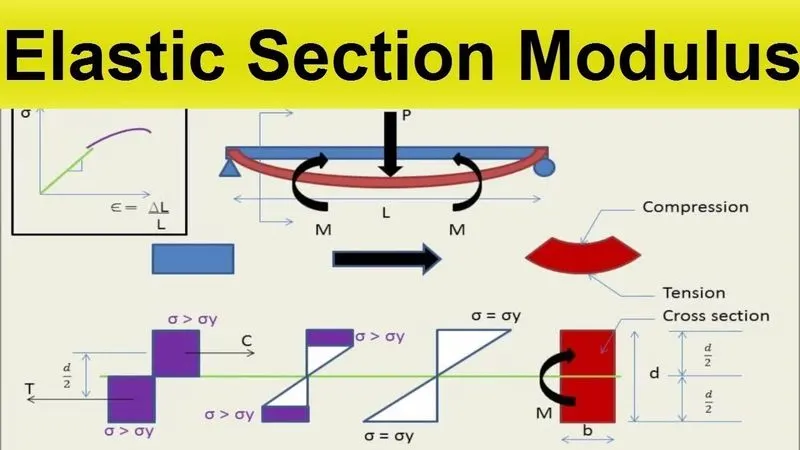
Section modulus is a geometric property for a given cross-section used in the design of beams or flexural members. Other geometric properties used in the design include an area for tension and shear, the radius of gyration for compression, and the moment of inertia, and the polar moment of inertia for stiffness. Any relationship between these properties is highly dependent on the shape. There are two types of section moduli
- Elastic section modulus
- Plastic section modulus
The Elastic Section Modulus is defined as,
S = I/y
Where,
S: is the Section Modulus
I: is the second moment of area(or area moment of inertia, not to be confused with the moment of inertia)
y: is the distance from the neutral axis to any given fiber. It is often reported using y = c, where c is the distance from the neutral axis to the most extreme fiber.
It is also often used to determine the yield moment (My) such that,
My = S × σy
Where σy is the yield strength of the material.
Section Modulus Calculation:
To Find better results, I have analyzed the two sections that are considered as Study 1 and Study 2 and again the two sections were optimized and analyzed and then compared to get better results.
STUDY: 1
Used ( Siemens NX) Software
For Study 1 the below section was considered has to parallel to x-coordinate for calculating the section modulus.
Create an intersection Curve with the help of the plane consider both the Outer & Inner panels of the hood.
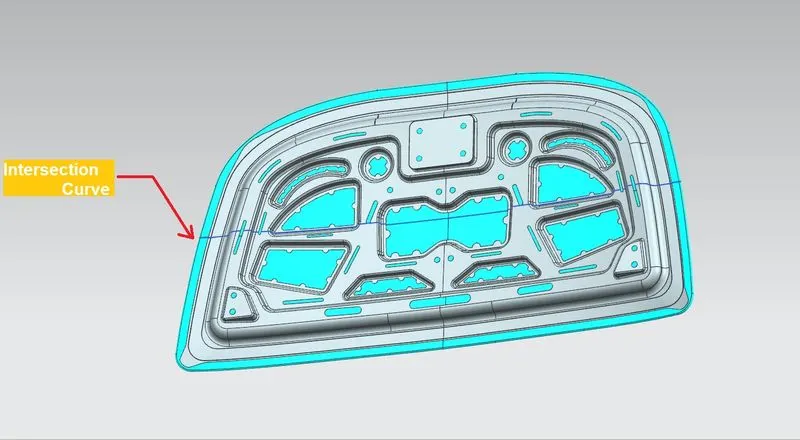
When the intersection curve has been created and hide the remaining parts of the hood, outer & inner panel, we will get this curve
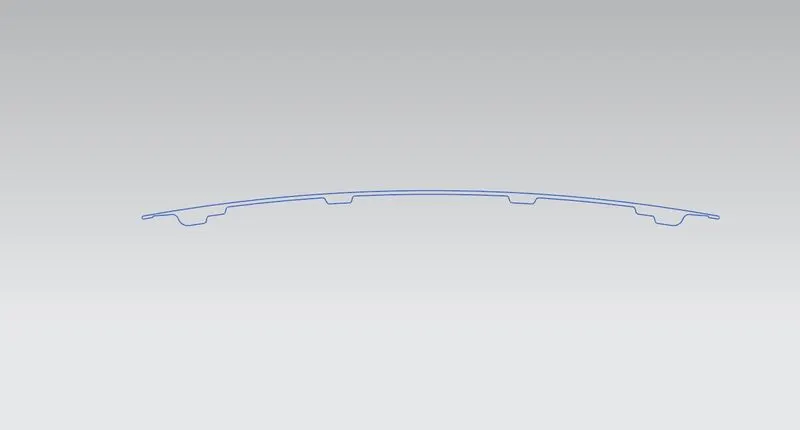
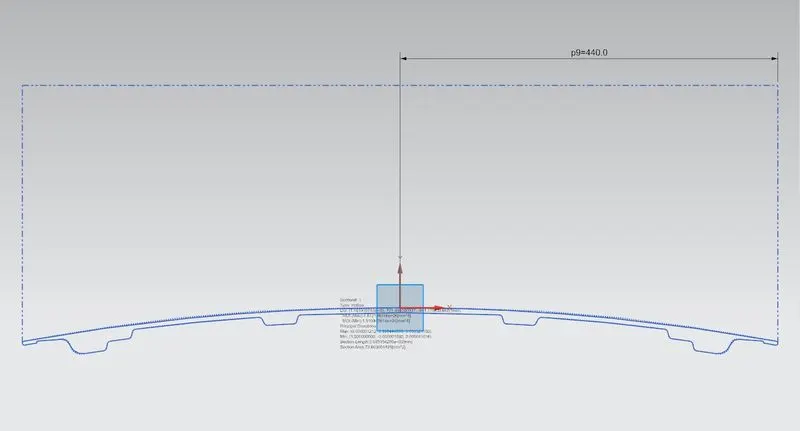
After the proper intersection curve has made, Use the Section Inertia Analysis tool to find the Moment of inertia and also show the distance from the neutral axis to the most extreme fiber.
Before Optimization:
By using the Section Inertia Analysis tool in Siemens NX the below-shown results were achieved.
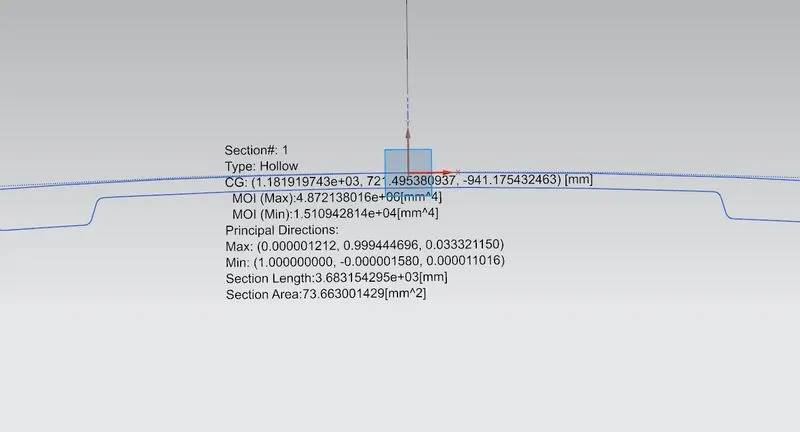
Moment of Inertia (MAX), Imax = 4.872138016 x 10^6 [mm^4]
Moment of Inertia (MIN), Imin= 1.510942814 x 10^4 [mm^4]
Section Modulus, S = Moment of Inertia (MOI) / Distance between the neutral axis and the extreme end of the object (y)
S = I/y
For Maximum MOI,
S = (4.872138016 x 10^6 [mm^4]) ÷ (440 mm)
Smax = 11073.041 mm^3
For Minimum MOI,
S = (1.510942814 x 10^4 [mm^4]) ÷ (440 mm)
Smin = 34.3396 mm^3
After Optimization:
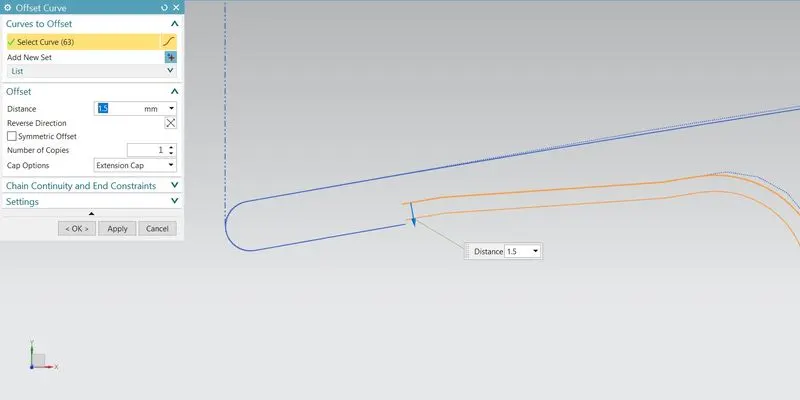
The hood inner panel width was increased to 1.5 mm to downwards than the original one and achieved the below-shown results in Siemens Nx.
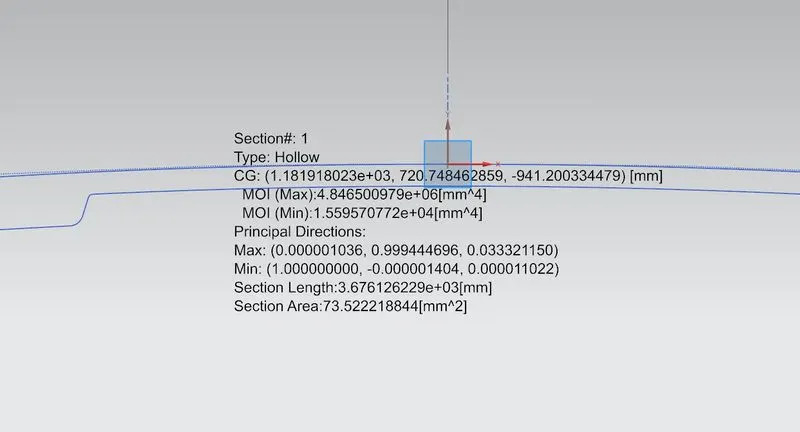
Moment of Inertia (MAX), Imax = 4.846500979 x 10^6 [mm^4]
Moment of Inertia (MIN), Imin = 1.559570772 x 10^4 [mm^4]
Section Modulus, S = Moment of Inertia (MOI) / Distance between the neutral axis and the extreme end of the object (y)
S = I/y
For Maximum MOI,
S = (4.846500979 x 10^6 [mm^4]) ÷ (440 mm)
Smax = 11014.775 mm^3
For Minimum MOI,
S = (1.559570772 x 10^4 [mm^4]) ÷ (440 mm)
Smin = 35.44 mm^3
STUDY: 2
Used (Siemens NX) Software
For Study 2 the below section was considered has to parallel to y-coordinate for calculating the section modulus.
Create an intersection Curve with the help of the plane consider both the Outer & Inner panels of the hood.
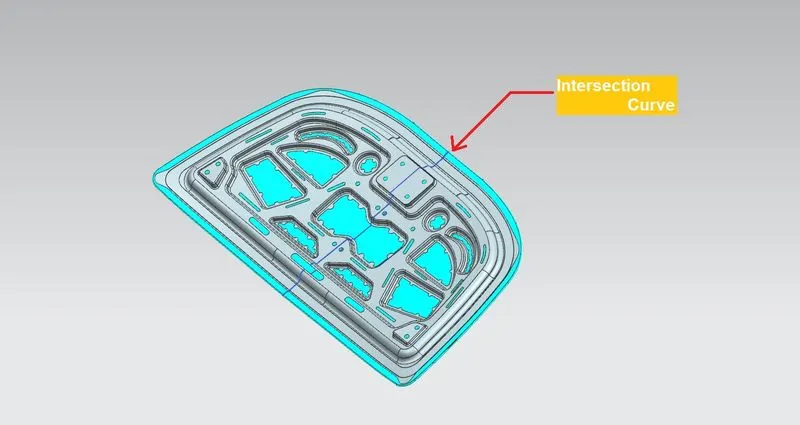
When the intersection curve has been created and hide the remaining parts of the hood, outer & inner panel, we will get this curve.
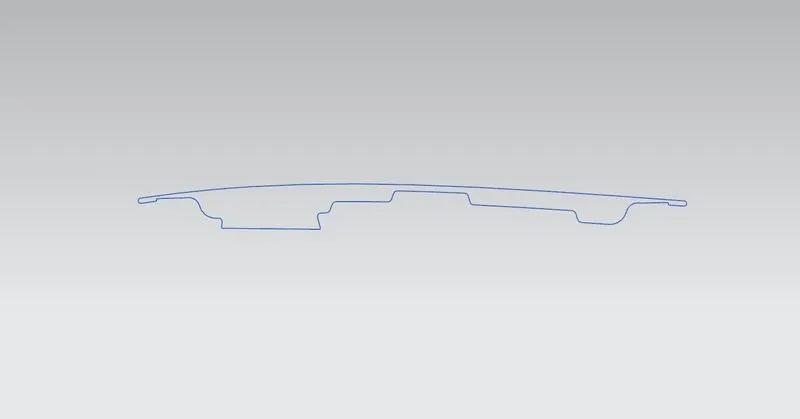
After the proper intersection curve has made, Use the Section Inertia Analysis tool to find the Moment of inertia and also show the distance from the neutral axis to the most extreme fiber.
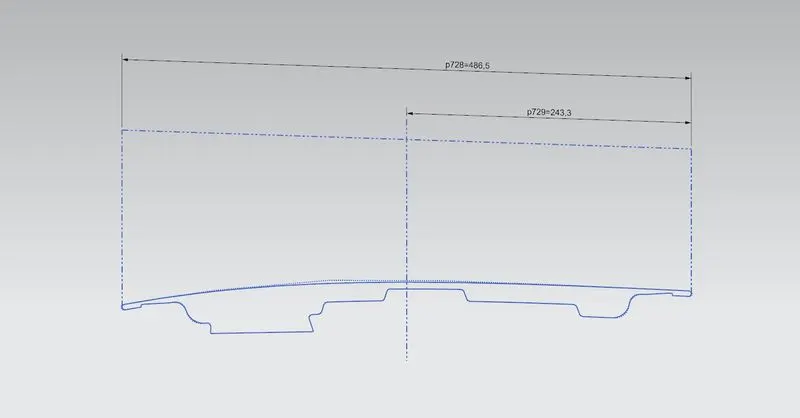
Before Optimization:
By using the Section Inertia Analysis tool in Siemens NX the below-shown results were achieved.
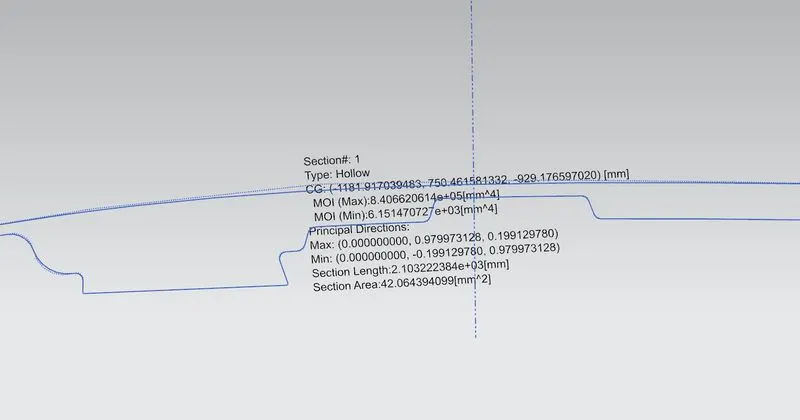
Moment of Inertia (MAX), Imax = 8.406620614 x 10^5 [mm^4]
Moment of Inertia (MIN), Imin = 6.151470727 x 10^3 [mm^4]
Section Modulus, S = Moment of Inertia (MOI) / Distance between the neutral axis and the extreme end of the object (y)
S = I/y
For Maximum MOI,
S = (8.406620614 x 10^5 [mm^4]) ÷ (243.3 mm)
Smax= 3455.24 mm^3
For Minimum MOI,
S = (6.151470727 x 10^3 [mm^4]) ÷ (243.3 mm)
Smin = 25.28 mm^3
After Optimization:
The hood inner panel width was increased to 1.5 mm to downwards than the original one and achieved the below-shown results in Siemens Nx.
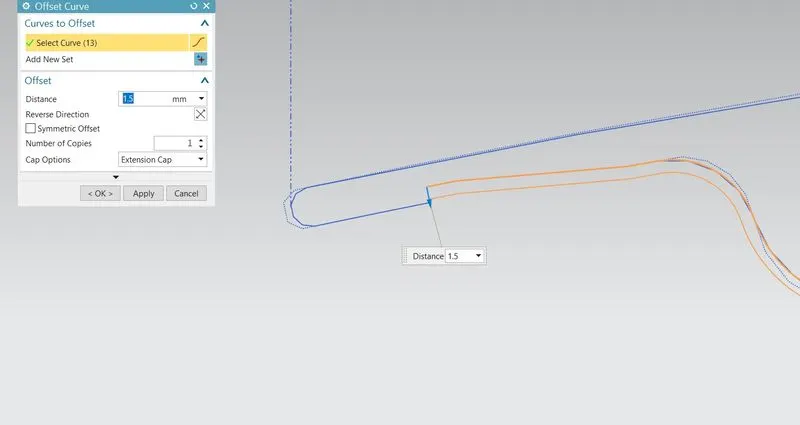
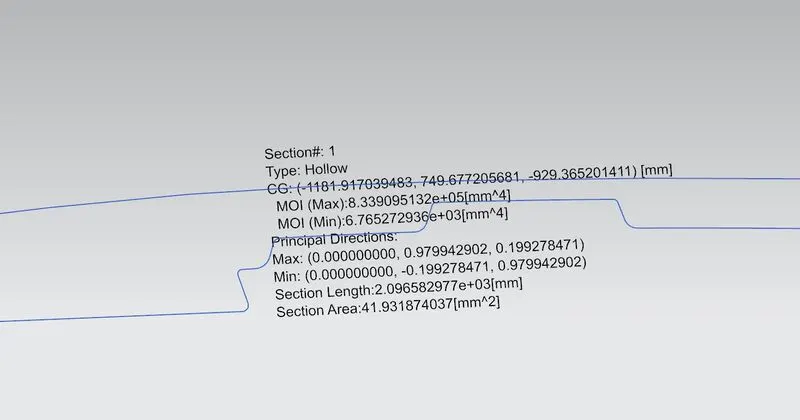
Moment of Inertia (MAX), Imax = 8.339095132 x 10^5 [mm^4]
Moment of Inertia (MIN), Imin = 6.765272936 x 10^3 [mm^4]
Section Modulus, S = Moment of Inertia (MOI) / Distance between the neutral axis and the extreme end of the object (y)
S = I/y
For Maximum MOI,
S = (8.339095132 x 10^5 [mm^4]) ÷ (243.3 mm)
Smax = 3427.494 mm^3
For Minimum MOI,
S = (6.765272936 x 10^3 [mm^4]) ÷ (243.3 mm)
Smin = 27.80 mm^3
Comparison Table:
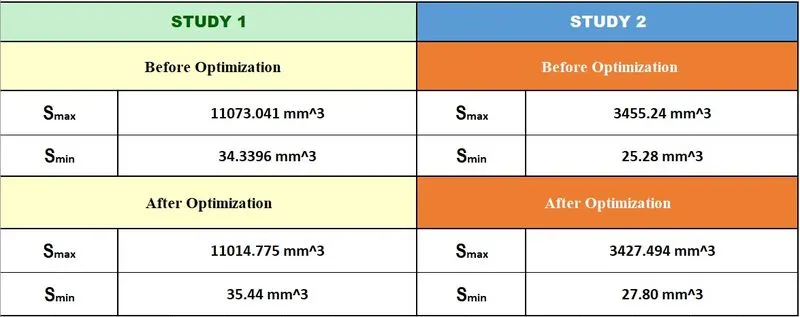
- At the comparison table we have achieved the section modulus result and for a maximum moment of inertia the section modulus value decreases after optimization but for a minimum moment of inertia the value increases.
- But the minimum limit of deformation of the hood needs to be analyzed so we’ll go with the minimum moment of inertia.
- After increasing the sectional area to 1.5 mm from the original the Section Modulus value increased which shows that the load-carrying capacity and resistance of the hood will also be increased simultaneously.
Conclusion:
Thus the section modulus of the Front Hood of a car was calculated and compared with the optimized hood and found the better result. Hence I’m concluding that when the sectional area of the hood increases the stiffness and resistance of the hood strength will also be increased.
From the result, we can conclude and say that off-setting the cross-section of the inner panel 1.5 mm downward(Optimized) would give a better section modulus and this would help in increasing the strength of the hood.