Section Modulus calculation and optimization
Section Modulus calculation and optimization
Introduction
In CAD modelling, the section modulus is typically used to design and analyse structural components. The section modulus of a component's cross-section can be calculated based on its geometry, which is often created using 3D modelling softwares in my case I have use Catia V5.
The section modulus is a geometric property of a structural cross-section, such as a beam or a column, that is related to its ability to resist bending or flexure. Specifically, it is defined as the ratio of the moment of inertia of the cross-section about a neutral axis to the distance from that axis to the outermost fiber of the section. In other words, it is a measure of the resistance of a section to bending stress.
The section modulus is denoted by the symbol "S" and is typically expressed in units of length cubed. It is an important parameter used in the design of structural components, as it helps engineers determine the size and shape of a section required to withstand a given bending moment or load. The greater the section modulus of a section, the more resistant it is to bending stress.
Its unit is length cubed, such as mm^3 or in^3. The section modulus can be calculated using the following formula:
S = I / y
where:
- S is the section modulus
- I is the moment of inertia of the cross-sectional area
- y is the distance from the neutral axis to the outermost fibers of the section.
The section modulus is an important parameter used in the design of structural components. Components with larger section modulus are generally stronger and more resistant to bending or torsion.
Initial Section of the Hood design
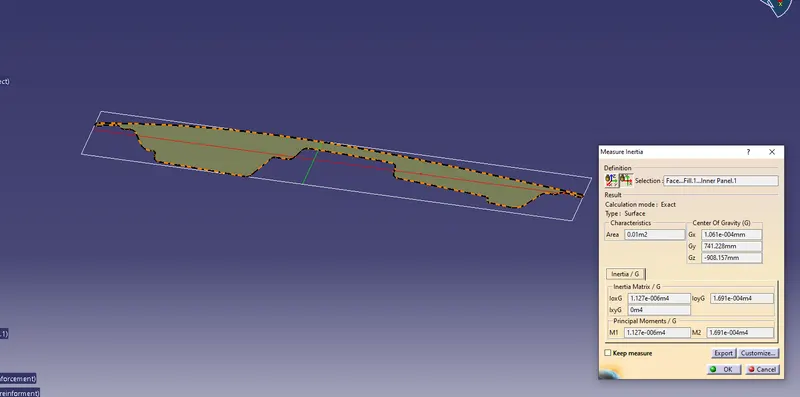
Here, I have found the moment of the section of the out body and inner body of the hood with the help of Measure inertia feature in Catia.
I got,
(Min Moment) M1 = 1.12696e-006 m^4 = 1.12696*10^5 mm^4
(Max Moment) M2 = 0.000169089 m^4 = 16.9089 mm^4
we only need is M1 as I,
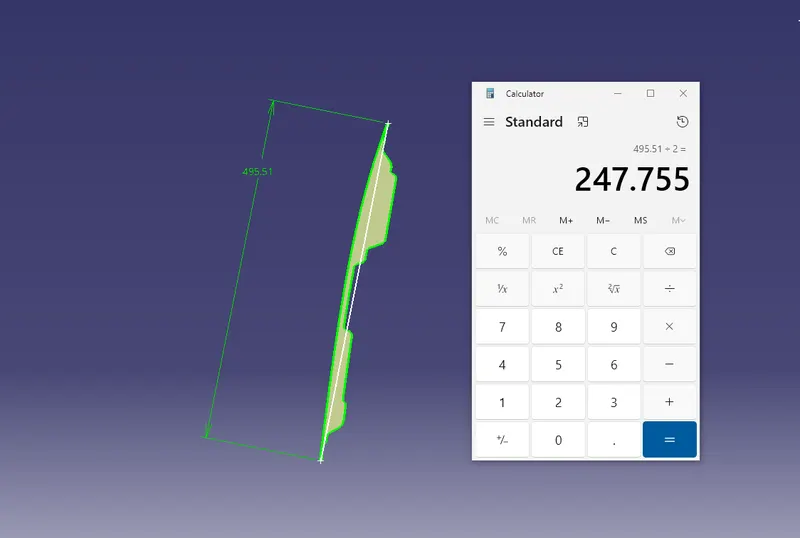
Here, I have found the 'y' of the section of the out body and inner body of the hood which is, y = 495.51/2 = 247.755 mm.
So, S1= I/y = 1.12696*10^5 mm^4 / 247.755 mm = 454.86872 mm^3
We got, S1= 454.86872 mm^3
Final Section of the Hood design
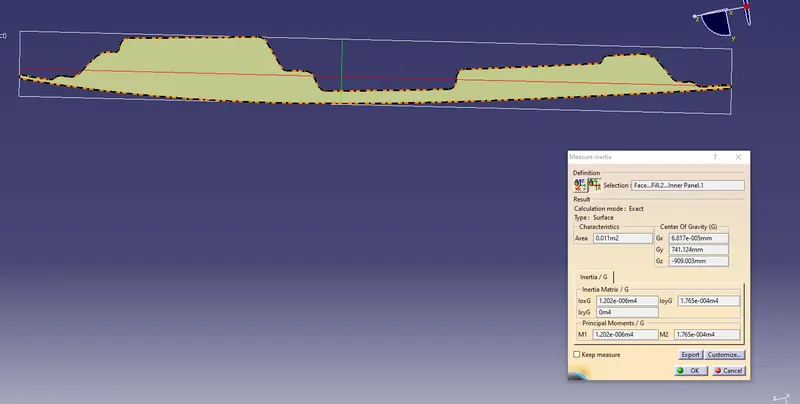
Here, I have found the moment of the section of the out body and inner body (which is off-setted by 0.7 mm) of the hood with the help of Measure inertia feature.
I got,
(Min Moment) M1 = 1.20249e-006 m^4 = 1.20249*10^5 mm^4
(Max Moment) M2 = 0.000176459 m^4 = 17.6459 mm^4
we only need is M1 as I,
So, S2= I/y = 1.20249*10^5 mm^4 / 247.755 mm = 485.35448 mm^3
We got, S2= 485.35448 mm^3
Conclusion
S1= 454.86872 mm^3 Initial Section of the Hood design
S2= 485.35448 mm^3 Final Section of the Hood design
Components with larger section modulus are generally stronger and more resistant to bending or torsion, in my case, S2.