Section Modulus calculation and optimization
Section Modulus:
Section modulus is a geometric property for a given cross section used in the design of beams or flexural members. Other geometric properties used in design include area for tension and shear, radius of gyration for compression, and second moment of area and polar second moment of area for stiffness. There are two types of section moduli, one is elastic section modulus and the another one is plastic section modulus.
Elastic Section Modulus:
The elastic section modulus is defined as S=I/y, Where I is the area moment of inertia and y is the distance from the neutral axis to any given fibre. It often repoorted using y=c, where c is the distance from the neutral axis to the most extreme fibre. It is also often used to determine the yield moment (My) such that My=S. sigma y, where sigma y is the yield strength of the material.
Plastic Section Modulus:
The plastic section moduluis is used for materials where elastic yielding is acceptable and plastic behavior is assumed to be a acceptable limit. Designs generally strive to ultimately remain below the plastic limit to avoid permanent deformations, often comparing the plastic capacity against amplified forces or stresses.
The plastic section modulus is used to calculate the plastic moment, Mp, or full capacity of a cross section. The two terms are related by the yield strength of the material in question, Fy, by Mp=Fy.Z. Plastic section modulus and elastic section modulus are related by a shape factor which can be denoted by k, used for an indication of capacity beyond elastic limit of material.
This could be shown mathematically with the formula as k = Z/S.
Section Modulus Calculation:
Section modulus inertia is finded by using the Intersecrtion curve comment. And this is the result,
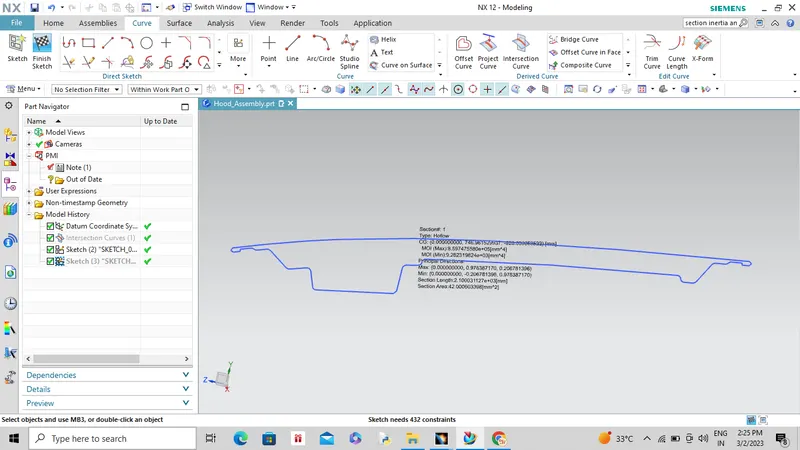
I(max) = 8.5974*10^5
I(min) = 9.2823*10^3
y=484.3055/2 =242.1527
S=I/y
S= 9.2823*10^3/242.1527
S= 38.33mm^3.
After Optimization;
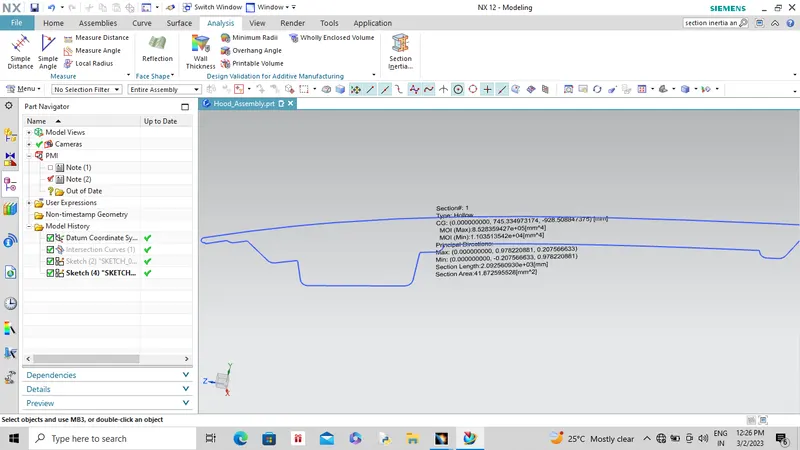
I(max) = 8.5283*10^5
I(min) = 1.1035*10^4
y= 242.1527
S=I/y
S= 1.1035*10^4/242.1527
S= 45.57mm^3.
Conclusion:
The strength of the material is directly proportional to the moment of inertia. The overall mass of an object is increase by increasing the sectional area, hence the strength is increase.