Section Modulus calculation and optimization
Report On Section Modulus Calculation Of Hood
Aim
Explain about section modulus and use the section of hood design from challenge 3 and calculate its section modulus.
Sectiom Modulus :
Section modulus is a geometric property for a given cross-section used in the design of beams or flexural members.
Section modulus is the ratio of moment of inertia of section about the neutral axis to the distance of the outermost layer from the neutral axis
S = I / Y it’s SI unit is mm^3 or m^3
Where,
I = Moment of inertia and
Y = distance from the outermost point to neutral axis
In simple terms,
The section modulus is the ratio of bending moment to bending stress for steel.
If your steel has a high section modulus it will be harder to bend and can withstand a high moment without having high bending stress.
It shows the resistance towards the bending.
Formulaes used to find section modulus of different shapes.
| Cross-sectional shape | Figure | Equation | Comment |
|---|---|---|---|
| Rectangle |  |
Solid arrow represents neutral axis | |
| doubly symmetric I-section (major axis) | 
|
NA indicates neutral axis | |
| doubly symmetric I-section (minor axis) |  |
NA indicates neutral axis | |
| Circle |  |
Solid arrow represents neutral axis | |
| Circular hollow section |  |
Solid arrow represents neutral axis | |
| Rectangular hollow section |  |
NA indicates neutral axis | |
| Diamond |  |
NA indicates neutral axis | |
| C-channel | |
NA indicates neutral axis |
 ,
,
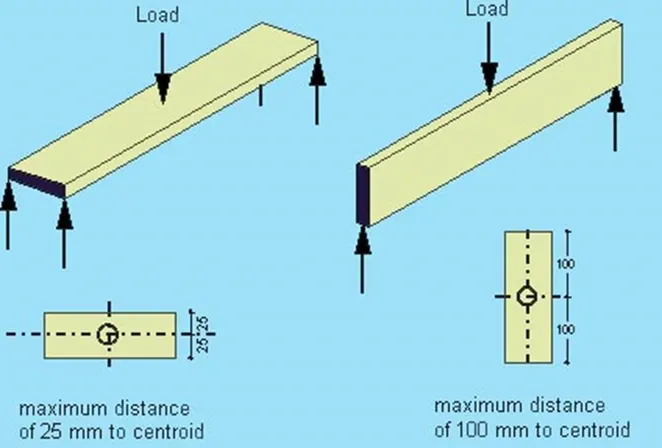
- With the image it can be shown how just rotating the wood ply can make difference in distance towards centeroid
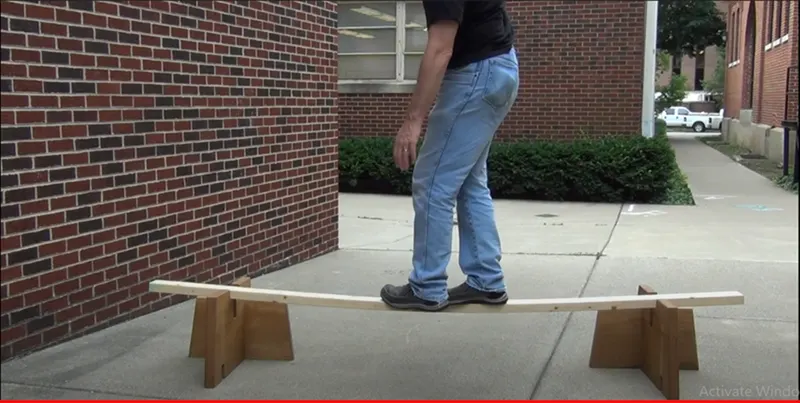
- Changing the position can show the difference in bending which is because of the centroid distance from extreme fiber end.
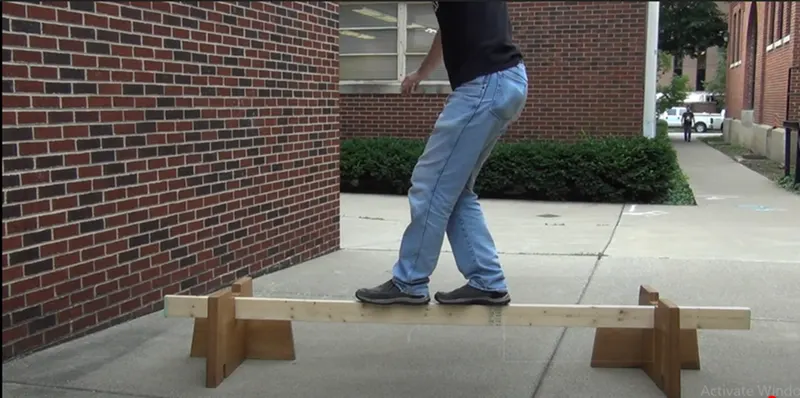
- In this position there is more material from axis to the specific direction, to resist the load which makes less bend amd improves the strength.
Section Modulus Calculation
# Case 1
- Cross section of designed hood befor optimization
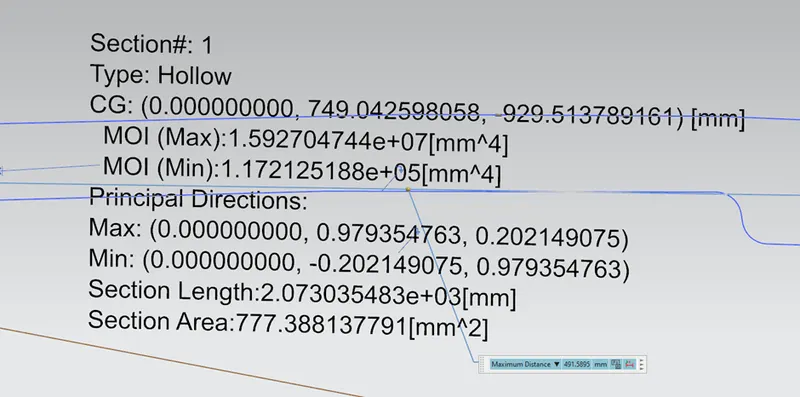
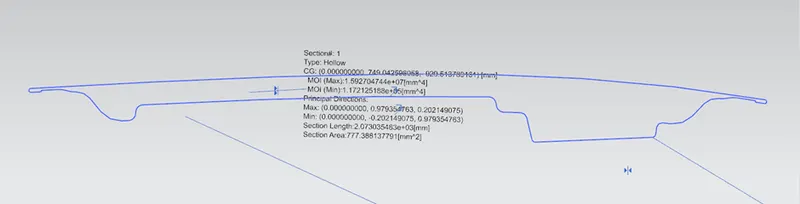
Moment of Inertia ( I ) = 1.172125188e+05 (mm^4)
Neutral Axis ( Y ) = 491.5895 / 2 = 245.79475 mm
Since Section Modulus ( S )= I / Y = 1.172125188e+05 (mm^4) / 245.79475
Therefore, S = 476.8715312 mm^3
# Case 2
- Cross section of designed hood after optimization
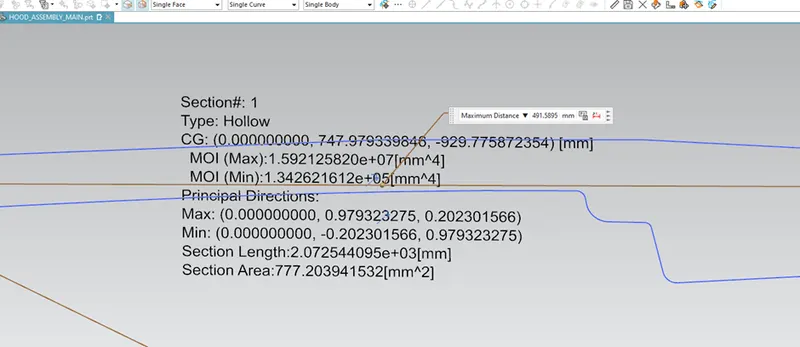
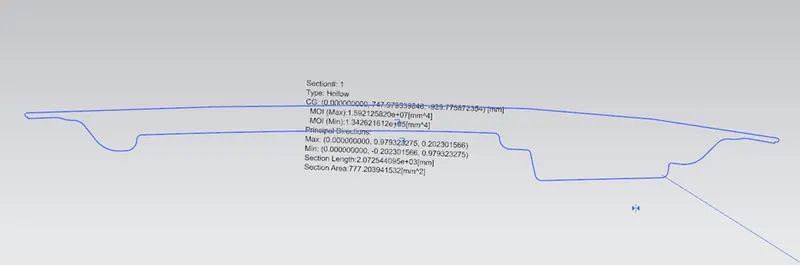
Moment of Inertia ( I ) = 1.342621612e+05 (mm^4)
Neutral Axis ( Y ) = 491.5895 / 2 = 245.79475 mm
Since Section Modulus ( S )= I / Y = 1.342621612e+05 (mm^4) / 245.79475
Therefore, S = 546.2368956 mm^3
With this we can conclude, after comparing #case 1 & #case 2,
we understand,
1. As we increase the section area, the moment of inertia & section modulus increases which means strength and load material also increases.
2. Adding 2mm of distance between the outer & Inner hood can increase 69.3653644 mm^3 section modulus.
3. The section modulus value of case 2 is higher than the case 1.