Section Modulus calculation and optimization
Aim:
To find the section modulus of the hood and optimization to improve the overall section modulus.
Objective:
Use the section from your Hood design and calculate the section modulus using the formula S= I/y.
Section Modulus:
The section modulus (S) is geometry property of the cross section used for designing beams and flexural members. It does not represent anything physically.
Formula of section Modulus: It may be defined as the ratio of total moment resisted by the section to the stress in the extreme fibre which is equal to yield stress.
Which is equal to yield stress.
Therefore
S=I/y,
Where
S= Section modulus (mm^3)
I = Moment of inertia of the section to the stress in the extreme end of the object (mm^4)
Y= Distance between the neutral axis and extreme end of the object (mm).
Area Moment of Inertia:
The area moment of inertia of a beam cross section area measures the beam ability to resist bending. The larger the moment of inertia less will be the bend.
Where,
M = Bending Moment
I = Area moment of Inertia
E = Young modulus
R = Radius of gyration
Neutral Axis: When beam is subjected to pure bending the top most fibres of the beam are subjected to maximum compression, while the bottom most fibre of the beams are subjected to maximum tension.
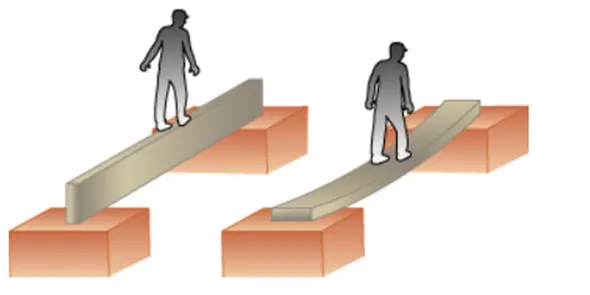
- This picture contains the following scene, Diagram of a beam on its narrow edge supported at both ends. A man is walking on a straight beam. Diagram of a beam resting on its flat side supported at both ends. A man is walking on the straight beam and its bending in the middle.
Calculation:
case -1) Section Modulus of Front Crash Before optimization :
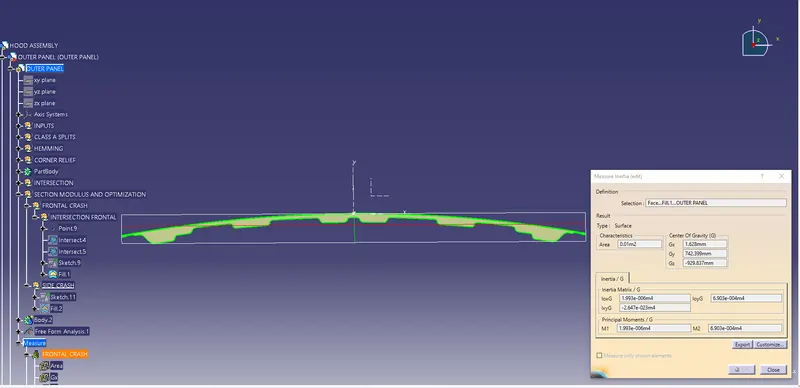
DISTANCE
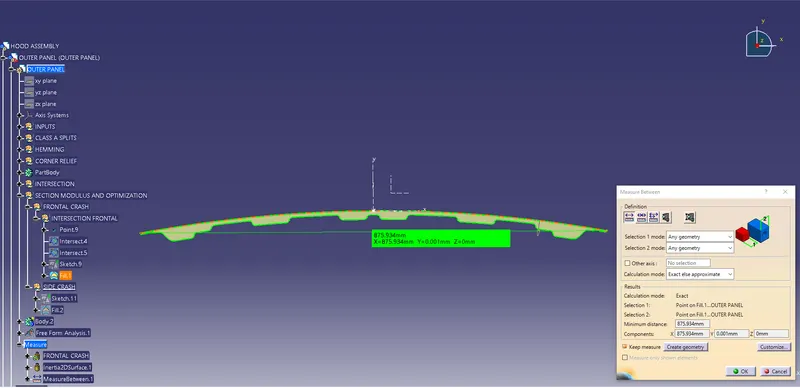
>Here we are considered the innerpannel section of the to analysis the section inertia analysis after doing the we got the desired results shown in the above image
I (MAX) = 6.903e-04(m^4)
= 6.903*10^8 mm
I (MIN) = 1.993*10^-6 (m^4)
= 1.993*10^6 mm
As per the section modulus equation,
S = I/Y
I = (max & min) Value is considered
Y = Total distance / 2
Y=875.93/2
Y=437.96 mm
Therefore,
S = 6903*10^5 /437.96 mm S = 1993*10^3/437.96 mm
S1(Maximum) = 1579.24*10^3 mm. S1(Minimum) = 4550.64 mm.
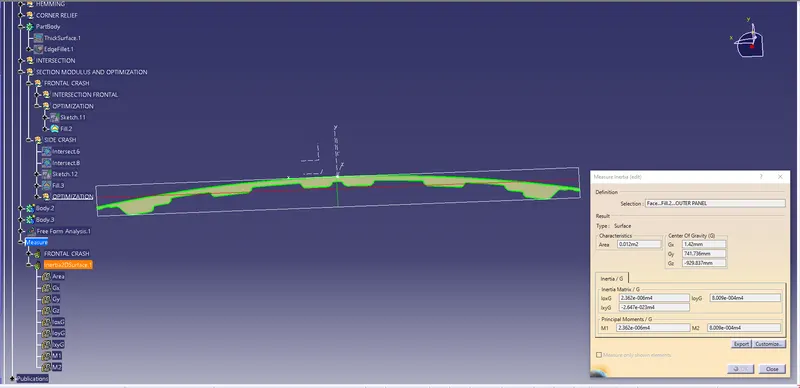
case -2) Section Modulus of Front Crash after optimization (1.8mm) :
DISTANCE
>Here we are considered an section of inner pannel at the cureved region and by doing the analysis we got the desired results shown below
I (MAX) = 8.009e-04(m^4)
= 8.009*10^8 mm
I (MIN) = 2.362e-06(m^4)
= 2.362*10^6 mm
As per the section modulus equation,
S = I/Y
I = (min & max) Value is considered
Y = Total distance / 2,
Total distance ,Y= 437.108 mm
Therefore,
S = 8009*10^5/437.108 mm S = 2362*10^3/437.108 mm
S2(Maximum)= 1832.27*10^2 mm. S2(Minimum)= 5403.69 mm
Results:
- After the calculations of the above 2 cases the section modulud of an S1(Maximum) and S2(Maximum) the difference is 253.03mm.
- After the calculations of the above 2 cases the section modulud of an S1(Minimum) and S2(Minimum) the difference is 853.05mm.
- The section modulus value of case 2 is higher than the case 1 for both Maximum & Minimum
- As we increase the section area, the moment of inertia & section modulus increase which means strength and load material also increase. Which the moment of inertia directly proportional to the strength of the material.
Calculation:
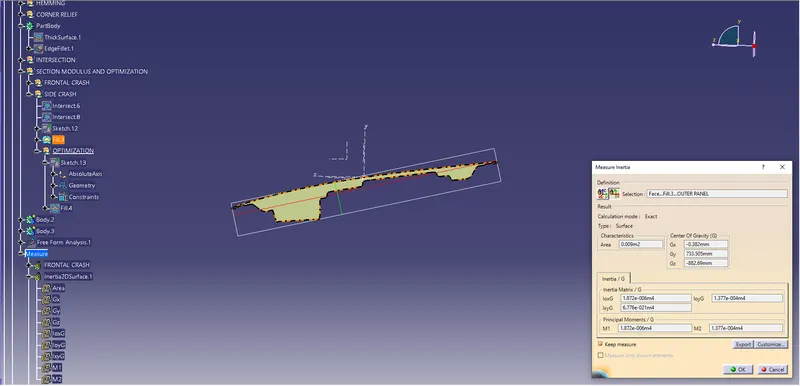
Section Modulus of Side Crash Before optimization :
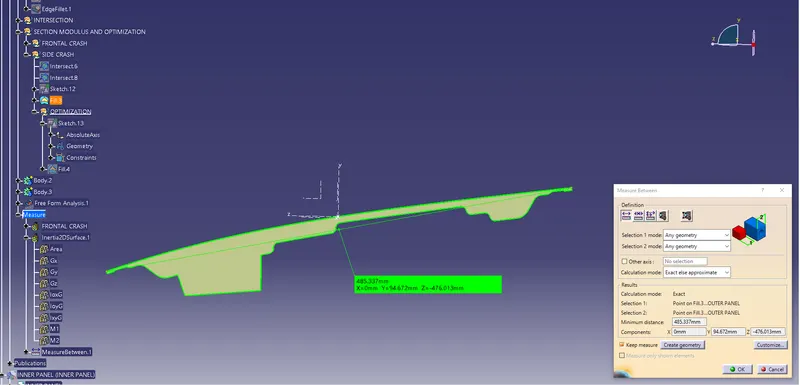
DISTANCE
>Here we are considered the innerpannel section of the to analysis the section inertia analysis after doing the we got the desired results shown in the above image
I (MAX) = 1.377e-04(m^4)
= 1.377*10^8 mm
I (MIN) = 1.872*10^-6 (m^4)
= 1.872*10^6 mm
As per the section modulus equation,
S = I/Y
I = (min & max) Value is considered
Y = Total distance / 2
Y=485.337/2
Y=242.66 mm
Therefore,
S1(Maximum) = 1337*10^5 /242.66 mm S1(Minimum) = 1872*10^3 /242.66 mm
S1(Maximum) = 550.97*10^3 mm. S1(Minimum) = 7714.49 mm.
case -2) Section Modulus of Side Crash after optimization (1.8mm) :
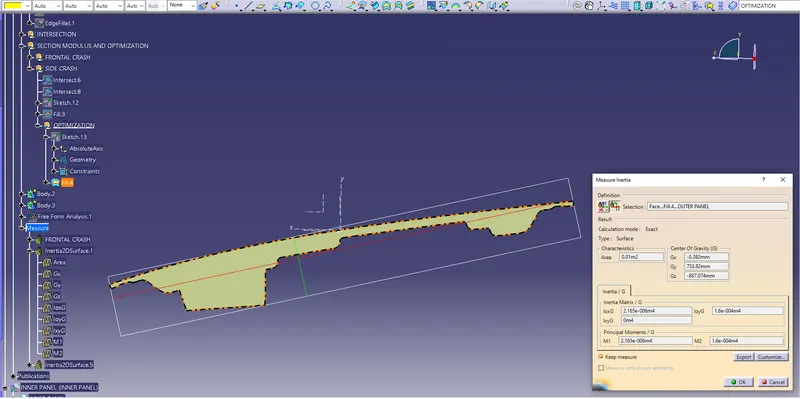
>Here we are considered an section of inner pannel at the cureved region and by doing the analysis we got the desired results shown below
I (MAX) = 1.6e-04(m^4)
= 1.6*10^8 mm
I (MIN) = 2.165e-06(m^4)
= 2.165*10^6 mm
As per the section modulus equation,
S = I/Y
I = (min & max) Value is considered
Y = Total distance / 2,
Total distance ,Y= 242.66 mm
Therefore,
S2(Maximum) = 1.6*10^8/242.66 mm S2(Minimum) = 2165*10^3/242.66 mm
S2(Maximum)= 659.358*10^3 mm. S2(Minimum)= 8921.94 mm
Results:
- After the calculations of the above 2 cases the section modulud of an S1(Maximum) and S2(Maximum) the difference is 108.38mm.
- After the calculations of the above 2 cases the section modulud of an S1(Minimum) and S2(Minimum) the difference is 1207.45mm.
- The section modulus value of case 2 is higher than the case 1 for both Maximum & Minimum
- As we increase the section area, the moment of inertia & section modulus increase which means strength and load material also increase. Which the moment of inertia directly proportional to the strength of the material.