Section Modulus calculation and optimization
SECTION MODULUS:
This is defined as ratio of total moment resisted by the section to the stress in the extreme fiber. This explains about the load that it can withstand upto its maximum by caluclating using the section modulus formula. If the section modulus increases the resistance of section towards the stress increase , then the load bearing capacity increases.
Formula for caluclating Section modulus:
S= i/y
S= Section modulus
I= moment of inertia
Y= Distance from neutral axis to the outermost fiber
Moment of Inertia:
It is defined as the product of mass to the square of the distance between the reference axis and the centre of the object. In this case we consider beam. Moment of inertia has conditions, those are :
1. The larger the mass the moment of inertia will be more.
2.The smaller the mass the moment of inertia will be less.
The area moment of inertia of a beams cross sectional area measures the beam ability to resist bending. The larger the moment of inertia less will be the bend.
Neutral axis:
The neutral axis is an axis in the cross section of a beam (a member resisting bending) or shaft along which there are no longitudinal stresses or strains cruves. This is centroid of the cross section of beam.
OBJECTIVE:
To find out the section modulus of the cross section of the desgined hood.
Use the Section from your Hood design and calculate the Section Modulus using the formula
S = I/y
Where,
S = Section Modulus
I = Moment of Inertia
y = distance between the neutral axis and the extreme end of the object.
Below is the caluclation for the section modulus and optimization.
Before Optimization and caluclations:
CASE:1
The hood inner and outer panel’s curve and inertia analysis is done for a closed curve.
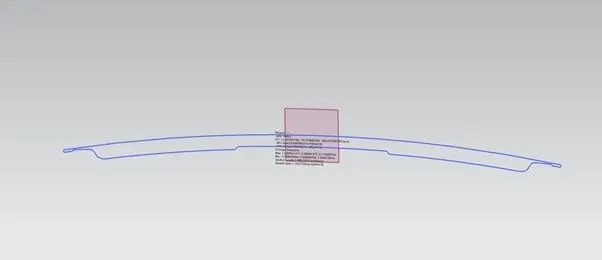
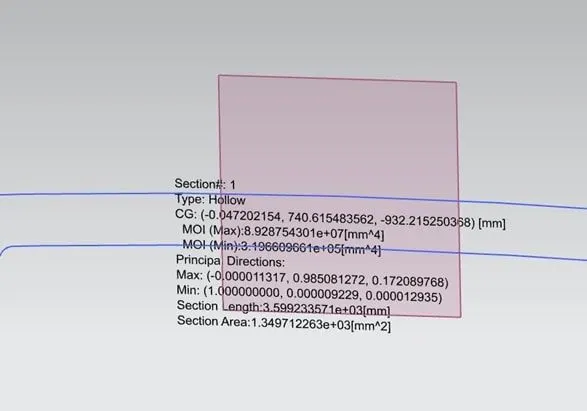
MOI (max) = 8.928754301e+07 (mm^4)
MOI (min) = 3.196609661e+05 (mm^4)
As per the section modulus equation,
S = I/Y
I = MOI (min) value is considered
Y = Total distance /2, Total distance =875.5680mm
Y = 875.5680 / 2
= 437.784 mm
Therefore, S = 319660.966 mm^4/437.784 mm
S = 730.179 mm^3
After optimization
CASE 2:
The hood inner and outer panel’s curve is offset by 0.5mm outwards and inertia analysis is done same for a closed curve.
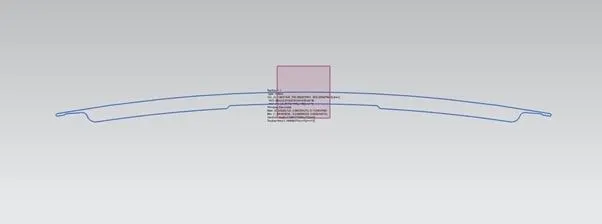
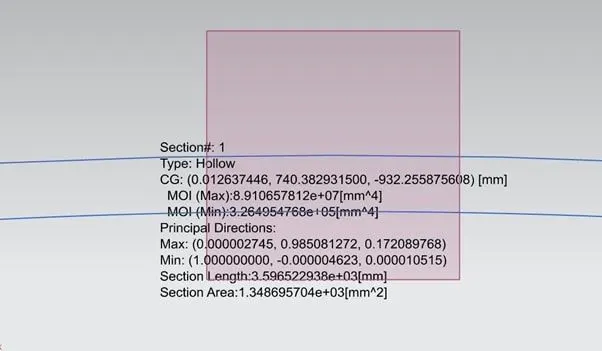
MOI (max) = 8.910657812e^07 mm^4
MOI (min) = 3.264954768e^05 mm^4
As per section modulus equation,
S = I / Y
I = MOI (min) value is considered
Y = Total distance /2, Total distance =875.5680mm
Y = 875.5680 / 2
= 437.784 mm
Therefore, S = 326495.4768 mm^4 / 437.784 mm
S = 745.792 mm^3
Conclusion:
Hence when comparing case 1 & case 2,
1. The section modulus value of case 2 is higher than the case 1.
2. As we increase the section area, the moment of inertia & section modulus increases which means strength and load material also increase.