Hood design-Week 2
HOOD DESIGN:
HOOD:
Hood is aslo termed as bonet in general terms. This is generally made of sheet metak IT CONTAINS FIVE PARTS THEY ARE:
1. Inner panel
2. Outer panel
3. Mastic data
4. Hinge assembly
5. Striker assembly
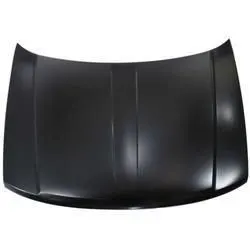
Above is the hood outer panel image.
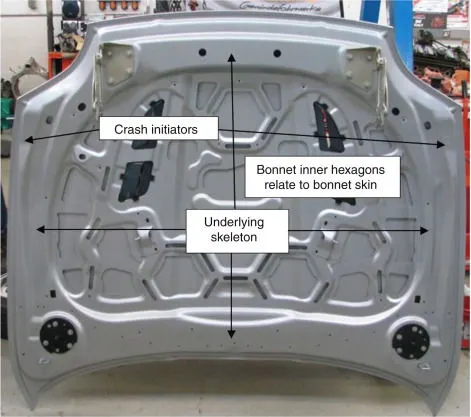
Above is the hood inner panel assembly image.
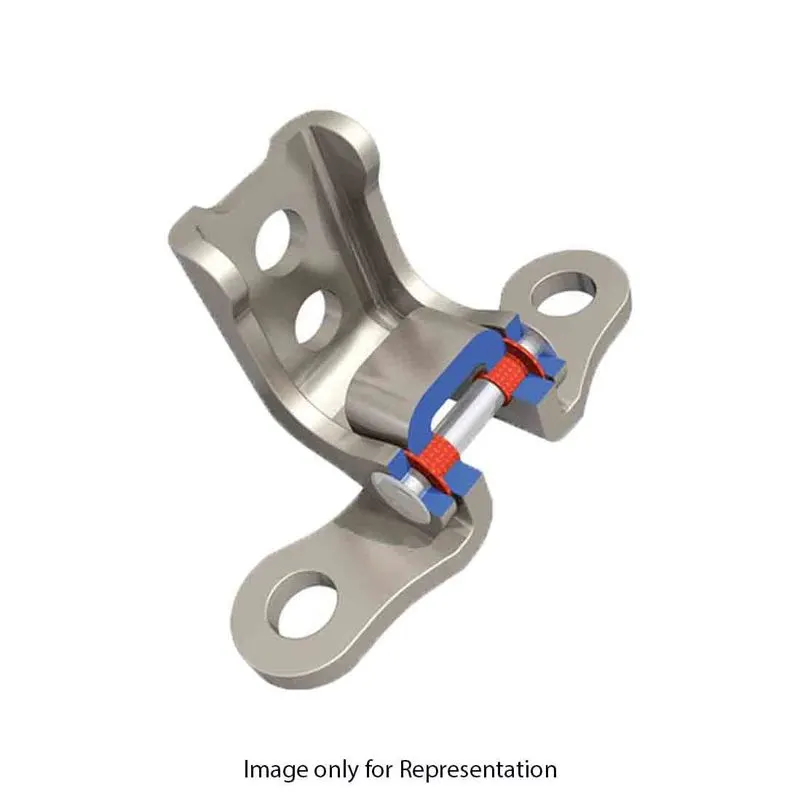
Above is the hinge assembly example image.
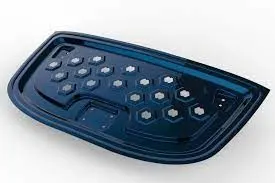
Above is the mastic points reference image.
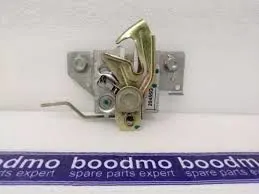
Above is the striker assembly.
While desgning of hood we should consider some points. There are five types of considerations:
1. Hood opening angle
2. Pedestrain's safety
3. Mastic data
4. Hood support
5. Latch trajectory
1. HOOD OPENING ANGLE:
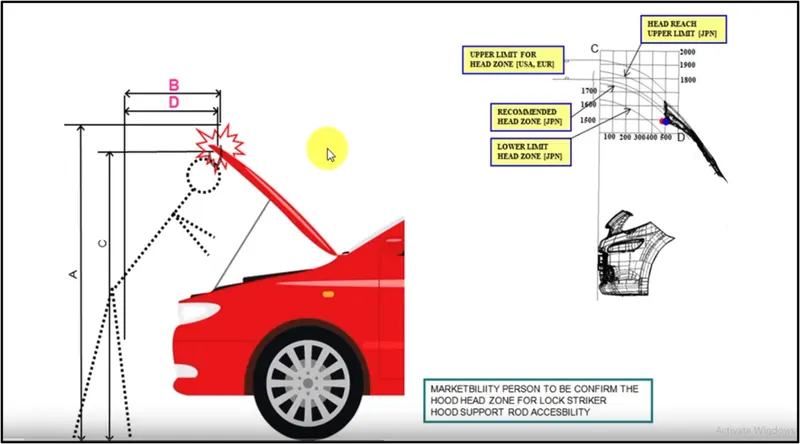
While designing the hood we should consider because when we open the hood to get access to the engine compartment to perform any operation it should not hurt head of passenger who involves in the operation.The minimum height of the hood should be such that it does not collide or hit to head of the person who is operating. So, the height of hood in open conditions should be more than the average height of humans in that region thereby no human gets hurt. We mostly follow EUROPEN STANDARDS.
Below is the example picture for deciding Hood head zone
2. PEDESTRAINS SAFETY:
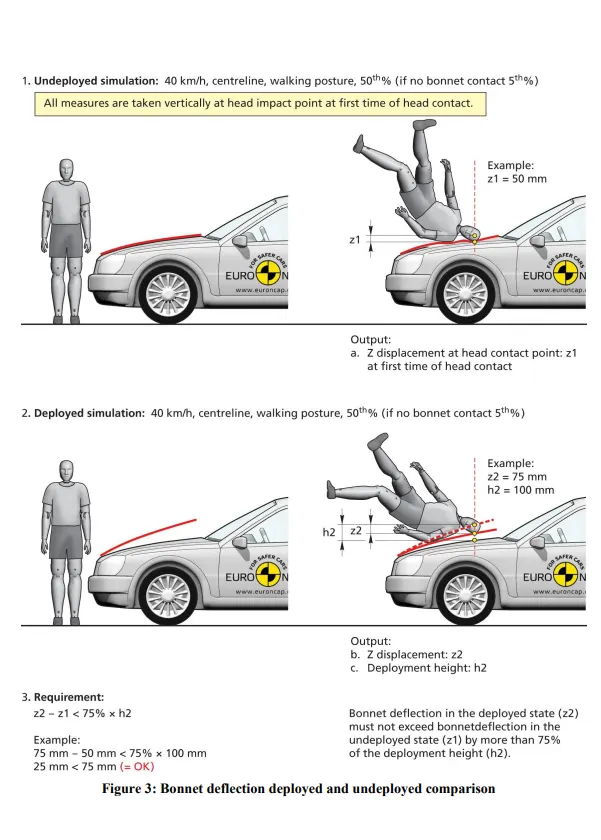
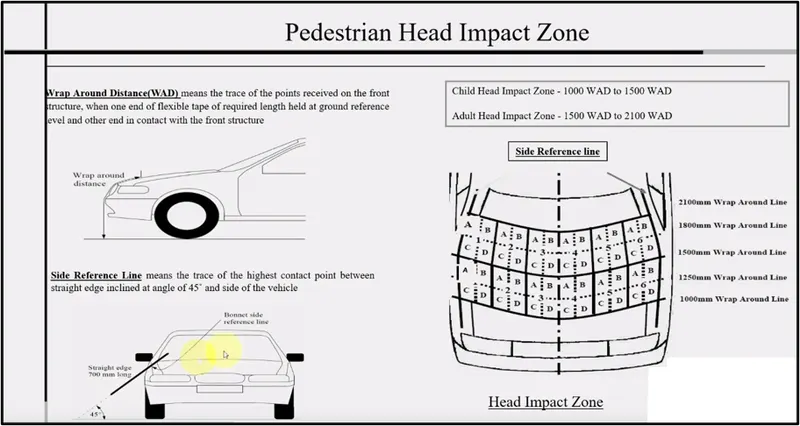
It is important to consider the safety of pedestrians as when your car hits the pedestrian during a crash. He may got hit at the hood it is very important to study the areas over the hood where different body parts of pedestrians are going to hit. So,we should also need to study the average height of adults and children while designing our hood.
MASTIC DATA:
This is the data which is given in points where the mastic material is applied between the hood inner and outer panel. This is given to avoid noise and vibrations which come from the roads and gives the hazzle free journey.
Hood support:
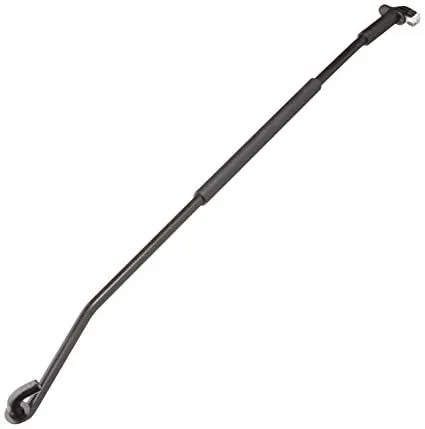
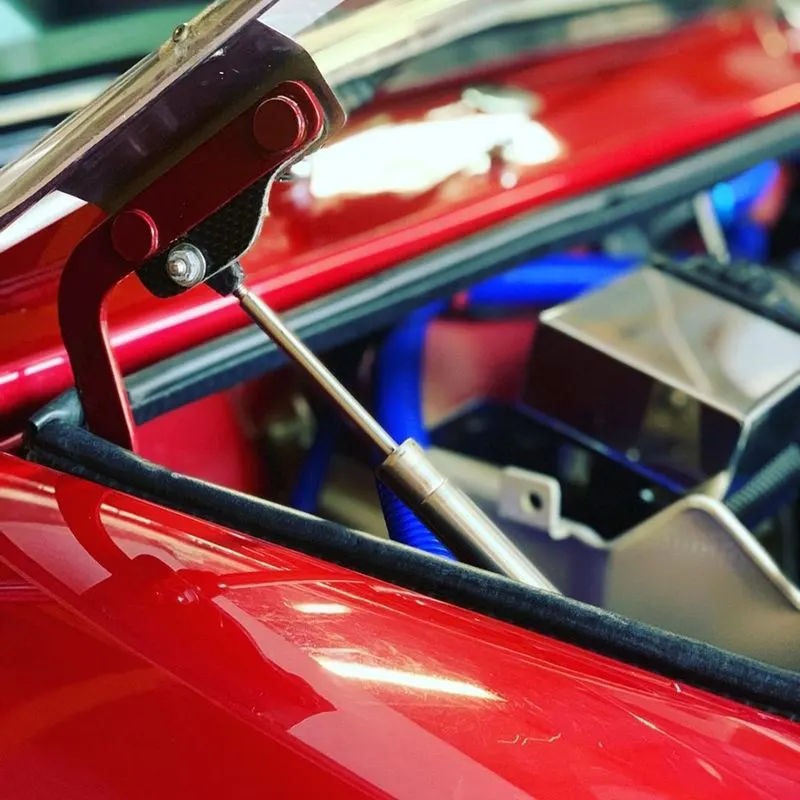
when we open the hood we need to support it for the operations to b done. For the support we can do it manually for a long time. So there are two types of hood support.
1. Support rod:
2. Stay gas:
5. LATCH TRAJECTORY:
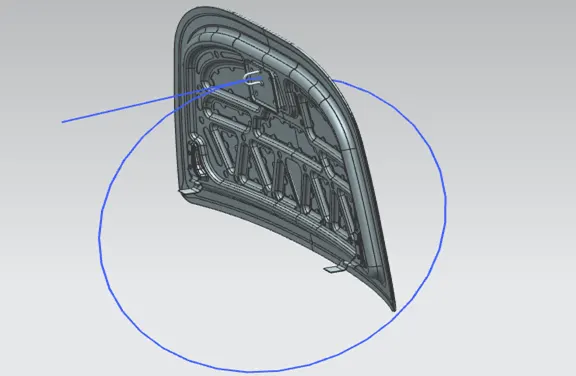
The latch trajectory shows the path of the striker when the hood is opened and closed on a vehicle. The radius of the circular trajectory is can be explained by the standards based on the average height of a person. The radius is measured from the hinge axis up-to the latch
.
MANUFACTURING PROCESS IN AUTOMOBILES;
There are some of the forming sheet metal manufacturing process in automobile industries:
They are :
1. Deeping drawing
2. Embossing
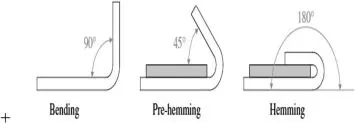
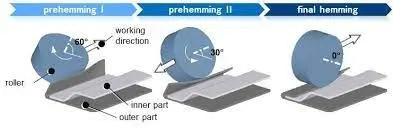
3. Hemming
1. DEEPING DRAWING:
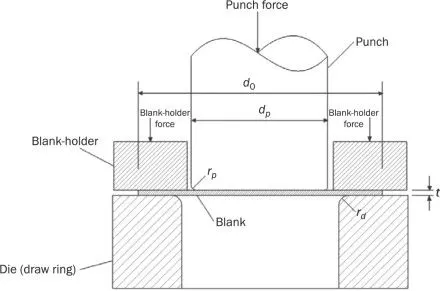
Deep drawing is a sheet forming process in which a sheet metal blank is radially drawn into a forming die by the mechanical action of a punch. It is thus a shape transformation process with material retention. The process is considered "deep" drawing when the depth of the drawn part exceeds its diameter. This is achieved by redrawing the part through a series of dies. The flange region (sheet metal in the die shoulder area) experiences radial drawing stress and tangential compressive stress due to the material retention property. These compressive stresses result in flange wrinkles (wrinkles of the first order). Wrinkles can be prevented by using a blank holder, the function of which is to facilitate controlled material flow into the die radius.
Deep drawing processes are divided into three types:
- Deep drawing with tools
- Deep drawing with active means
- Deep drawing with active energy
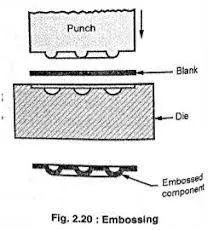
2. EMBOSSING:
Sheet metal embossing is a stamping process for producing raised or sunken designs or relief in sheet metal. This process can be made by means of matched male and female roller dies, or by-passing sheet or a strip of metal between rolls of the desired pattern. It is often combined with Foil Stamping to create a shiny, 3D effect.
3.HEMMING:
Sheet metal are thinner than plate metal (.25 in and thicker) but thicker than foil (.006 in and thinner). It’s most commonly available in steel and aluminium, in various gauges (thicknesses). It’s available with various coatings for corrosion resistance or surface finish. Sheet metal is made by taking a large cast ingot and rolling it into a long ribbon of the desired thickness. This long, flat piece of metal is then rolled into a coil and sent directly or cut into sheets before being sent to a machine shop.
Below is the hood assy attachment .Please find the attachment.