Section Modulus calculation and optimization
Objective:
to determine the previous design's section modulus in order to analyse its strength and to improve the design in order to see a difference in the bending strength of the hood.
Introduction:
- Section Modulus is a geometric property for a given cross-section used in the design of beams or flexural members. Other geometric properties used in design include area for tension and shear, radius of gyration for compression, and moment of inertia and polar moment of inertia for stiffness.
- There are two types of section moduli, the elastic section modulus and the plastic section modulus.
- For general design, the Elastic section modulus is used, applying up to the yield point for most metals and other common materials.
- The elastic section modulus is defined as S = I / y, where I is the second moment of area (or area moment of inertia, not to be confused with moment of inertia) and y is the distance from the neutral axis to any given fibre.
- It is also often used to determine the yield moment (My) such that My = S × σy, where σy is the yield strength of the material which is maximum allowable load in a mechanical component.
- The Plastic section modulus is used for materials where elastic yielding is acceptable and plastic behavior is assumed to be an acceptable limit.
Calculating Procedure:
First we take an intersection curve of outer hood panel and inner panel in specific datum plane. Project intersection curve on new sketch and then trimmed inner geometry and closed outer geometry with lines and will get an closed profile sketch to measure the inertia. later we use “Measure the Inertia” option and by selecting the profile will get inertia, we use min inertia for 'I' from the formula of section modulus (S = I / y)
Y will be the distance of neutral axis to extreme end point of the hood.
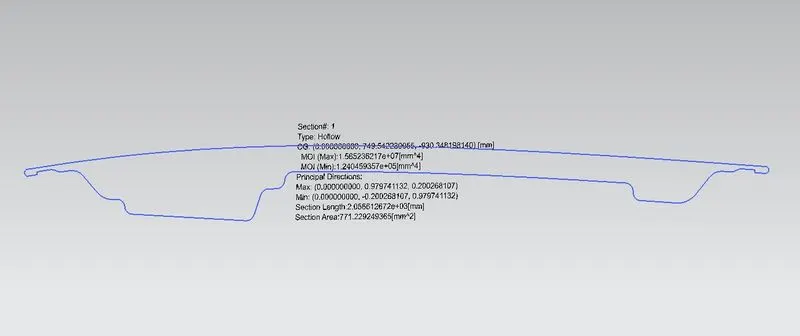
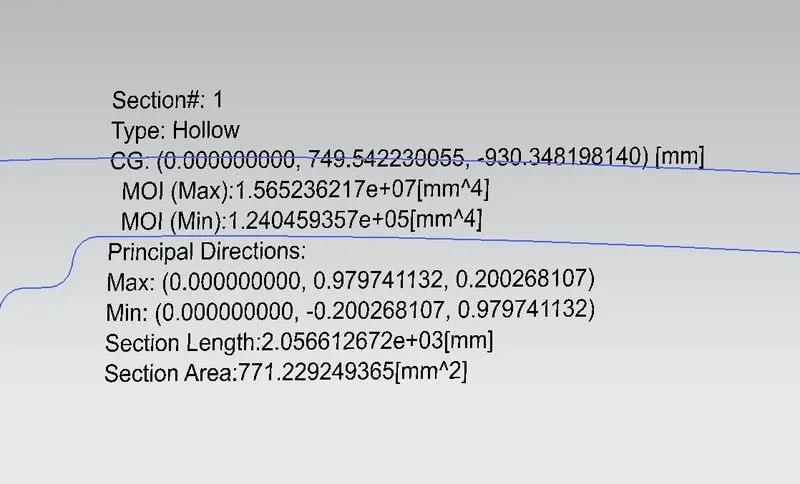
Moment of inertia(max) = 1.56523×10^7×mm^4
Moment of inertia(min) = 1.24045×10^5×mm^4
Y=472.8097/2=236.40485 mm
S=I/Y
S=1.24045×10^5/236.405= 5.24 mm^3
Hood Design Optimization
By increasing the depth of the inner panel by 0.5 mm
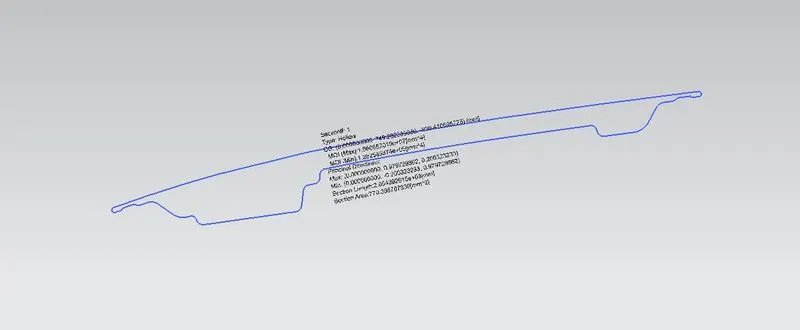
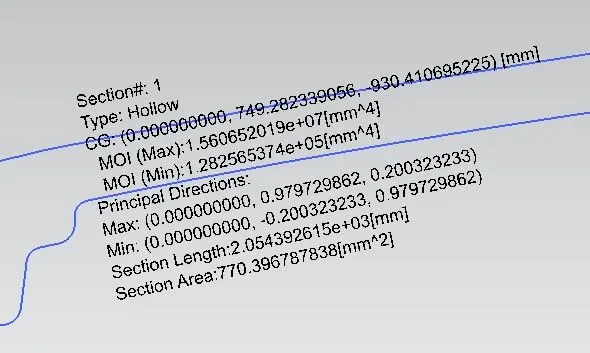
Moment of inertia(max) = 1.56065×10^7×mm^4
Moment of inertia(min) = 1.28256×10^5×mm^4
Y=472.8097/2=236.40485 mm
S=I/Y
S=1.28256×10^5/236.405= 5.42 mm^3
Conclusion:
So, here the difference can be seen in the moment of inertia and the change in the section modulus can be seen by the change in the design(depth)