Section Modulus calculation and optimization
REPORT FOR SECTION MODULUS CALCULATION AND OPTIMIZATION
Aim:
To use the Section from your Hood design and calculate the Section Modulus using the formula
S = I/y
Where,
S = Section Modulus
I = Moment of Inertia
y = distance between the neutral axis and the extreme end of the object
And, to find the section modulus of the hood and optimization to improve the overall section modulus.
Section modulus:
The section modulus (S) is the geometric property of the cross-section used for designing beams and flexural members. It does not represent anything physically.
-
The formula of Section Modulus:
It may be defined as the ratio of the total moment resisted by the section to the stress in the extreme fiber which is equal to yield stress.
S=I / Ymax
Where,
S = Section modulus (mm^3)
I = Moment of inertia (mm^4)
Y = Distance between neutral axes and outermost fiber (mm)
Moment of inertia:
The moment of inertia, otherwise known as the mass moment of inertia, angular mass, second moment of mass, or most accurately, rotational inertia, of a rigid body, is a quantity that determines the torque needed for a desired angular acceleration about a rotational axis, akin to how mass determines the force needed for the desired acceleration. It depends on the body's mass distribution and the axis chosen, with larger moments requiring more torque to change the body's rate of rotation.
Sectional Modulus Calculation and Optimization:
Frontal Impact:
Case 1:
Here is the sectional modulus of hood design before optimization of Front Impact:
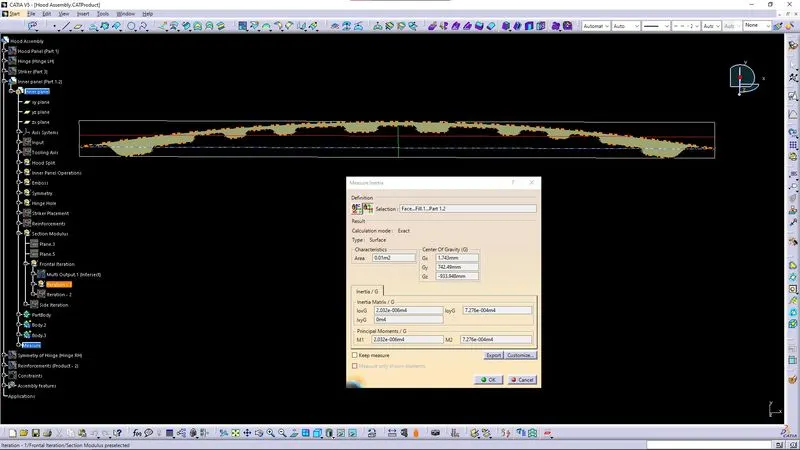
Length: Distance between neutral axes and outermost fiber (mm)
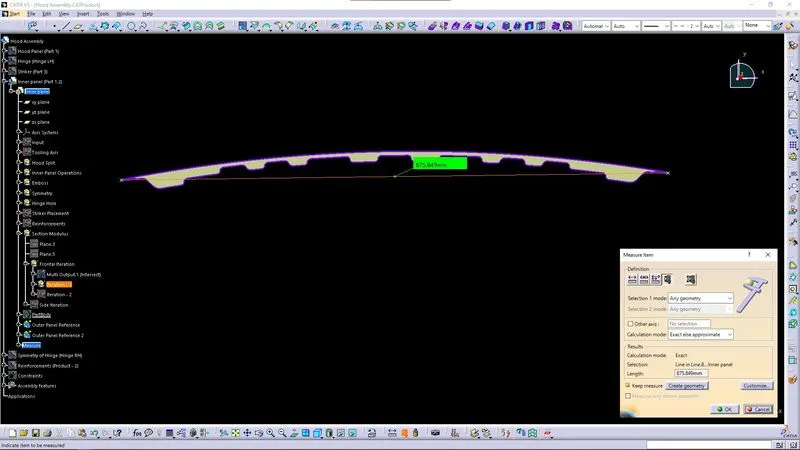
Distance between the outermost end to another outermost end (d) = 875.849mm
Case 2: Optimized design
In order to increase the sectional modulus, the cross-sectional area has to be increased. So here is the optimized design:-
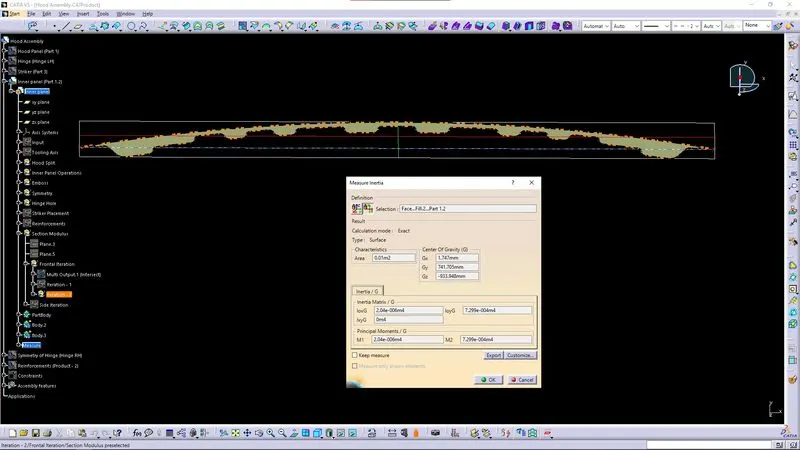
Table of Section Modulus Calculation of Front Crash:
|
Moment of Inertia (I) before Optimization in Moment |
Moment of Inertia (I) After Optimization in Distance |
Distance (Y=d/2) in mm |
Section Modulus before optimization (S1 = I/Y) in mm |
Section Modulus after optimization (S2 = I/Y) in mm |
|
|
Minimum |
M1 = 2.032*10^6 |
M1 = 2.04*10^6 |
875.849/2 = 437.92 |
4640.11 | 4659.73 |
|
Maximum |
M2 = 7.276*10^8 |
M2 = 7.299*10^8 | 437.92 | 1661490.68 | 1667226.29 |
Results:
- As we increase the section area, the moment of inertia & section modulus increase which means strength and load material also increase. Which is the moment of inertia directly proportional to the strength of the material.
- x - x - x -
Side Impact:
Case 1:
Here is the sectional modulus of hood design before optimization of Side Impact:
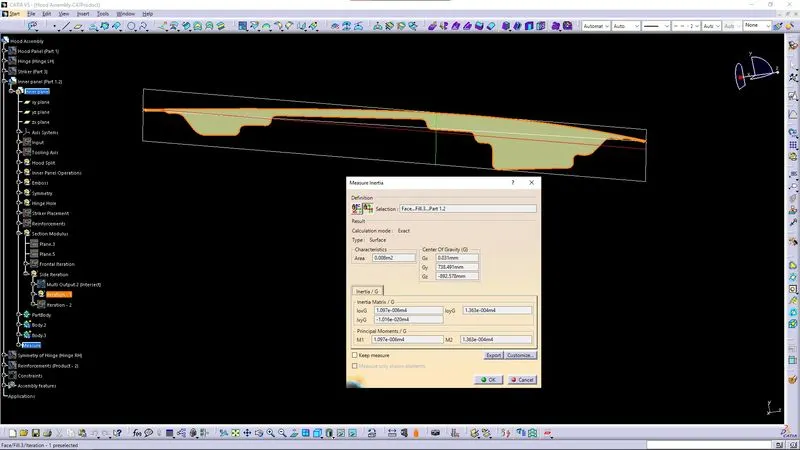
Length: Distance between neutral axes and outermost fiber (mm)
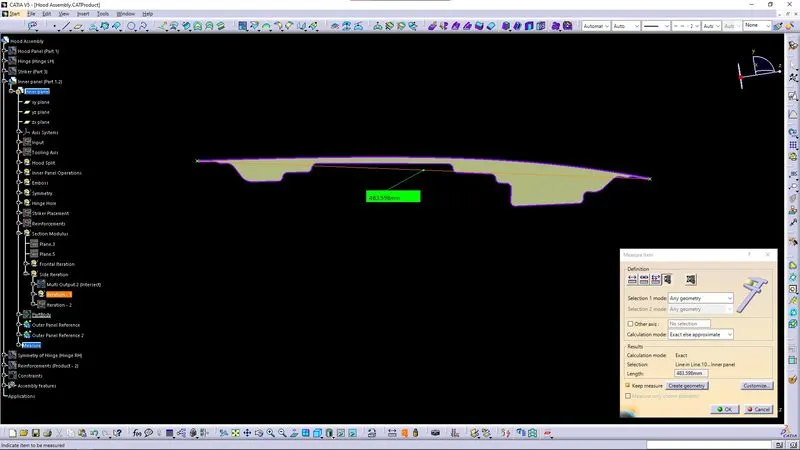
Distance between the outermost end to another outermost end (d) = 483.598mm
Case 2: Optimized design
In order to increase the sectional modulus, cross-sectionalonal area has to be increased. So here is the optimized design:-
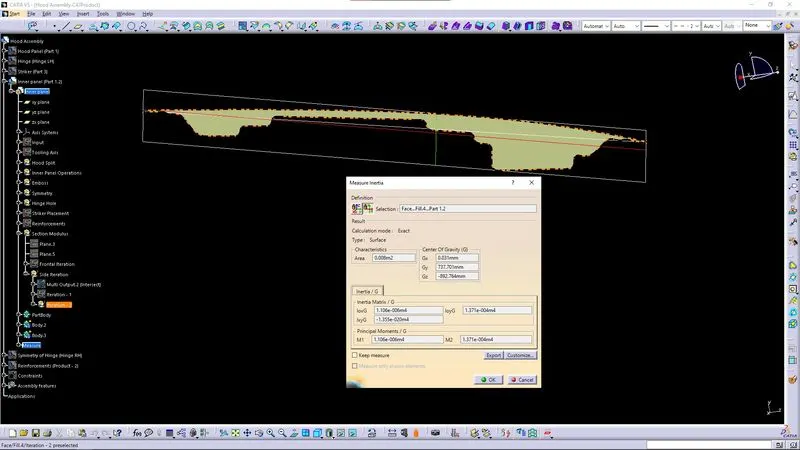
Table of Section Modulus Calculation of Side Crash:
|
Moment of Inertia (I) before Optimization in Moment |
Moment of Inertia (I) After Optimization Distance |
Distance (Y=d/2) in mm |
Section Modulus before optimization (S1 = I/Y) in mm |
Section Modulus after optimization (S2 = I/Y) in mm |
|
|
Minimum |
M1 = 1.097*10^5 |
M1 = 1.106*10^5 |
483.598/2 = 241.799 |
4536.82 | 4575.63 |
|
Maximum |
M2 = 1.363*10^8 |
M2 = 1.371*10^8 | 241.799 | 563691.33 | 567196.90 |
Result:
- As we increase the section area, the moment of inertia & section modulus increase which means strength and load material also increase. In which the moment of inertia is directly proportional to the strength of the material.
- x - x - x -
Conclusion:
- Hence when comparing case 1 & case 2, Section Modulus the Hood of the car was calculated and optimized section modulus with some changes or optimization and found some better results.
- In which this concludes if front and Side Impact loads will be applied to the Hood, if it is flat then force will not be distributed properly and the hood is weak compared to the embossed one, so that we create primary and secondary embosses, Which Results in increasing the section modulus.As we increase the section modulus increase which means strength increases and stress decreased.
- - -