Section Modulus calculation and optimization
Section Modlus:-
Section modulus is a geometric property for a given cross section used in the design of beams or flexural members. Other geometric properties used in the design include area for tension and shear, radius of gyration for pressure and moment of inertia, and polar moment of inertia for stiffness. Any relationship between these properties is highly dependent on the shape involved. Equations for the section moduli of common shapes are given below. There are two types of section moduli, elastic section modulus and plastic section modulus. The section moduli of various profiles can also be found as numerical values for common profiles in tables listing the properties of such profiles.
Sectio Modlus Formula:- S =I/Y
Here;
S = Section Modulus
I = Moment of inertia
Y = Distance For Netural axis to the end
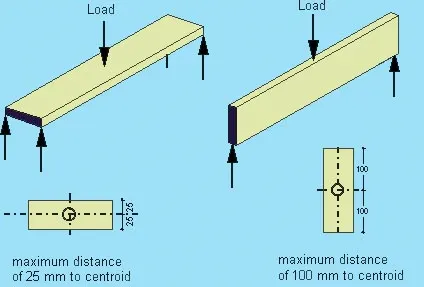
Elastic Section Modulus:-
For general design, the modulus of elasticity of the section is used, which is applied up to the yield point for most metals and other common materials.The elastic section modulus is defined as S = I / y, where I is the second moment of area (or area moment of inertia, not to be confused with moment of inertia) and y is the distance from the neutral axis to the given fiber. . It is often given using y = c, where c is the distance from the neutral axis to the outermost fiber, as seen in the table below. It is also often used to determine the yield moment (My) such that My = S × σy, where σy is the yield strength of the material.
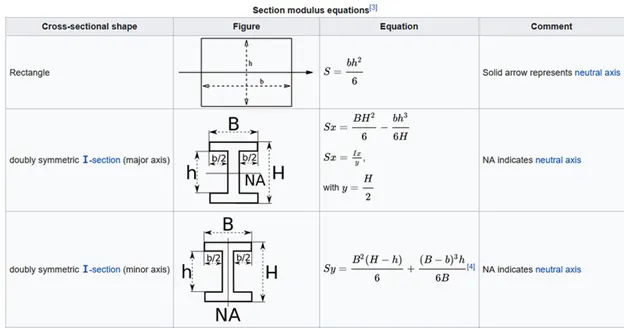
Plastic Section Modulus:-
The plastic section modulus is used for materials where elastic yielding is acceptable and plastic behavior is considered an acceptable limit. Designs generally try to stay below the plastic limit to avoid permanent deformations, often comparing plastic capacity with amplified forces or stresses.The plastic section modulus depends on the location of the plastic neutral axis (PNA). The PNA is defined as the axis that divides the cross-section such that the compressive force from the region in compression equals the tensile force from the region in tension. So for sections with constant yield stress the area above and below the PNA will be the same, but for composite sections this is not necessarily the case.The plastic section modulus is the sum of the cross-sectional areas on each side of the PNA (which may or may not be the same) multiplied by the distance from the local centroids of the two areas to the PNA:
= +
The modulus of the plastic section can also be called the "first moment of area.The plastic section module is used to calculate the plastic moment, Mp or full capacity of the section. These two terms are connected by the yield strength of the respective material, Fy, using Mp=Fy*Z. The plastic section modulus and the elastic section modulus are related by a shape factor, which can be denoted by "k", which is used to indicate the capacity above the elastic limit of the material. This could be shown mathematically by the formula:-
K=Z/S
the form factor for a rectangular cross-section is 1.5.
So here we calculate the modulus of elasticity
Case 1:-
Study of desigen for Hood Inner panel
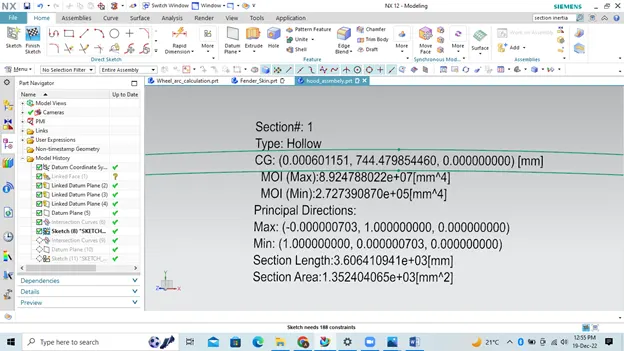
Moment of Inertia maximum=8.924788088 X []
Moment of Inertia minimum=2.727390870 X []
Distance b/w he netural axis and the extreme end of the object Y=879.453/2 [ Y=439.72]
Section Modulus(S)= I/Y
For Maximum,
Smax=20.2965253 X []
For Minimum,
Smin=6.202562699 X []
Case 2:-
Hood Desigen Optimization:-
Increase the depth of Inner pannel 1mm
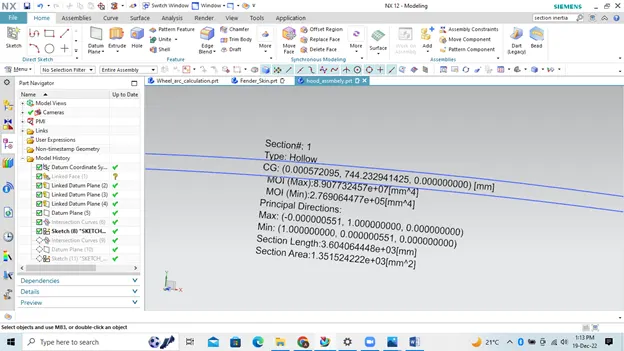
Moment of Inertia maximum=8.907732457 X []
Moment of Inertia minimum=2.769064477 X []
Distance b/w he netural axis and the extreme end of the object Y=439.72
Section Modulus(S)= I/Y
For Maximum,
Smax=20.2577377809 X []
For Minimum,
Smin=6.2973357523 X []
Conclusion:-
The section modulus of the car hood was calculated and optimized section modulus with some changes or optimization and found some better results.