Section Modulus calculation and optimization
Objective:
Use the Section of Hood design and calculate the section modulus using the formula S = I/y
S = Section Modulus
I = Moment of Inertia
Y = distance between the neutral axis and the extreme end of the object
Create a new section that has improved the section modulus of the previous section
Consider Stainless steel AISI 302 – cold-rolled – y = 520 M Pa
Section Modulus:
Section modulus is a geometric property for a given cross-section used in the design of beams or flexural members. Other geometric properties used in design include area for tension and shear, radius of gyration for compression, and second moment of area and polar second moment of area for stiffness. Any relationship between these properties is highly dependent on the shape in question. Equations for the section moduli of common shapes are given below. There are two types of section moduli, the elastic section modulus and the plastic section modulus.
The section modulus is used by engineers to quickly predict the maximum stress a bending moment will cause on a beam. The equation for the maximum absolute value of the stress in a beam subjected to bending:
σm = MY/I
where:
- σm — Maximum absolute value of the stress in a specific beam section;
- M — Bending moment to which the beam is subjected in that section;
- y — Largest distance from the neutral axis to the surface of the member; and
- I — Second moment of area (also known as area moment of inertia) about the section neutral axis (also calculated by this tool)
For example, in a circle, the largest distance equals the radius, while it equals half the height in a rectangle.
As the ratio I/c only depends on the geometric characteristics, we can define a new geometric property from it, called the section modulus, denoted by the S letter:
S = I/Y
As well as the second moment of area, this new geometric property is available in many tables and calculators, but if you want to know how to calculate section modulus from the moment of inertia, simply divide I by c, and you'll get it.
Finally, we can relate the section modulus to the stress and moment:
σm = M/S
Take these considerations into account when calculating section modulus and maximum stresses:
- We obtain the bending moment through a static or structural analysis of the beam.
- To get the section modulus, we can use tables for predefined structural members, but this calculator is the best option if you're dealing with custom geometries.
- If we're considering a uniform section beam (as usual), the location of the maximum stress will be at the point of maximum bending moment. If that's not the case, σm could be at a different place.
- The previous formulas apply to materials that exhibit an elastic behavior and obey Hook's law. When there's plastic deformation instead of elastic deformation, we need to use the plastic section modulus.
Calculation of Section Modulus
Case 1
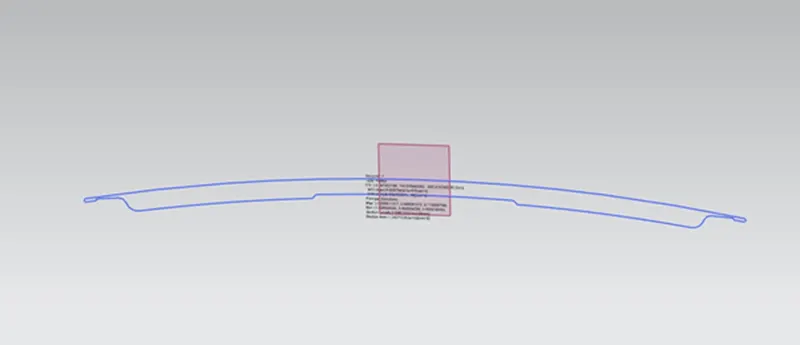
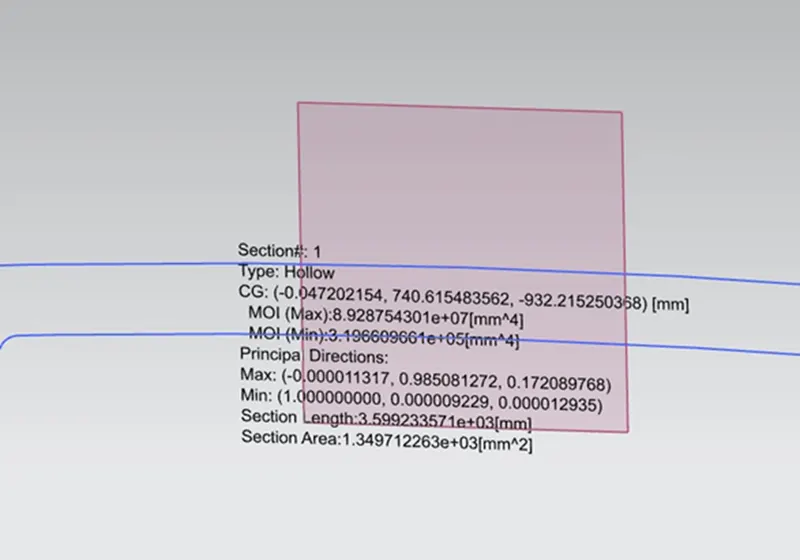
MOI (max) = 8.928754301e+07 (mm^4)
MOI (min) = 3.196609661e+05 (mm^4)
As per the section modulus equation,
S = I/Y
I = MOI (min) value is considered
Y = Total distance /2, Total distance =875.5680mm
Y = 875.5680 / 2
= 437.784 mm
Therefore, S = 319660.966 mm^4/437.784 mm
S = 730.179 mm^3
Case 2
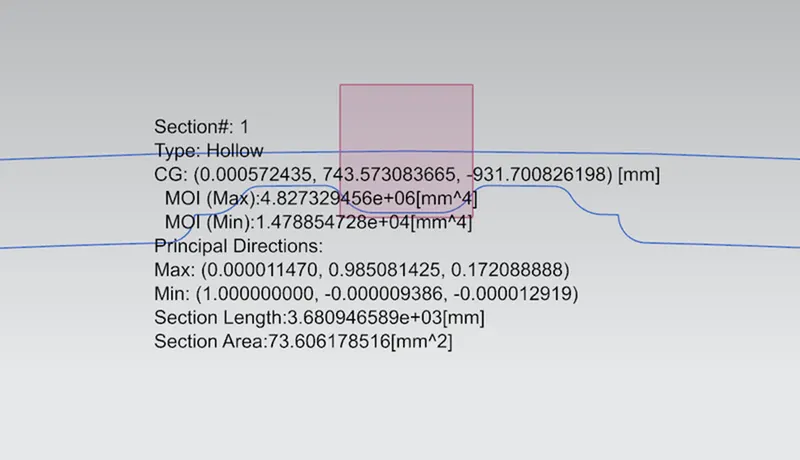
Here the minimum moment of inertia, I = 1.478854728e+04 [mm^4]
The distance between neutral axis and extreme end of the object, Y = 440.7 mm
Therefore the Section Modulus, S = I/Y
S = 1.478854728e +04 [mm^4] / 440.7 [mm]
= 35.9164 [mm^3]
CONCLUSION:
The strength of the material is directly proportional to the moment of inertia, hence increase in sectional area there is have increase in overall mass of an object ,hence have increase in strength.