Hood design-Week 2
AIM
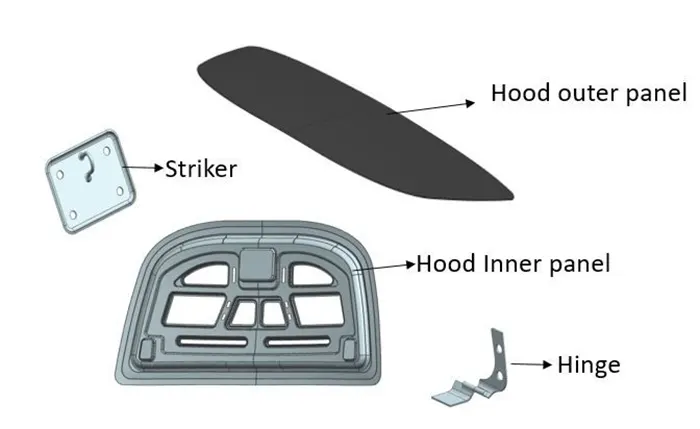
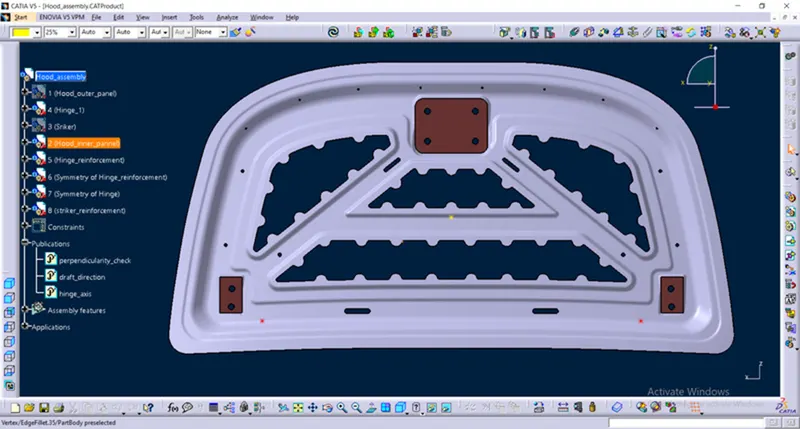
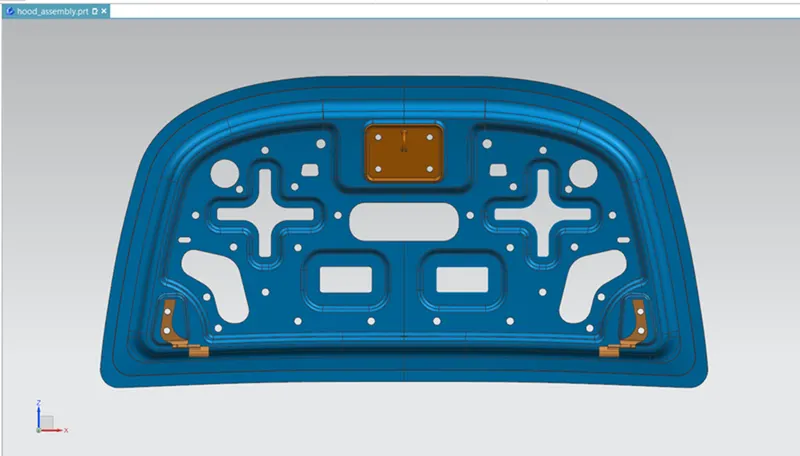
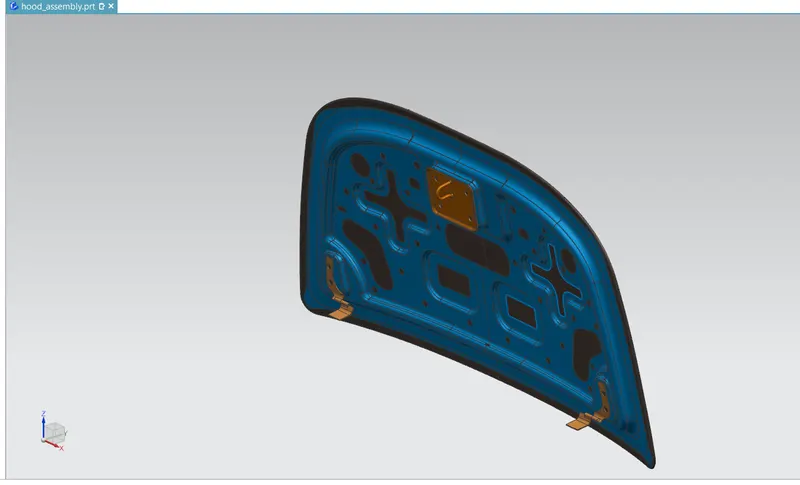
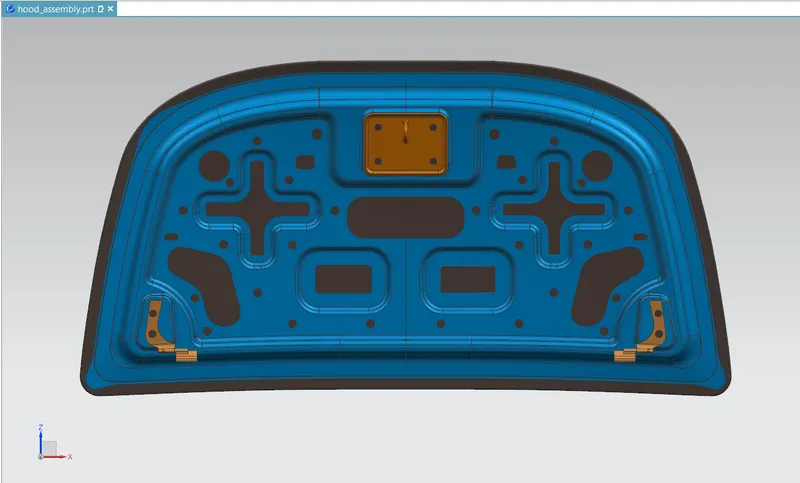
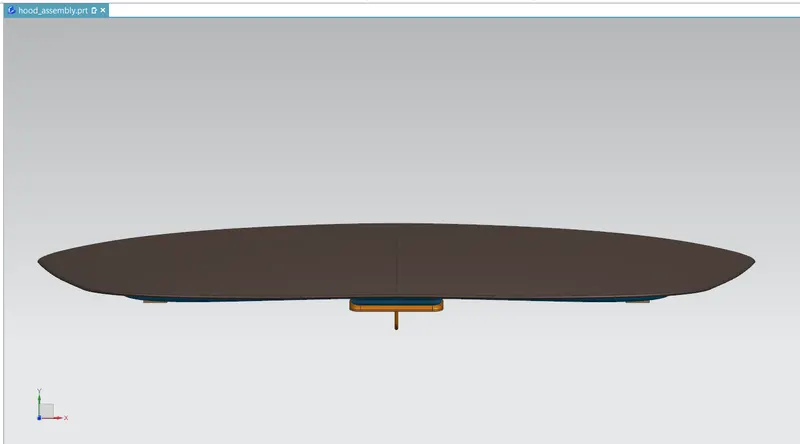
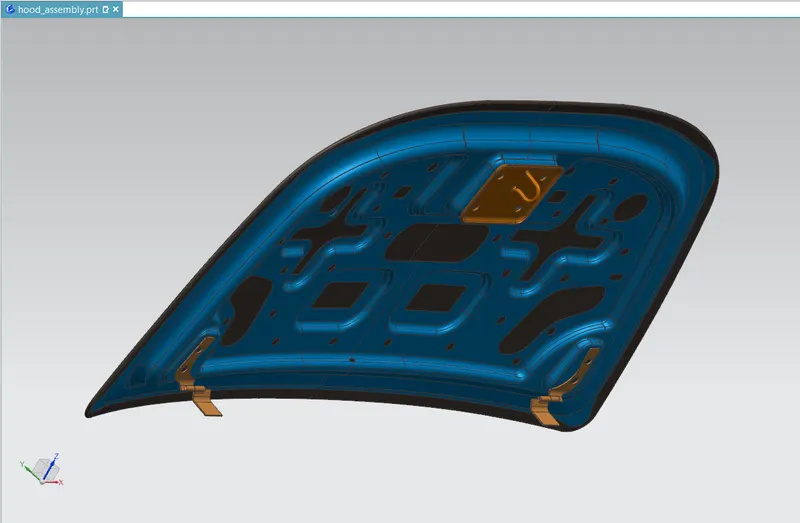
The hood assembly in this project is the construction of a hood assembly from the hood outer panel and the hood inner panel.
INTRODUCTION
A car hood, also referred to as a “bonnet” in some countries, is the hinged cover that rests over the engine bay of a front-engine vehicle. The car hood protects the engine and connected parts from the elements while providing easy access for repairs and maintenance.
Car hoods are typically constructed from steel and sometimes from aluminum. Aftermarket car hoods may be constructed from various other materials, including carbon fiber, fiberglass, or dry carbon.
A concealed latch is typically used to lock the hood in place while driving. A release for the mechanism can be accessed from the dash below the steering wheel. On race cars and vehicles with an aftermarket hood, exposed pins may be used to secure the car hood.
Hoods sometimes contain a hood scoop or a power bulge to allow for greater engine capacity and airflow to increase the car’s performance output
The first important criteria for designing the hood is to set an opening angle till which the hood panel can be opened. This opening angle is different for different countries which largely depends on the average height of a person in that particular country.
The movement of the hood can be controlled by either one of them:
- Gas stay
- Support rod
1.Gas Stayb
A gas spring is a type of spring that, unlike a typical mechanical spring that relies on elastic deformation, uses compressed gas contained within an enclosed cylinder sealed by a sliding piston to pneumatically store potential energy and withstand external force applied parallel to the direction of the piston shaft
2.Support Rod
A hood stay rod for a vehicle is provided to use conveniently, and to prevent pollution by installing and releasing a hood stay rod automatically according to opening and closing a hood without using a hand.
Padestrian safety
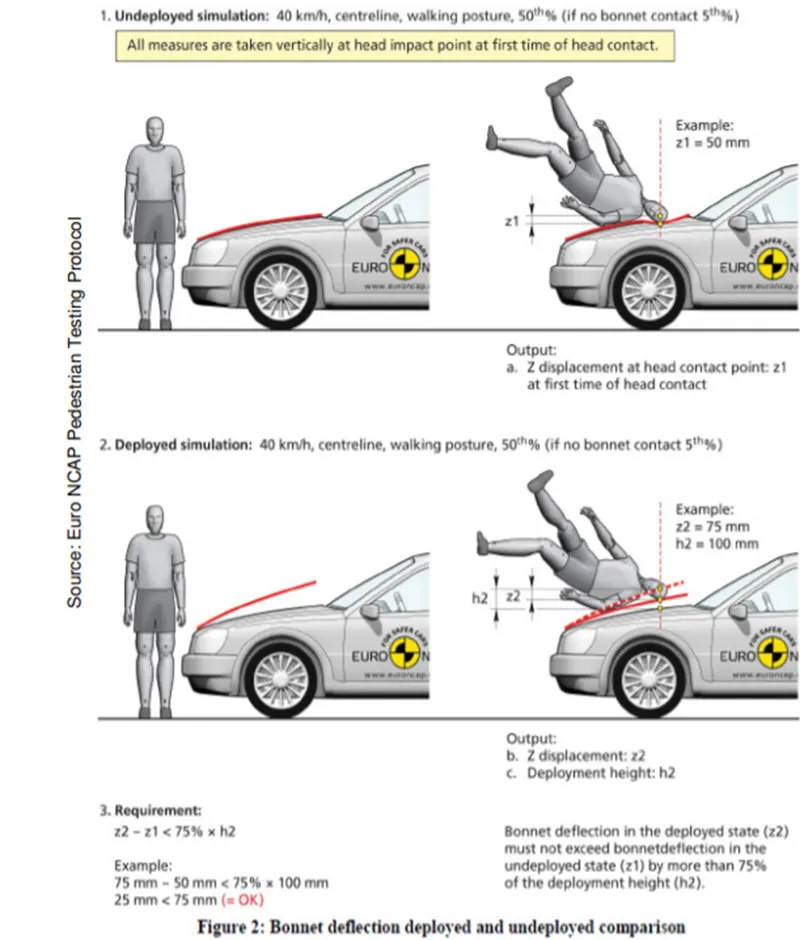
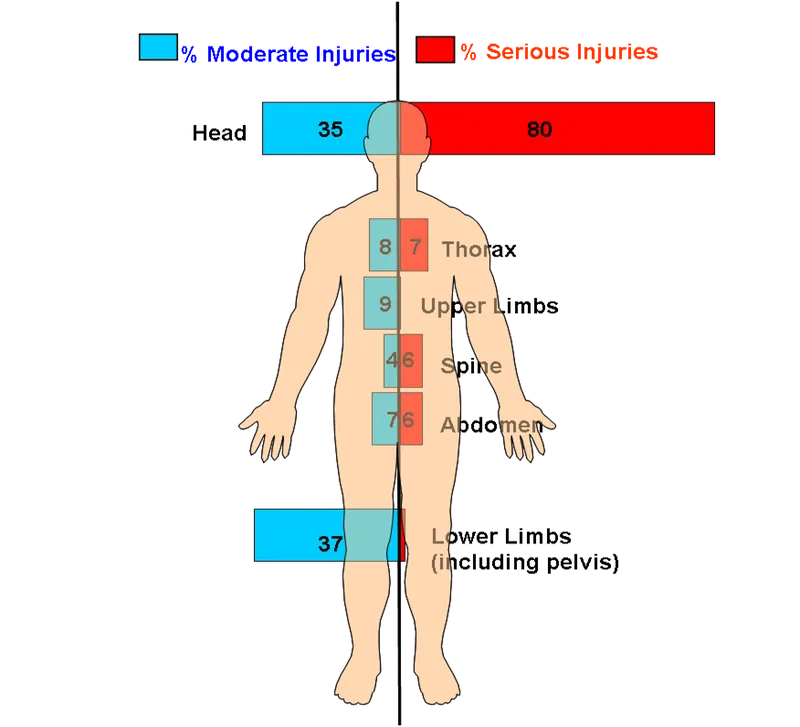
The hood of most vehicles is usually fabricated from sheet metal, which is a compliant energy absorbing structure which poses a comparatively small threat. Most serious head injuries occur when there is insufficient clearance between the hood and the stiff underlying engine components. A gap of approximately 10 cm is usually enough to allow the pedestrian’s head to have a controlled deceleration and a significantly reduced risk of death.Creating room under the hood is not always easy because usually there are other design constraints, such as aerodynamics and styling. In some regions of the hood it can be impossible. These include along the edges on which the hood is mounted and the cowl, where the hood meets the windshield. Engineers have attempted to overcome this problem by using deformable mounts, and by developing more ambitious solutions such as airbags that are activated during the crash and cover the stiff regions of the hood.Some models, like the Citroën C6 and Jaguar XK feature a novel pop-up bonnet design, which adds 6.5 cm (2.5", C6) extra clearance over the engine block if the bumper senses a hit. In 2012 and 2015, the Volvo V40 and the Land Rover Discovery Sport have an under-the hood airbag designed to operate if the hood senses a hit. The airbag is also designed to cover the windshield pillars to help protect the pedestrian's head.
Noise, vibration, and harshness (NVH)
Noise, vibration, and harshness (NVH), also known as noise and vibration (N&V), is the study and modification of the noise and vibration characteristics of vehicles, particularly cars and trucks. While noise and vibration can be readily measured, harshness is a subjective quality, and is measured either via jury evaluations, or with analytical tools that can provide results reflecting human subjective impressions. The latter tools belong to the field psychoacoustics.
Interior NVH deals with noise and vibration experienced by the occupants of the cabin, while exterior NVH is largely concerned with the noise radiated by the vehicle, and includes drive-by noise testing.
NVH is mostly engineering, but often objective measurements fail to predict or correlate well with the subjective impression on human observers. For example, although the ear's response at moderate noise levels is approximated by A-weighting, two different noises with the same A-weighted level are not necessarily equally disturbing. The field of psychoacoustics is partly concerned with this correlation.
In some cases the NVH engineer is asked to change the sound quality, by adding or subtracting particular harmonics, rather than making the vehicle quieter.
Design parameters
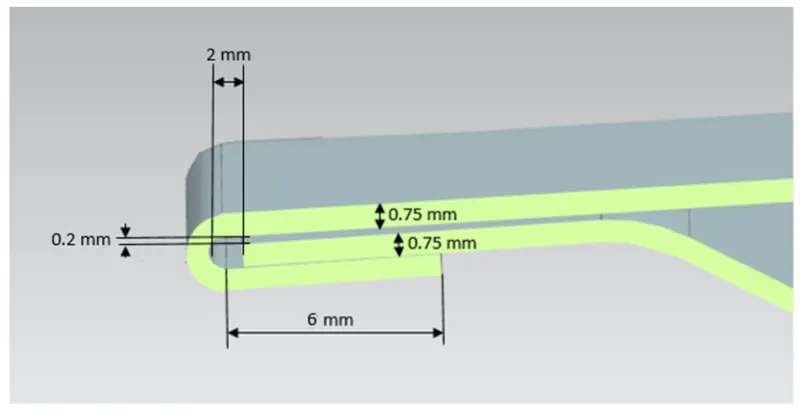
- Outer Panel Thickness = 0.75mm
- Inner Panel Thickness = 0.75mm
- Reinforcement Thickness = 1.5mm
Master sketch
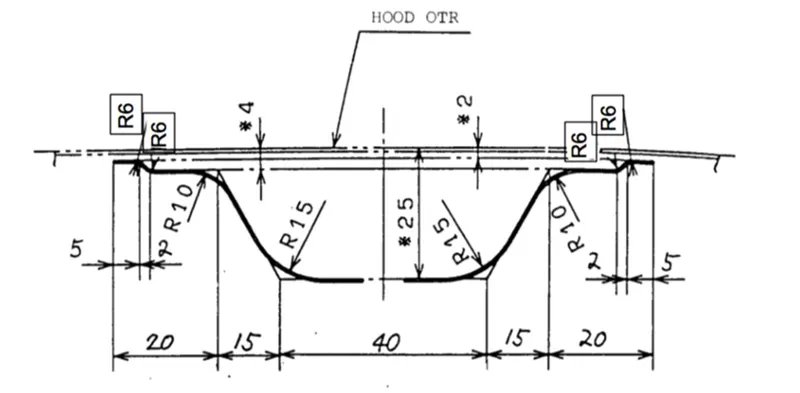
The master section is created based on the requirements received from the marketability team and the manufacturing requirements that we saw before. Below are the images of the master section used for the design
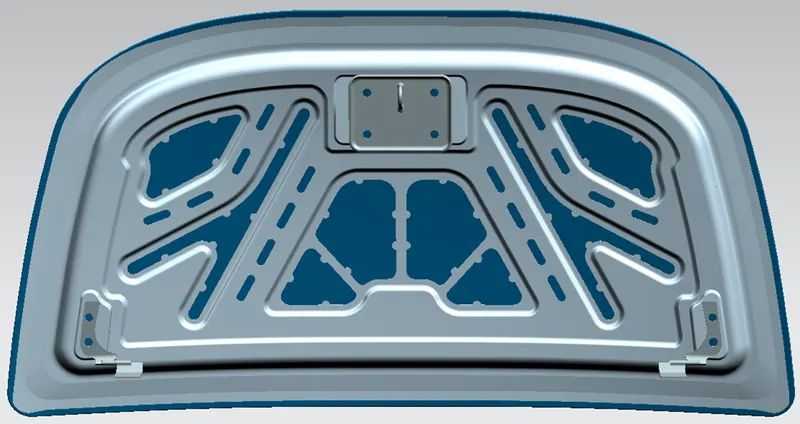
HOOD INNER PANEL
- By using the wave geometry linker the styling surface will be extracted as a linked body.
- The styling surface was trimmed into half using the trim surface along x co-ordinate.
- Then two surfaces at the offset of 0mm were generated and one feature grouped as parent file and the other one was used as the working surface.
- By using the master sketch three surfaces were off-set at a distance of 2mm, 4mm and 25mm downwards.
- For creating the 5mm flange the corner of the tangent curve will be offset inwards at the distance of 20mm with a 30mm filleted corner and the remaining portion was trimmed.
- Then for creating the next flange the second offset surface was trimmed at a distance of 40mm.
- By using through curves both the surface were connected to create a flange at an outward angle of 80 degree as per the manufacturing parameter.
- Then the third surface was trimmed and used to create the flange at the distance of 55mm.
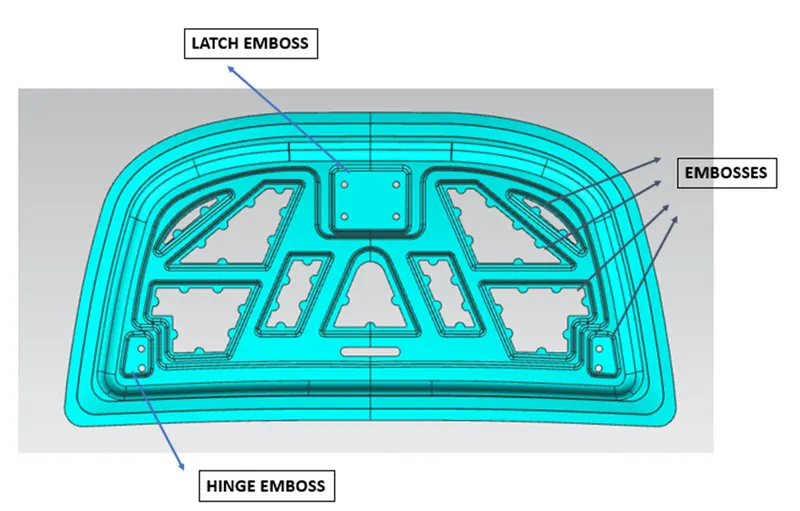
- Then the required embosses were created to reduce the transmission of force and it should satisfy the requirements of NASC regulations and the embosses must have a outward draft to satisfy the tooling direction.
- Below diagram represents the ideology of the design, the orange line represents the direction of force dissipation when the hood attempts an unexpected crash.
- Then by using the edge blend and face blend all the sharp corners were blended and smoothened out as per manufacture requirements.
- For fixing the hinge assembly a flat surfaced embosses were created which is exactly parallel to the x coordinate.
- Then to avoid the intersections while mirroring the intersecting curve was extended and trimmed exactly then the other half was mirrored and sewed together.
- Now the latch emboss was created using the linked surface of the latch and for creating the emboss trim and extend were used following the Law extension.
- Finally the inner panel was created successfully by thickening it to 0.75 mm
HOOD OUTER PANEL
Outer panel is a skin of inner panel which gives a luxurious look to the car, The hamming region is created to the class A surface, Through which the outer panel is joined to the inner panel. The relief has given in the corners. Relief are provided on the surface to avoid springback situations. The thickness is given as per the data i.e, 0.75
Reinforcement :
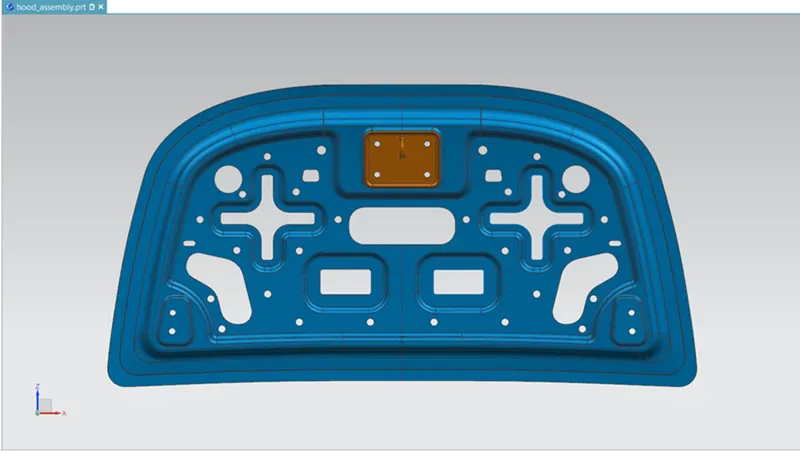
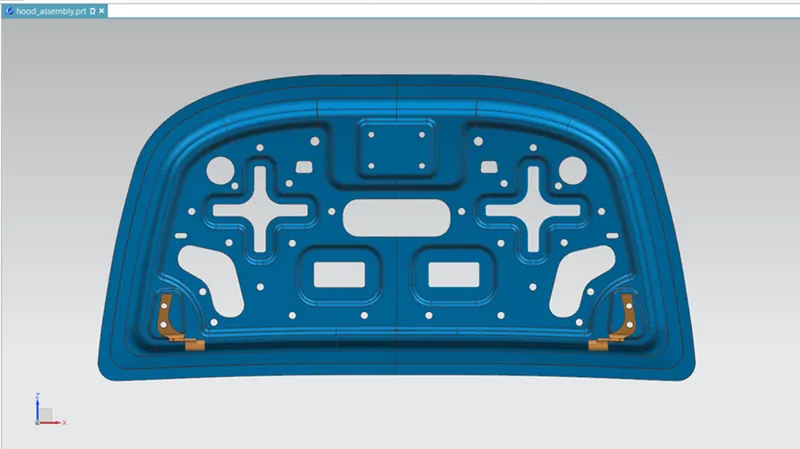
Reinforcements are provided according to the design requirements. Mainly it is provided at the hinge and latch regions to improve the strength locally. Usually thickness of reinforcements will be higher than that of the inner panels and the value varies according to cost and requirement. According to the design requirement here it is given 1.5mm thickness to both hinge and latch reinforcements.
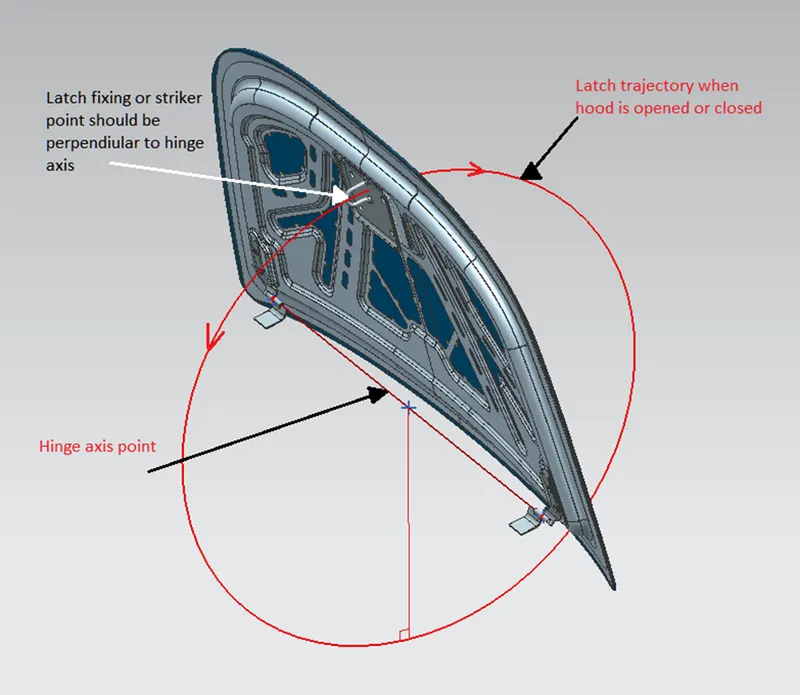
Latch Trajectory :
This handle is connected to an insulated cable that runs towards the front of the vehicle. The other side of the cable is connected to a latch under the hood that keeps the hood flush against the car's body. Pulling the interior release handle will disengage the latch and open the hood a few inches.
Emboss :
This handle is connected to an insulated cable that runs towards the front of the vehicle. The other side of the cable is connected to a latch under the hood that keeps the hood flush against the car's body. Pulling the interior release handle will disengage the latch and open the hood a few inches.
Mastic Sealant Data
A selection of high quality vehicle-specific mastic joint sealants & adhesives from professional vehicle assembly sealant and adhesive manufacturers such as Sika, Geocel and Otto Chemie for a wide variety of commercial and industrial sealing & bonding applications around all types of vehicles. There's specialist Sikaflex vehicle assemble sealants and vehicle adhesives for windscreen assembly, maintenance and repairs, vehicle sealant & adhesives suited to vibration dampening etc. and polyurethane vehicle mastic sealants for waterproofing and bonding which adhere perfectly to a variety of substrates and are suitable for a wide range of timber, metal and glass
Hemming :
Hemming is a technology used in the automotive industry to join inner and outer closure panels together (hoods, doors, tailgates, etc.). It is the process of bending/folding the flange of the outer panel over the inner one. The accuracy of the operation significantly affects the appearance of the car’s outer surfaces and is therefore a critical factor in the final quality of a finished vehicle
HOOD DESIGN
CONCLUSION
The complete assembly of the hood outer and hood inner panel was designed as per requirement.
The latch and the hinges were also placed at appropriate position by following a latch trajectory strategy.