Roof Design
INTRODUCTION TO ROOF:
An automotive roof or car top is the portion of the automobile that sits above the passenger compartment, protecting the vehicle occupants from Sun, Wind, Rain and other external element. Under the styling surfaces that are seen from the outside, there are many other structures under the roof that contributes to its strength and stability. The number of such reinforcement structures/supports differs with respect to the size of the vehicle. They are primarily installed on the flatter areas of the roof to enhance the strength.
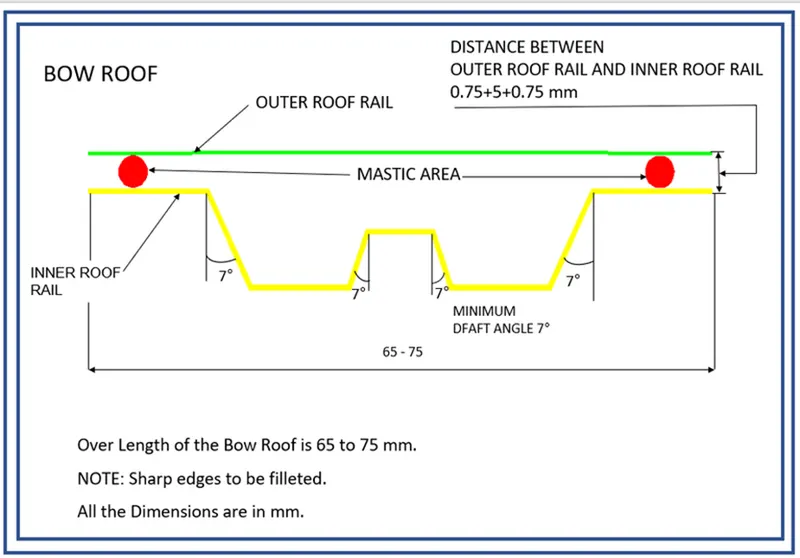
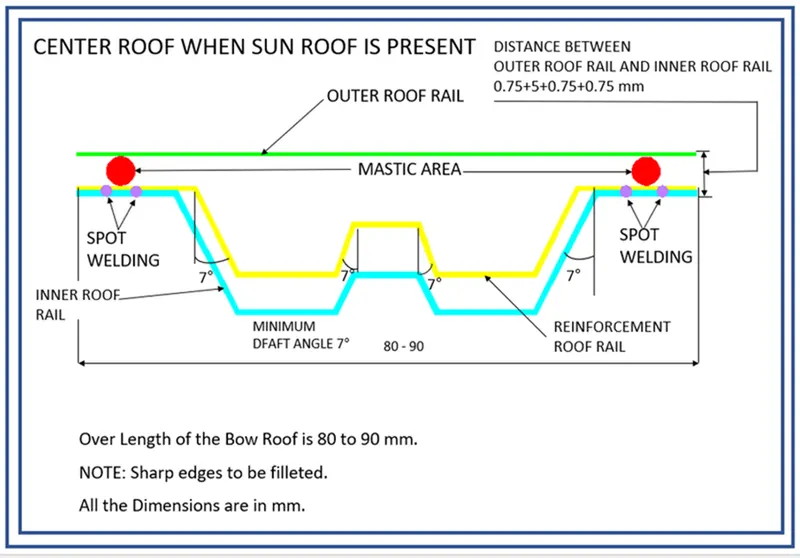
They are the Front Roof Rail, Rear Roof Rail, Center Rail and Bow Roof Design which are given Mastics and spot welded to the roof flanges & ditch and improve NVH value by increasing the strength of the roof using mastics sealants.
TYPES OF CAR ROOFS:
- Convertible roofs
- Hard Tops
- Sunroofs
- T- Tops
- Target tops
- Vinyl roofs
DESIGN CONSIDERATION OF ROOF:
- Visibility Criteria
- Head Clearance
- Curvature Study
- Heat Distortion and snow load criteria
- Draft Analysis
- Safety Parameters
ROOF CRUSH TEST FOR PASSENGER CAR:
Safety point of view vehicle roof plays a very crucial role, especially in rollover kind of accidents, In which vehicle tips over onto its side of the roof Vehicle rollover crashes are the cause of many fatalities and head, neck and spine trauma around the world.
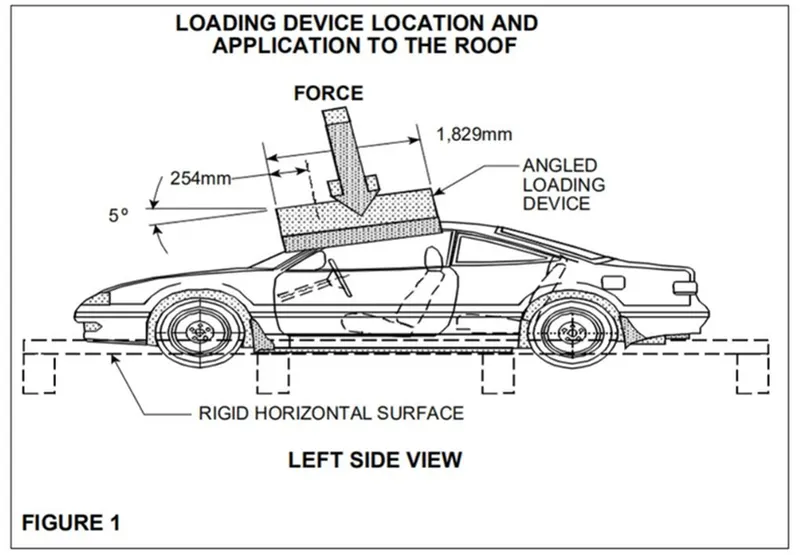
Strength of the roof structure to occupant protection in a real-world rollover crash, requiring the maximum moving distance of the roof structures should be less than 127 mm, (5 in), where the induced load is 1.5 times the vehicle weight.
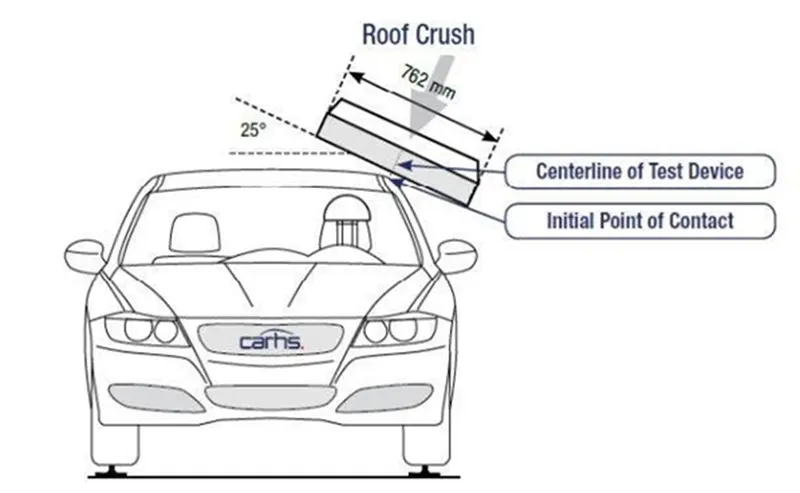
For the test, the passenger can be rigidly placed or positioned on a horizontal surface with the doors locked and the window closed. Furthermore, a flat, rigid block with a lower surface a rectangle measuring 30 inches wide by 72 inches long (762mm x 1829 mm) shall not move more than 5 inches (127mm), measured as the distances between the original location of the lower surface of the test device and its location as the specified force level is reached when it is used to apply a force of 1.5 times the unloaded vehicle weight (UVW) or 5000 lbs. (22224N), whichever is less. To either side or forward edge of the vehicle.
This test can be conducted on either side of the roof structure, the front left or the front right side but not on both sides in one single test and still meet the requirement of the test. The rigid plate shall not move faster than 0.5 inches/second and the force applied on the plate shall not exceed the lesser of 1.5 times the unloaded vehicle weight (UVW) expressed in kilograms multiplied by 9.8 or 5000 lbs. (22240N).
Also, the direction of the force shall be downward and perpendicular to the lower surface of the rigid plate such that it moves in a straight line without rotation. The duration of the test shall not exceed 120 seconds. The longitudinal axis of the plate is pitched forward at a 5’ angle as viewed from the side of the passenger car as shown,
The lateral axis or the roll of the plate is such that it forms a 25’ outboard angle with a horizontal surface as viewed from the front of the passenger car as shown in below, fig
MASTER SECTION AND ITS PARAMETERS:
JOINING PROCESS:
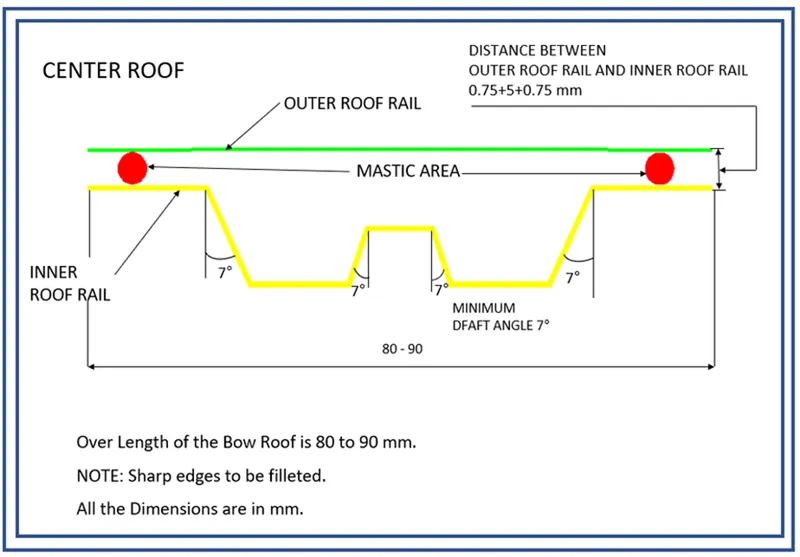
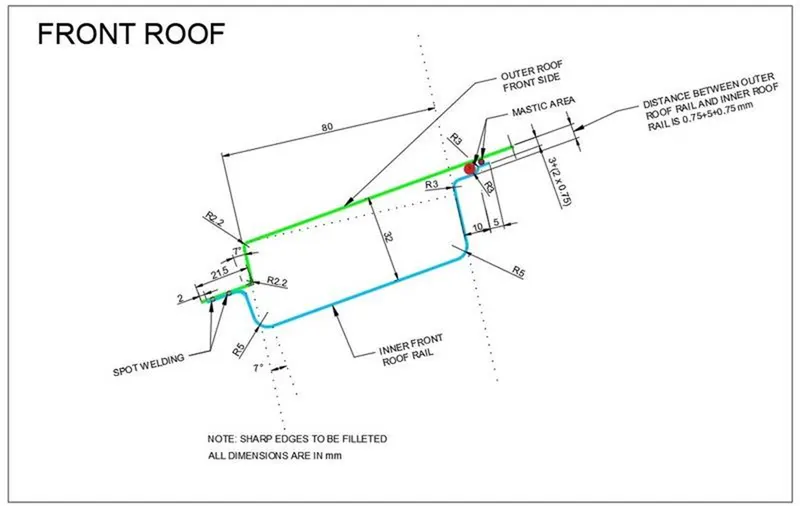
Mastics are introduced between the roof's outer panel and the reinforcements for joining. Where ever the mastics are introduced there is remarkable strength. Spot welding is also introduced to join the reinforcement and the outer panel.
REINFORCEMENT AND ITS TYPES:
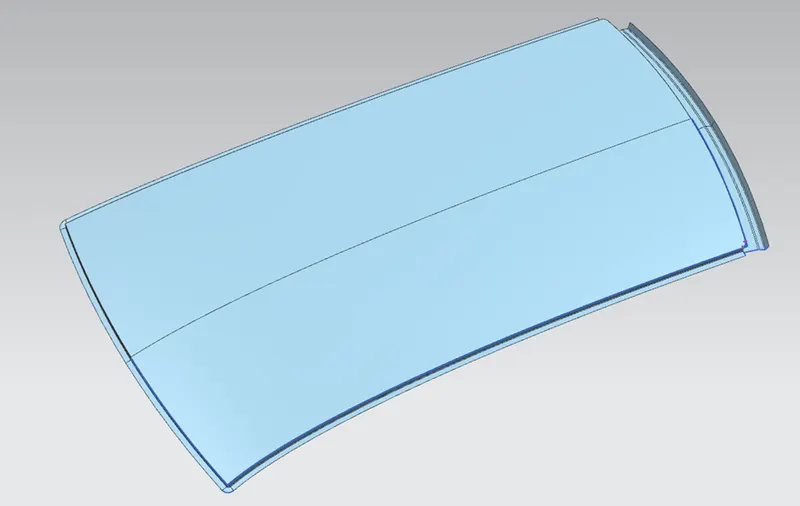
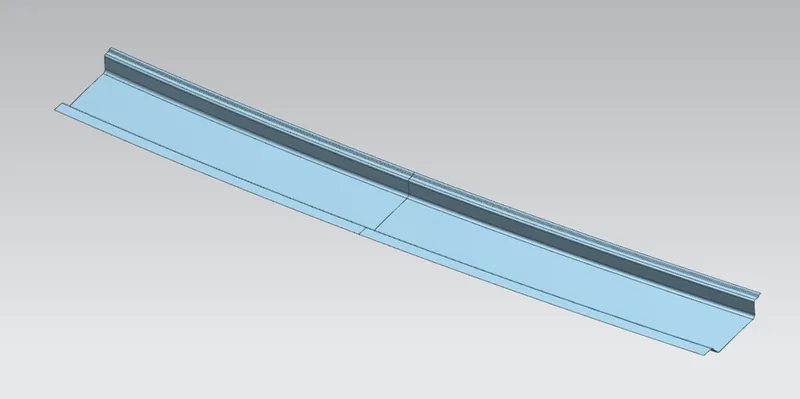
If the roof is flat, it is weak and cannot able to withstand the external load like snow load, roll over and etc. so in order to increase the strength of the roof, reinforcement like front roof rail, central roof rail, rear roof rail and the bow roof are introduced and joined in the flat surface of the roof with different joining process. In general, there are four types of reinforcement used in the hard rooftop they are:
- Front roof rail
- Central Roof rail
- Rear roof rail
- Bow roof rail
ROOF OUTER PANEL:
FRONT ROOF:
REAR ROOF:
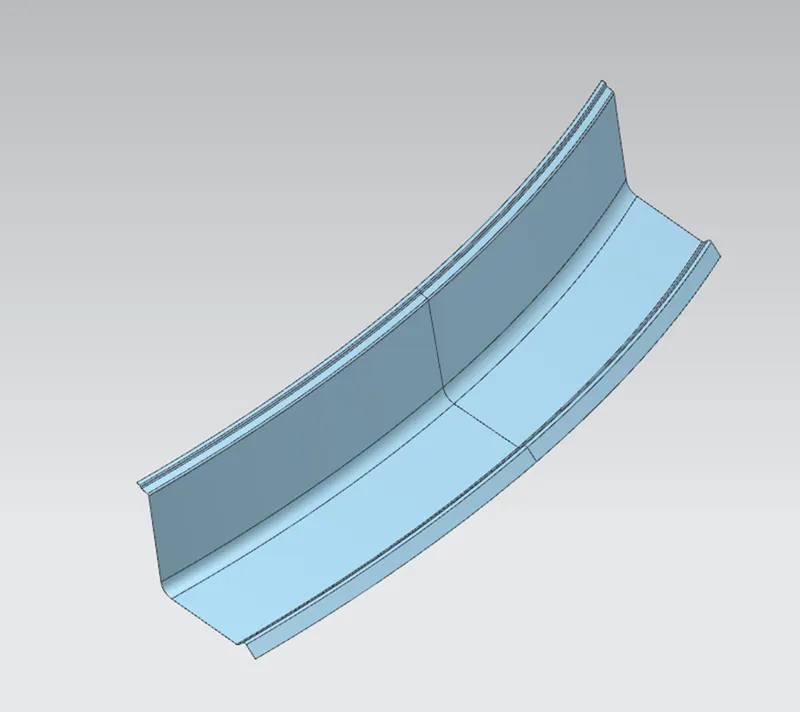
CENTER ROOF:

CENTER ROOF WHEN SUNROOF:

BOW ROOF:


ROW BOW CALCULATIONS:
To make sure the roof design passes the Analysis test some of the criteria are to be considered before the design of bow rails under the roof & they are:
- Heated Distortion Criteria
- Snow Load Condition
HEAT DISTORTION CRITERIA:
The heat distortion study plays a major role in sheet metal usage. Heat distortion temperature is the temperature limit above which the material cannot be used for structural applications. This study is used to predict the heat distortion temperature at the material where it starts to soften when exposed to a fixed load at an elevated temperature. In order to avoid bending or damage on the roof, based on the heat distortion temperature, this study will predict the bow roof position which helps to strengthen the roof.
Prediction Formula:


Judgment Condition: OK < 2.7mm < NG
However, if the value is in the range of 2.7 < W < 3.5, provide outer panel reinforcement in the planning stage, and determine whether the reinforcement is needed or not through tests.
L: ROOF length in X-direction[mm] (ROOF dimension with OY)
R: ROOF curvature
Rx: X curvature
Ry: Y curvature
t: ROOF plate thickness[mm]
l: BOW ROOF span[mm]
SNOWED CRITERIA:
This test is done to know how the roof is behaving when there is snow over. Normally due to the snow weight the dent will happen. But the roof should be designed in such a way that when the snow is removal the roof should go it its original position. This basic requirement for snow load criteria.
Prediction Formula:
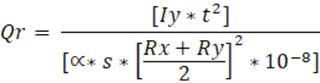



Judgement Condition = Qr > 3.1
T: Roof plate thckness[mm]
Ly:
- Distance between the front & rear roof Rails on the vehicle along with 0Y[mm]
- Length of Roof Panel with the centre point between Roof rail Front/Rear as the front and rear reference point.
Lx:
- Distance between the Left and Right end of the roof on the Roof BOW [mm]
- Width of the roof panel exposed on the surface.
Y: Distance from Front Roof Rail to Roof BOW[mm]
S: Distance for which Roof Bow bear divided load[mm]
Iy: Geometrical moment of inertia of Roof BOW (Y cross-section) [mm4]
Rx:
- Lateral direction curvature radius of roof panel Y cross-section on Roof BOW [mm]
- Roof panel curvature Radius of the Length Lx in Front view
Ry:
- Longitudinal Direction curvature radius of the Roof panel X cross-section on Roof BOW [mm]
- Roof panel X curvature radius of length s in Side view.
| Heat Distortion Criteria | ||||||||
| L | R | Rx | Ry | t | I | W | OK/NG | |
| CASE-1 | 2031.58 | 3556.62 | 2577.08 | 5737.35 | 0.75 | 390.94 | 1.58 | OK |
| CASE-2 | 2031.58 | 5605.32 | 6598.41 | 4872.06 | 0.75 | 483.38 | 2.14 | OK |
| CASE-3 | 2031.58 | 5753.39 | 11011.34 | 3893.99 | 0.75 | 375.02 | 2.06 | OK |
| CASE-4 | 2031.58 | 5342.50 | 14688.41 | 3265.03 | 0.75 | 333.32 | 1.91 | OK |
| SNOW LOAD PREDICTION | ||||||||||||||
| Iy | t | α | My | Lx | Ly | Y | s | L1 | L2 | Rx | Ry | Qr | OK/NG | |
| CASE-1 | 37451.00 | 0.75 | 2019429 | 716863.6 | 1141.3 | 1964.3 | 484.4 | 525 | 484.4 | 565.6 | 2630.1 | 4510 | 3.16E+77 | OK |
| CASE-2 | 16873.08 | 0.75 | 2141570 | 960001.4 | 1087 | 1964.3 | 1050.1 | 509.4 | 565.6 | 453.2 | 6525 | 3788.5 | 1.38E+80 | NG |
| CASE-3 | 28376.66 | 0.75 | 1815138 | 693021.3 | 1059.3 | 1964.3 | 1503.3 | 457.05 | 453.2 | 460.9 | 11615.6 | 4309.4 | 4.92E+82 | OK |