Roof Design
OBJECTIVE :
- The objective of this project is to design a car roof with essential flanges and reinforcements like ditch area, front roof rail, bow roofs, central roof rail, and rear roof rail for the given styling surface
- Perform a curvature study on the roof and perform the calculations for the heat distortion and snow load criteria to determine whether the bow roofs are at the correct positions.
- Finding a moment of inertia and section modulus for Bow roofs, central roof rail. front roof rail and rear roof rail.
- Perform the draft analysis for each reinforcement
CAR ROOF :
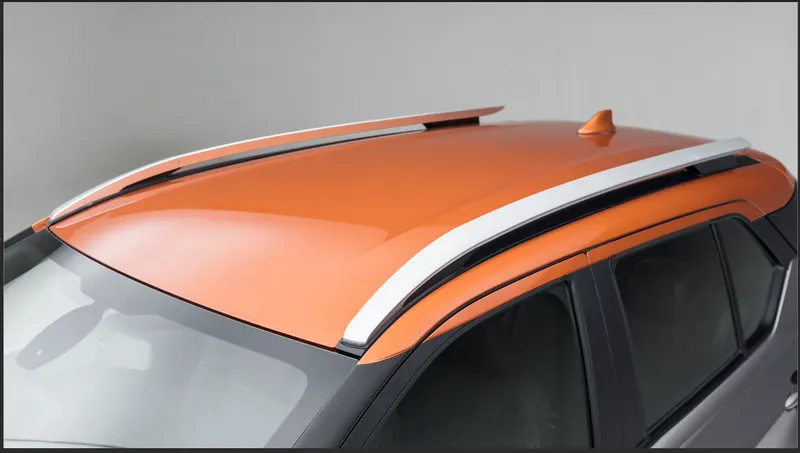
An automobile roof or car top is the portion of an automobile that sits above the passenger compartment, protecting the vehicle occupants from sun, wind, rain, and other external elements. The roof is the structure above the windshield glass having the reinforcements to provide strength to the overall structure and to withstand overhead forces like snow.
The manufacturing process of the automobile roof component comprises the following steps respectively consisting of an outer plate processing process, a strip-shaped assembly and annular assembly processing process and an automobile roof side beam processing process, and finally, an automobile roof combining process.
Hot stamping is a forming method for manufacturing automotive structural parts from thin steel sheets whereby material sheets are heated, pressed into a desired shape while hot and low in strength, and rapidly cooled (quenched) so that the steel transforms into strong and stable martensite.
DESIGN CONSIDERATION OF ROOF:
- Visibility criteria
- Headroom clearance
- Bow roof position
- Heat distortion and Snow load criteria
- Draft analysis
WHY REINFORCEMENTS :
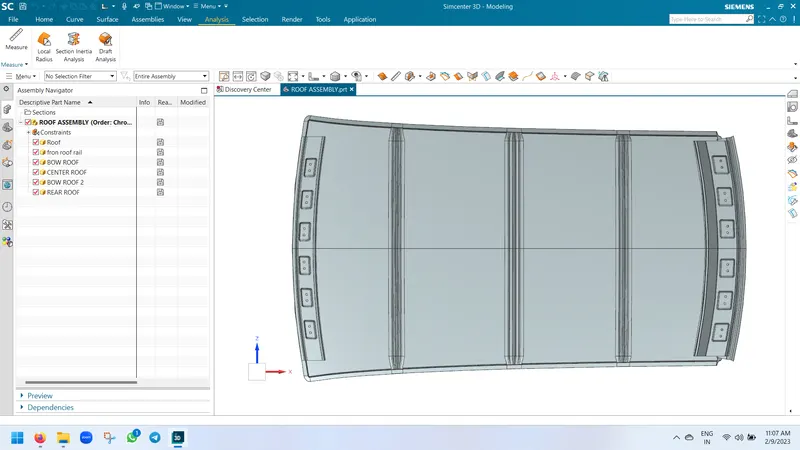
If the roof is flat it is very weak and cannot able to withstand the forces like snow, so in order to increase the strength of the roof these reinforcements like front roof rail, central roof rail, rear roof rail, and bow roofs are introduced and joined to the flat surface of the roof with the different joining process.
Different types of reinforcements that the car has are :
- Front roof rail
- Bow roofs
- Central roof rail and
- Rear roof rail
Complete part: Outer Roof:
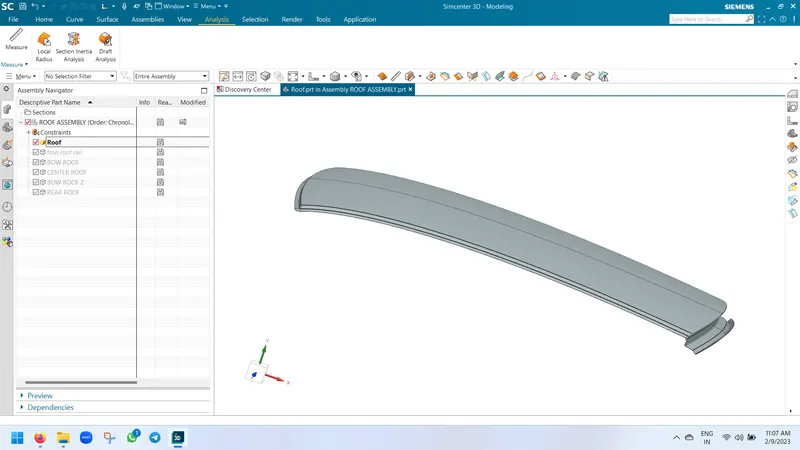
Front Roof: Bow Roof:
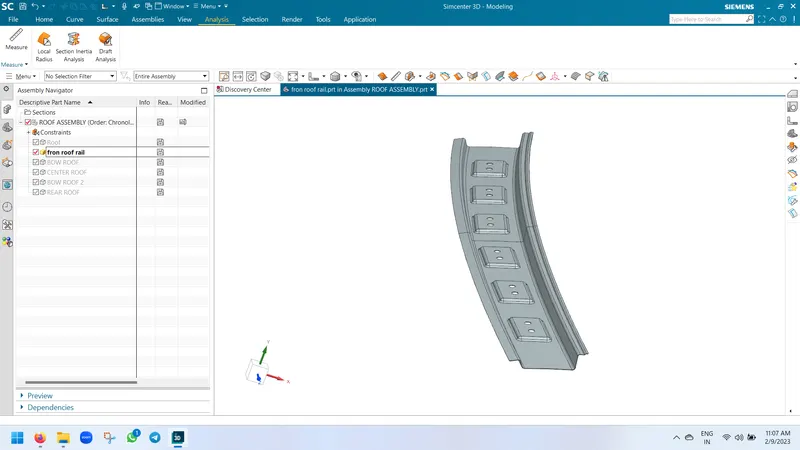
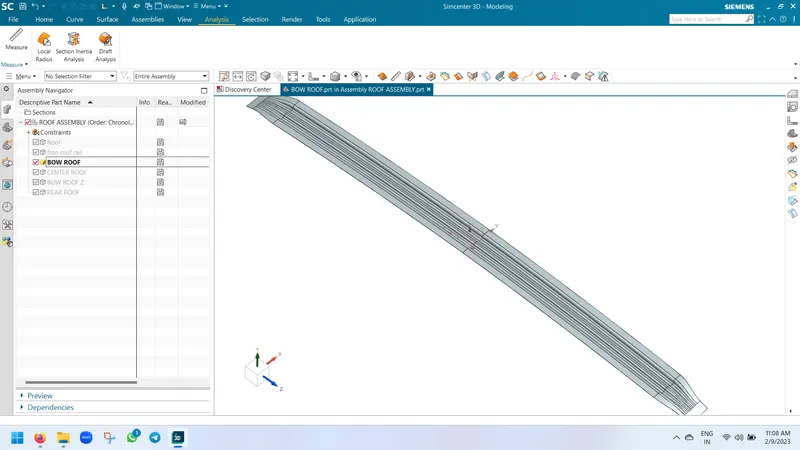
Centre Roof: Rear Roof:
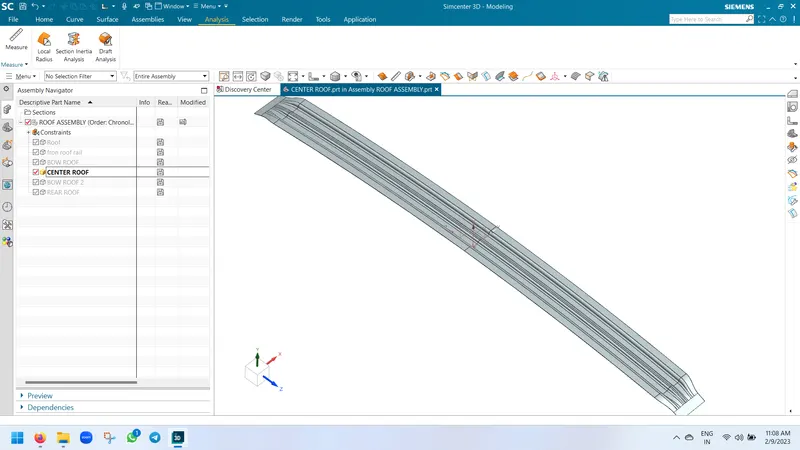
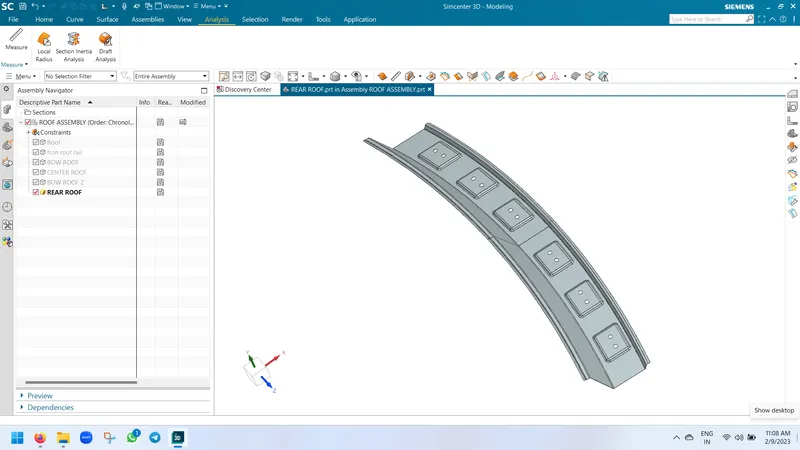
CURVATURE STUDY ON THE ROOF:
- Heat Distortion
- Snow Load
HEAT DISTORTION:
Heat distortion studies play an important role in sheet metal application. Heat distortion is the temperature limit above which material cannot be used for structural application. This study is useful to find where the material starts to soften when exposed to a fixed load at elevated temperature. In order to avoid bending, damage to the roof is based on the heat distortion temperature. This study will provide the which position of the bow roof give enough strength to the roof.
Bow roof prediction formula:
W = [1.73 x 10^(-3) x L] + [1.85 x 10^(-8) x (R^2)/t] + [ 1.10x10^(-3) x l] - 2.68
Where,
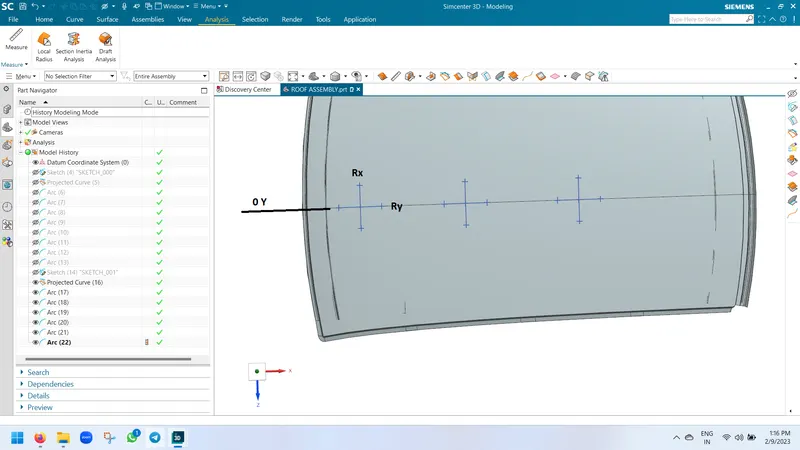
L = Roof Length in X-Direction[mm](Roof dimension in 0-Y)
R = Roof curvature
R = 2(Rx*Ry)/(Rx+Ry)
Rx = X curvature
Ry = Y curvature
t = Roof plate thickness [mm]
l = Bow Roof Span [mm]
Judgment Condition
OK< 2.7
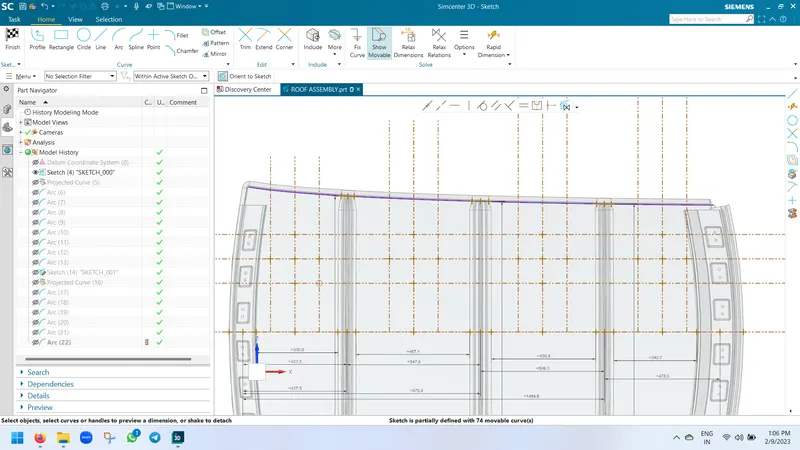
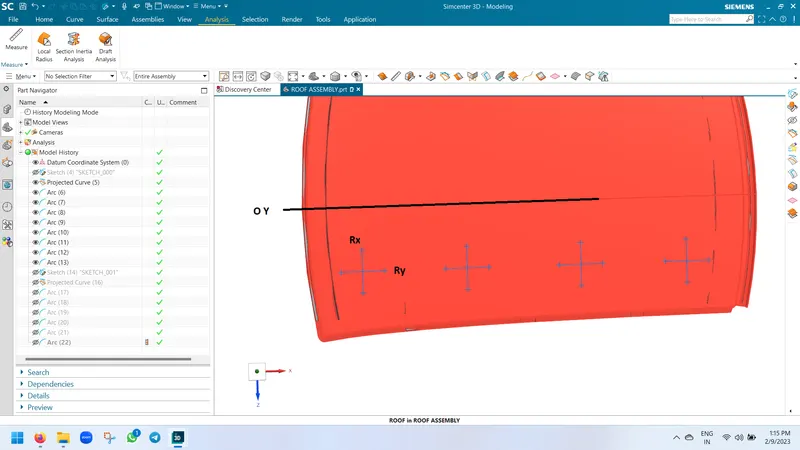
L=2028.3 mm; t=0.75 mm;
| Sections | Rx | Ry | R = 2(Rx*Ry)/(Rx+Ry) | l | W |
Judgment Condition (OK< 2.7) |
| 1 | 5736.8267 | 2278.7106 | 3261.807 | 335.8 | 1.45 | Satisfied |
| 2 | 20027.0808 | 11017.2422 | 14214.721 | 467 | 6.3177 | Unsatisfied |
| 3 | 9858.9057 | 10524.9383 | 10181.04 | 428.4 | 3.848 | Unsatisfied |
| 4 | 6309.3619 | 14791.7755 | 8845.652 | 340.7 | 3.125 | Unsatisfied |
SNOW LOAD:
Snow load criteria study is used to check the durability of the roof to withstand the snow falls on the roof and reflex it is original shape without any permanent deformation after load being removed.
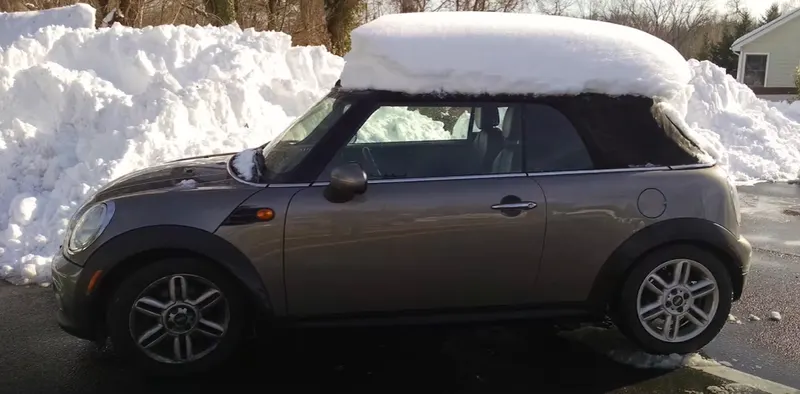
Snow load prediction formula:
Qr = [Iy x t2] / [α x s x [(Rx + Ry)/2]2 x 10-8]
Note: The Qr value given over here is correct. There was a typo error in the formula given in the video.
Where,
α = My x Lx2 x 10-12 , My = Y(Ly-Y)
t = Roof plate thickness [mm]
Ly = Distance between the front and rear roof Rails on the Vehicle along with 0Y[mm]
Length of Roof panel with the center point between Roof rail Front /Rear as the front and rear reference point.
Lx = Distance between the Left and Right end of the roof on the Roof BOW [mm]
The width of the roof panel is exposed on the surface.
Y = Distance front Front Roof Rail to Roof BOW[mm]
s = Distance for which Roof BOW bears divided load [mm]
s = L1/2 + L2/2
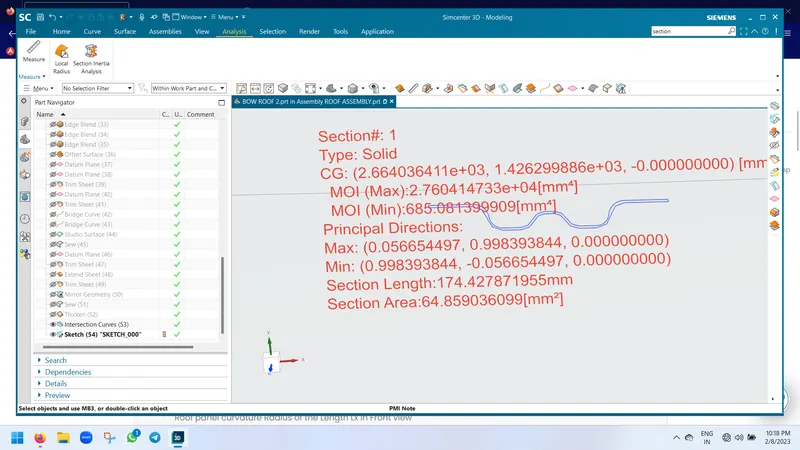
Iy = Geometrical moment of inertia of Roof BOW (Y cross-section )[mm4]
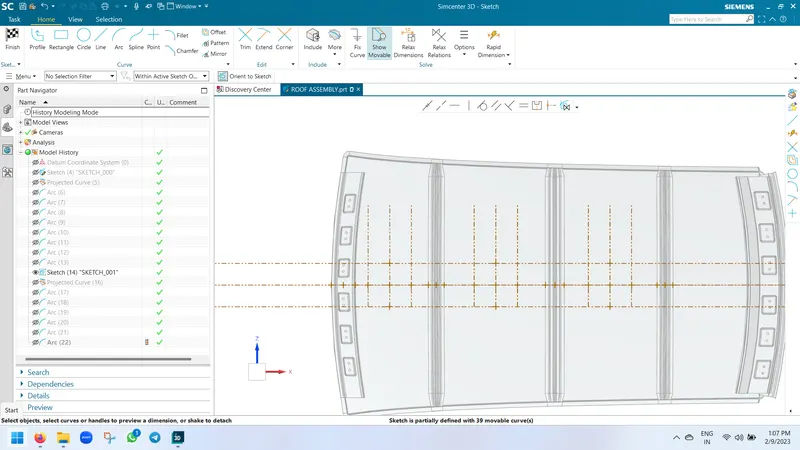
Rx = Lateral direction curvature radius of roof panel Y cross-section on Roof BOW [mm]
Roof panel curvature Radius of the Length Lx in Front view
Ry = Longitudinal Direction curvature radius of the Roof panel X cross-section on Roof BOW [mm]
Roof panel X curvature radius of length s in Side view
Judgment condition
Qr ≥ 3.1
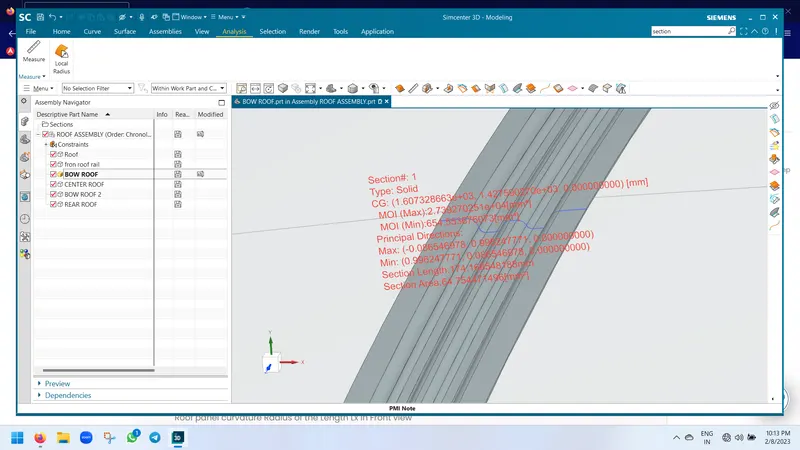
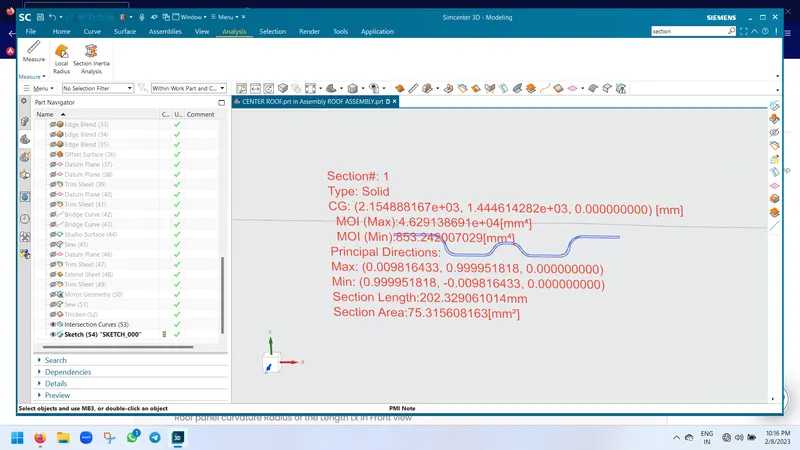
Ly=1958.3; t=0.75;
|
Sections |
Iy | L1 | L2 | S | Lx | Y | My | α |
| 1 | 654.55 | 427.55 | 547.9 | 487.7 | 1114 | 427.5 | 654417 | 0.872 |
| 2 | 853.24 | 547.9 | 509.3 | 528.6 | 1070.8 | 975.4 | 958720.66 | 1.099 |
| 3 | 685.08 | 509.3 | 473.5 | 491.4 | 1050 | 1484.8 | 702816.05 | 0.775 |
| Sections | Rx | Ry | [(Rx+Ry/2)^2]*10^-8 | Qr |
Judgment Condition (Qr ≥ 3.1) |
| 1 | 4710.6474 | 2849.5516 |
0.143 |
6.05 | satisfied |
| 2 | 5233.7188 | 5943.2792 | 0.312 | 2.65 | unsatisfied |
| 3 | 4270.4582 | 4156.5 | 0.177 | 5.72 |
satisfied |
Draft analysis for all components:
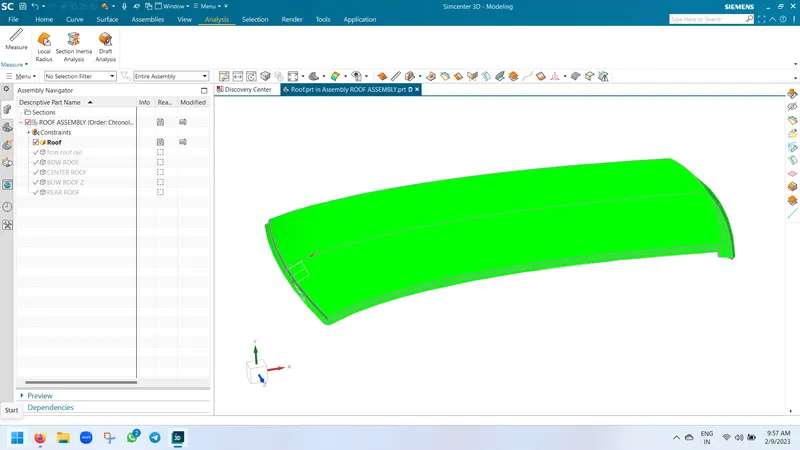
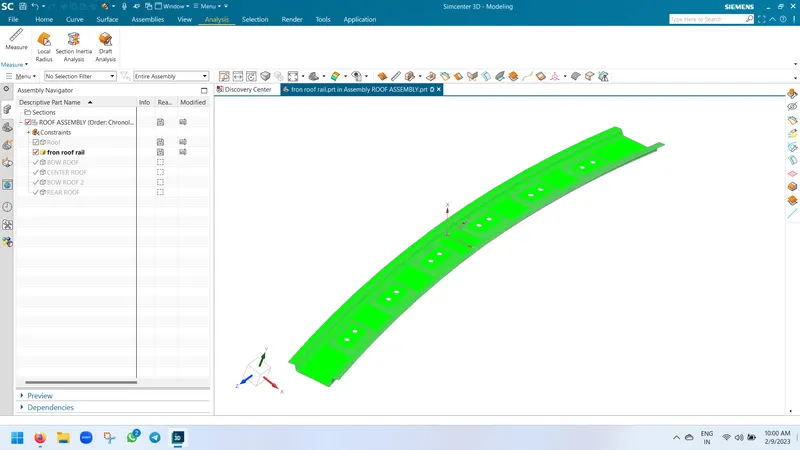
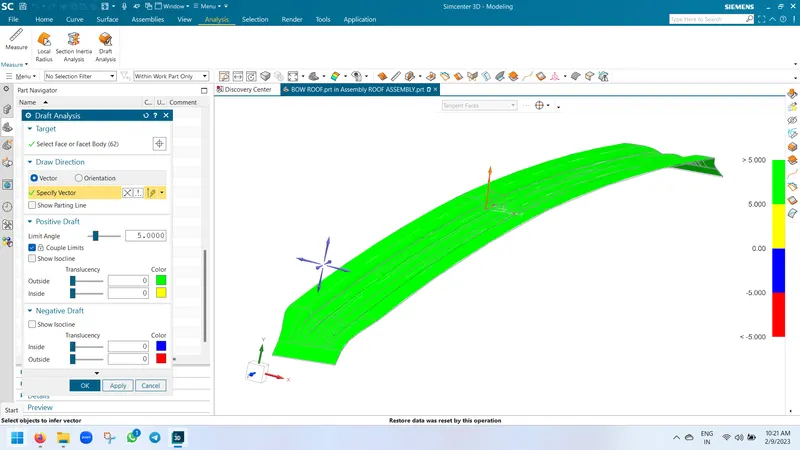
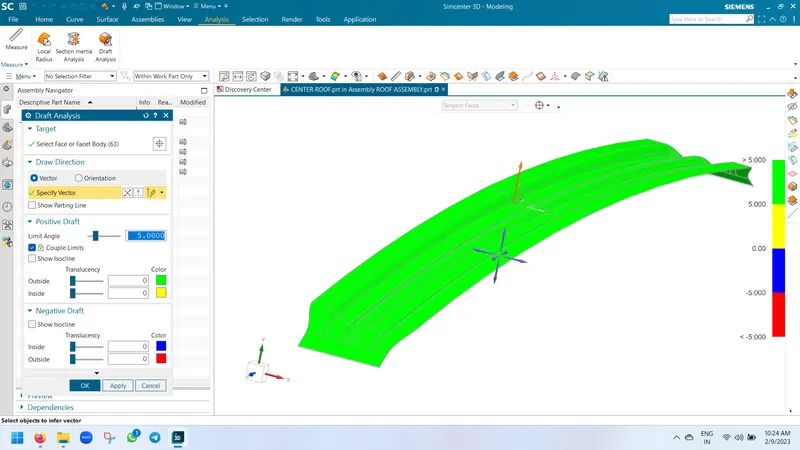
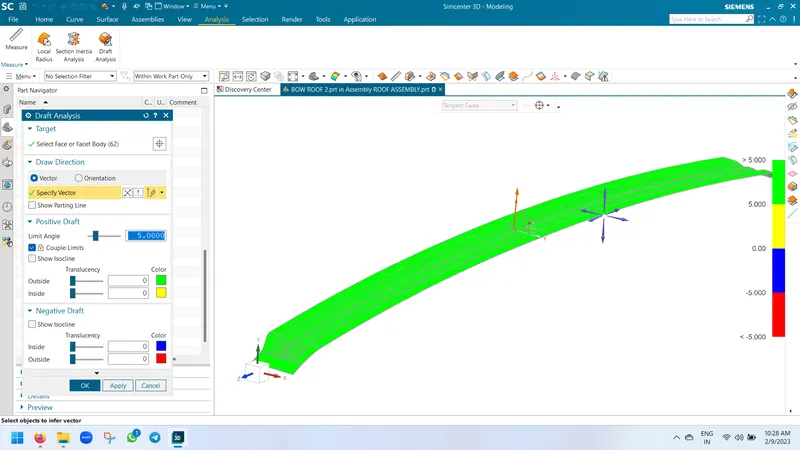
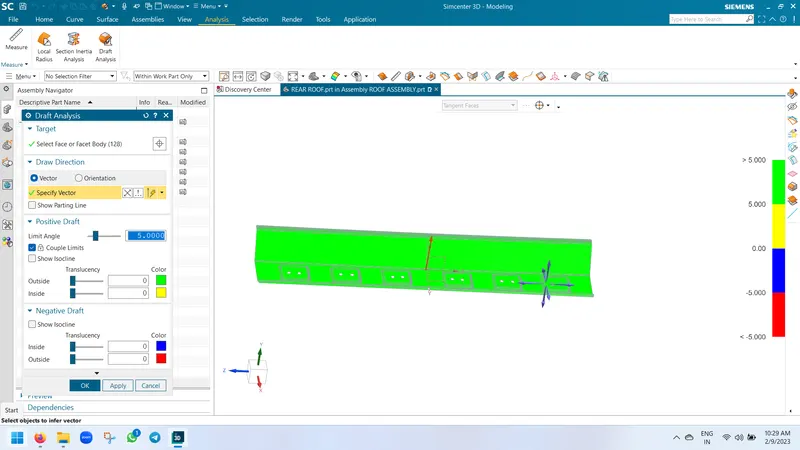
The Draft Analysis command enables you to detect if the part you drafted will be easily removed. This type of analysis is performed based on color ranges identifying zones on the analyzed element where the deviation from the draft direction at any point, corresponds to specified values.
A minimum draft angle of 70 is considered for analysis. green color infers on the parts that all face along the tooling direction have a positive draft angle greater than 70 and passed in the analysis.
Outer roof rail:
Front roof:
Bow roof:
Center roof:
Bow roof 2:
Rear roof:
CONCLUSION:
I did the roof design and check heat distortion and snow load conditions for bow roofs are placed in the right place or not. So, after finishing my design I did the heat distortion and snow load condition. After, finishing the curvature study. And last, we check the draft analysis. Because, whether the part is manufacturable or not. That is why we doing this analysis.
In my design, I have observed from the curvature study that the placement of the reinforcements is not proper so by changing the position of those reinforcements we can get the best results.