Roof Design
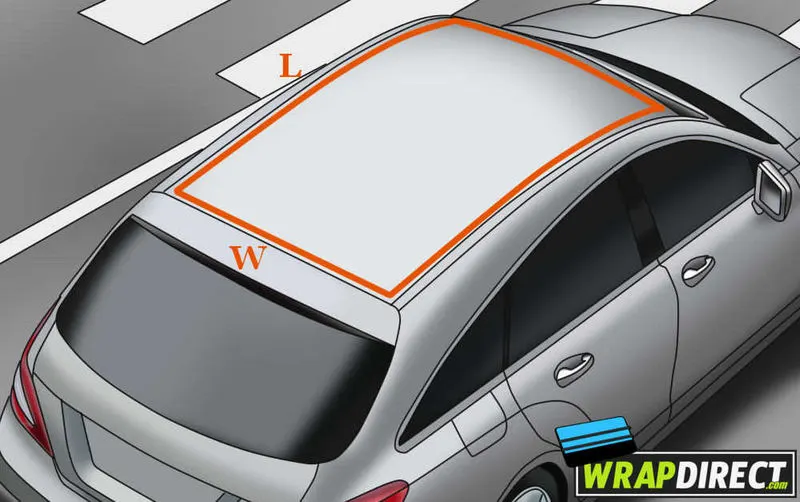
Aim :
- For the given roof styling, create an ASSEMBLY by developing the essential flanges for the outer roof and creating the reinforcements, and carryout essential calculations to ensure the strength of the roof.
Theory :
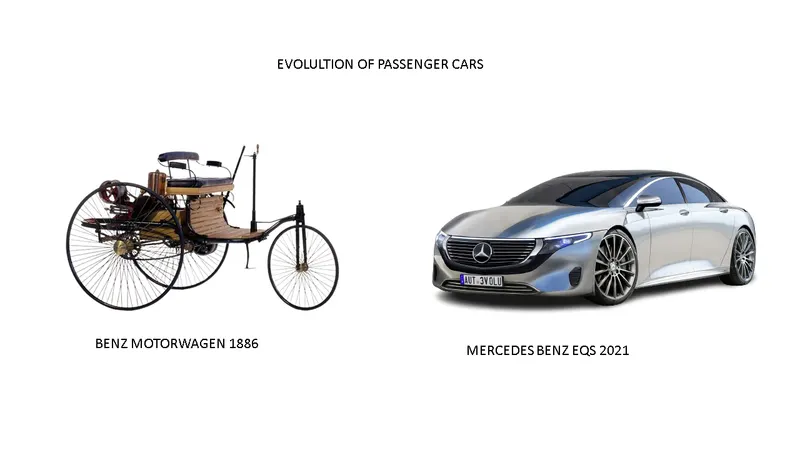
- The roof or the top most portion of the car is basically there to protect the passengers from outside climatic conditions and other outside elements as well. At very early stages the automobiles don’t had roof as we have right now. As the technologies came and the automobiles became fast, powerful and reliable at the same time, many evolutions stated to see in the automotive scene. Many innovative designs started to appear. As a result, we have the cars we see right now.
CAR ROOF TYPES :
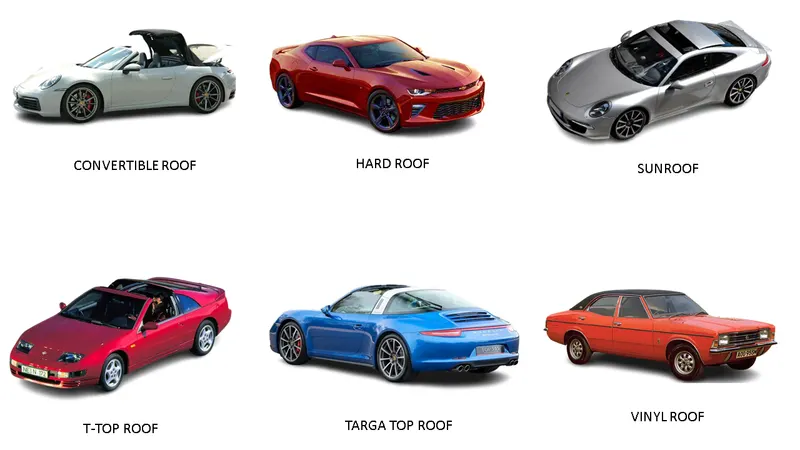
- Throughout the yeas OEMs have come up with different types of automotive designs and due to that almost all the fundamental parts of the automobiles had many make overs throughout the years. These changes are due to the influence both aesthetic and functional reasons. So in the market we can see many automobiles with different types of roof types. So, of the roof classifications are:
- Convertible roof
- Hardtops
- Sunroof
- T-tops
- Targa tops
- Vinyl roof
Convertible roofs
- Convertible roofs also known as cabriolet is the type of roof design in which the passenger have the option to ride without the roof over. Depending on the design the roof can retract of can be removed and stored in many ways depending on the manufacturer. These types of roofs allow the passenger to enjoys the outside world while driving and can close the roof anytime they want at the same time. The main drawback of this kind of roofs is that it can affect the structural rigidity of the over all car. Convertible roof provides very less protection than a conventional hard top as the roofs are normally made of some kind of cloth or fabric. In some cases, we can find detachable hard roofs, that is the roof will be of metal or plastic and can be removed manually and stored somewhere in the car according to the convenience. Lamborghini’s Aventador convertible is an example of convertible hard top.
Hard top
- Hard tops are structurally sound hard roofs most usually made out of metal. These roofs are typically attached by means of weld to the pillars of the car. These types of roofs are not detachable. There are also pillarless hardtop cars, with which the car doesn’t have a b pillar due to the particular design of the car. In this case the roof will only be attached to the A and C pillars of the car. Coming back to the conventional hard top roof, the main advantage of it over the convertible is that it can provide structural rigidity to the car and can provide the car with good rollover mitigation depending hoe the hard top is designed. Most of the commercial automobiles are having the hardtops.
Sunroof
- A sunroof is a panel mostly made out of glass which can be moved to open up a portion of the roof which allows fresh air to renter into the passenger cabin also it can provide a roomy feel to the cabin. This type of roof can provide some amount of outside feel which convertible can provide while not compromising too much on the safety aspect which a hard roof can provide. It’s a best of both worlds. Sunroofs are a trend in today’s industry.
T-top
- These are uncommon roof type which has a rigid bar going along the centre of the car connecting the front and rear pillars of the car as show in the picture above. Mostly the open portions will have a side panel which are removable. There are usually made out of good quality safety glass.
Targa tops
- This type could be called as semi-convertible cars. This design has a removable roof but only for the centre portion. The back will be covered which is typically an elaborated rear window. Most of the Targa designs, the rear window is fixed but some models have foldable windows also. An example of a Targa top can be found in picture shown above.
Vinyl roof
- These were very common in the early American market. Vinyl roof was originally given to the convertible cars to represent how it looks with roof, which evolved into a styling statement
CAR ROOF AND SAFETY:
- Safety should be a priority while coming to an automobile. Many companies like Volvo are showing interests and dedicated a huge part of their R&D solely on safety. A vehicle on road is very likely to have an accident as anything could happen, be it the climatic conditions, lack of attention of the driver, of due to the other vehicles on the road. Whatever the reason the goal is that no one inside the car or on the road should be harmed. So, there are several safety systems are present in the modern cars. Roofs can also aid in improving the safety of a vehicle.
- Apart from avoiding the climatic conditions and other external elements, another problem vehicles can come across is roll over. The main reason to have strong roof in an event of a roll over crash is to keep the survival of the passenger and the passenger cabin intact. The goal here is to absorb the impacts of the crash by keeping the passenger cabin intact as possible as we can. In that way the passengers who is trapped inside can move around and escape after the crash. Also, while in an event of crash, the passenger should be inside the vehicle, the passenger should never eject or thrown out of the car during a crash. So, if the roof is intact, the other window s etc will likely to be stayed intact as the roof is connected to these parts keeping the passengers inside the vehicle.
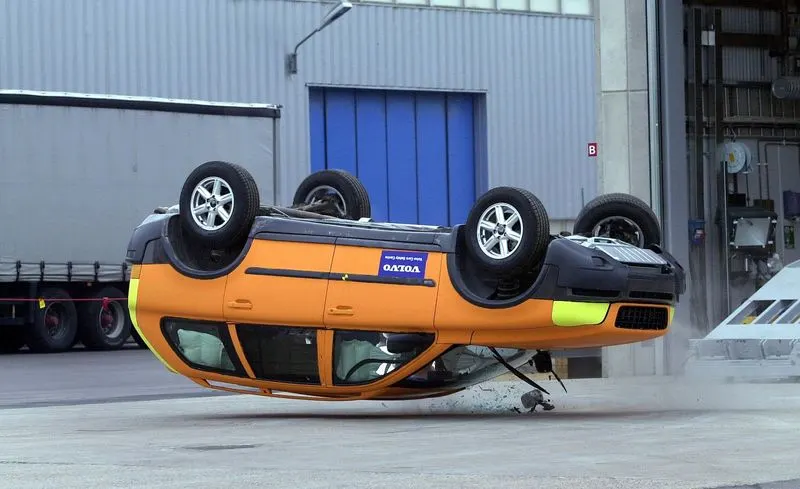
ROOF IMPACT LOAD TEST
ROLL OVER TEST
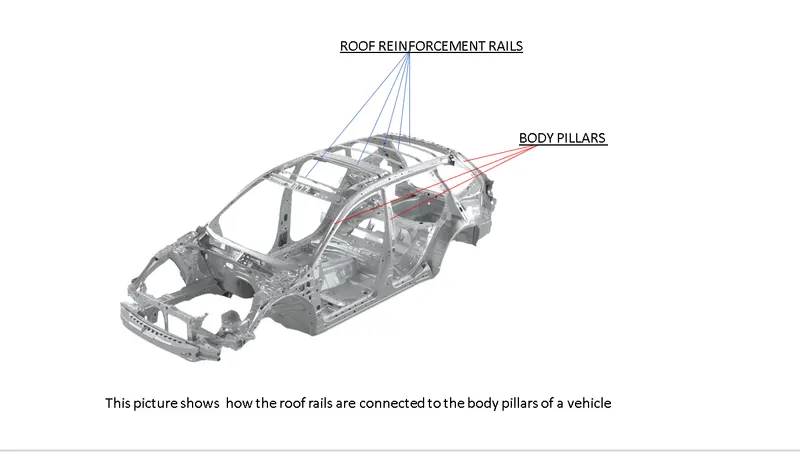
Car roof not only protect the passengers from the climatic conditions and the external elements, it also serves some purpose in structural rigidity of the car and the safety aspect as well. A well-designed roof with proper reinforcements can strengthen the roof and provide adequate protections in the event of a car rolls over. There are different types of reinforcements are used by manufactures to strengthen their cars. Most of them provide their cars with different roof rails with connects with different pillars of the car cabin and the outside roof panels as well. These rails are connected using spot welds and mastic sealants where spots welds are not an option due to the class A interaction.
CAR ROOF DESIGN :
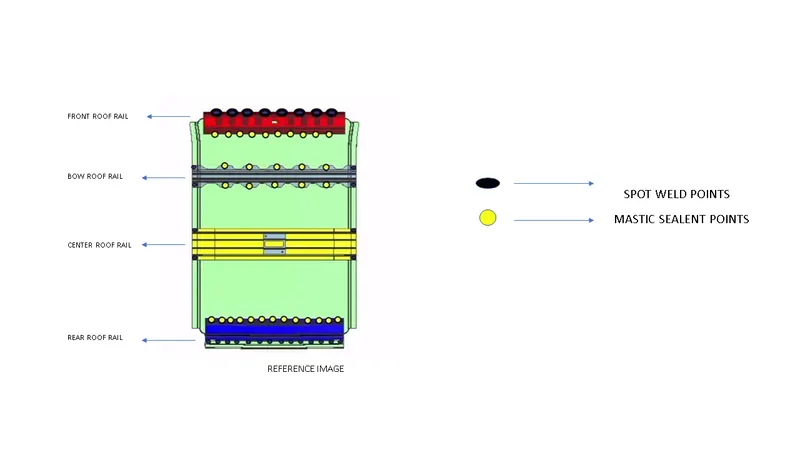
The roof as a part contains many components. It consists of the outer panel and roof rails for reinforcement. These rails will help in good slow load bearing capability and heat distortions. The roof rails also aid in good rollover mitigation.
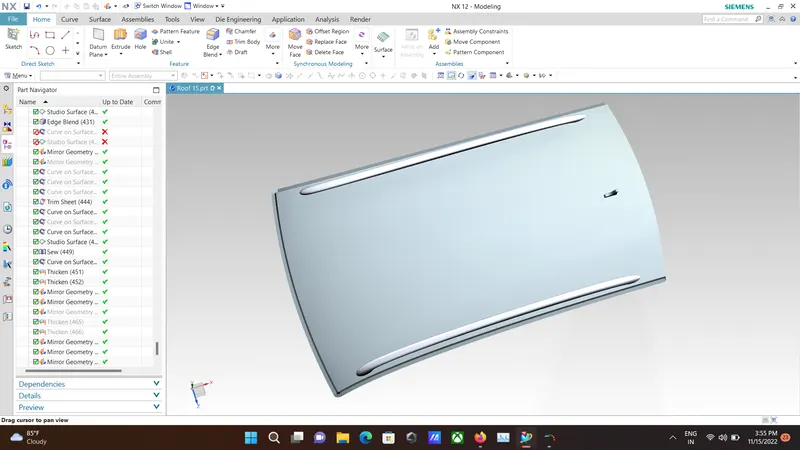
In this project, the roof is designed using the styling surface and the master sections.
An example of roof and its components are given below
MASTER SECTIONS AND DESIGN CRITERAIAS :
Master section ;
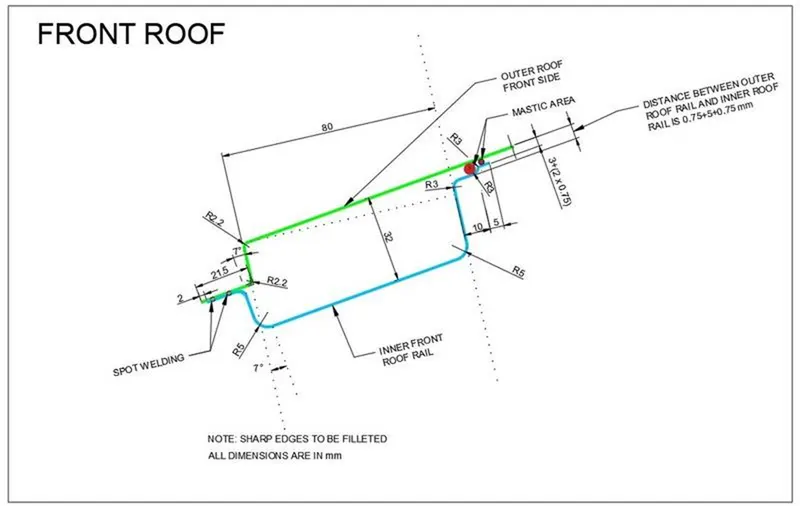
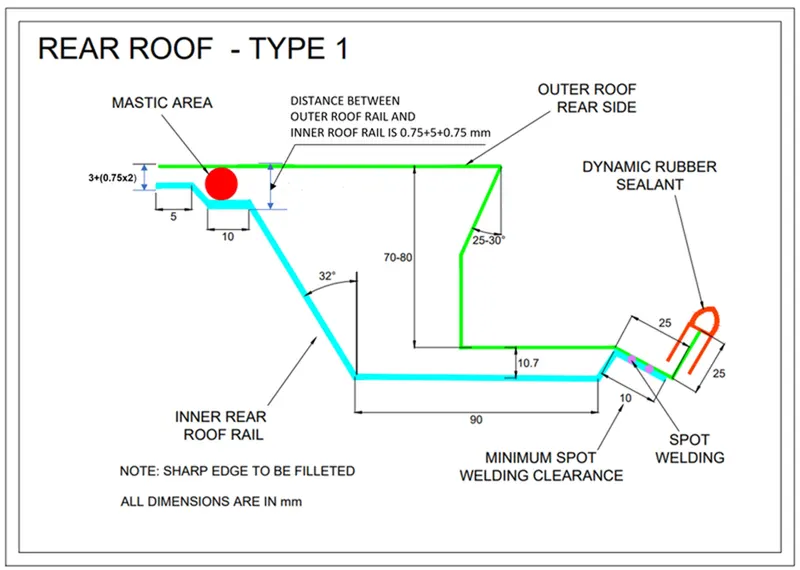
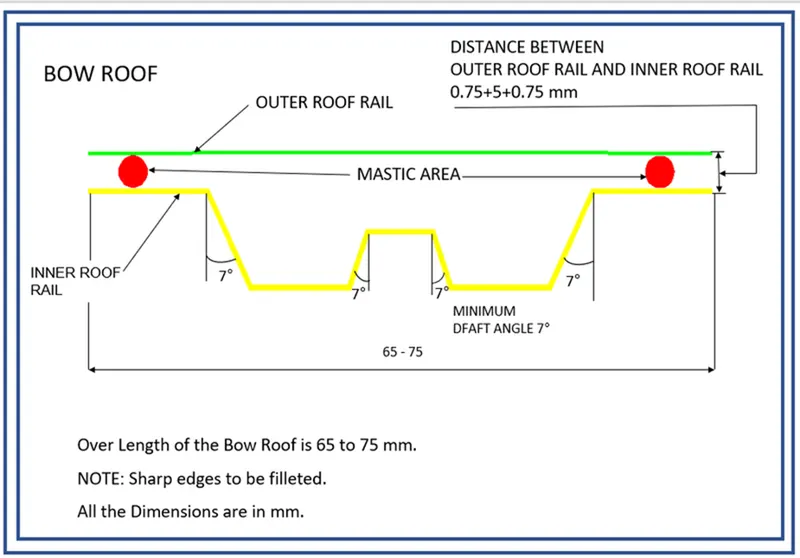
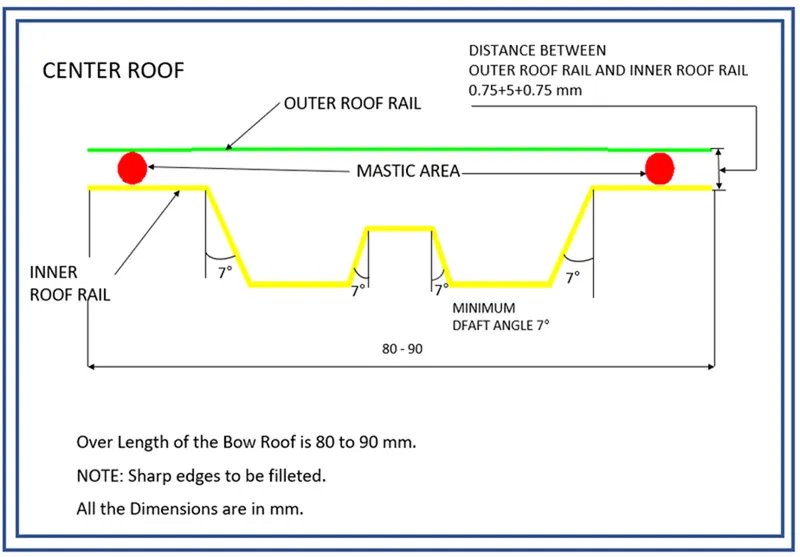
The following master section is referred for designing this roof.
Design consideration :
Certain design considerations are taken while designing this roof components. The roof ditch area is created with an opening tool angle of 7 degrees.
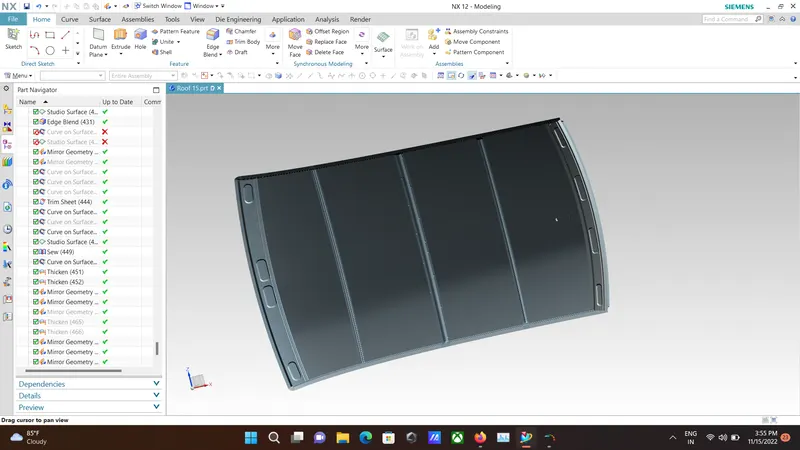
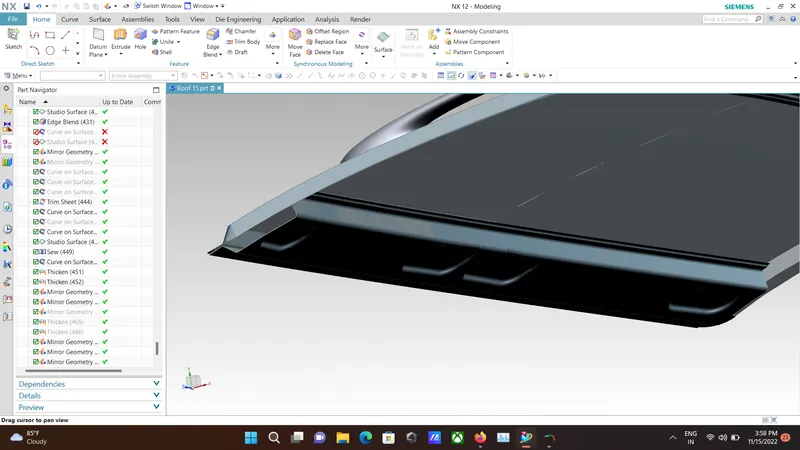
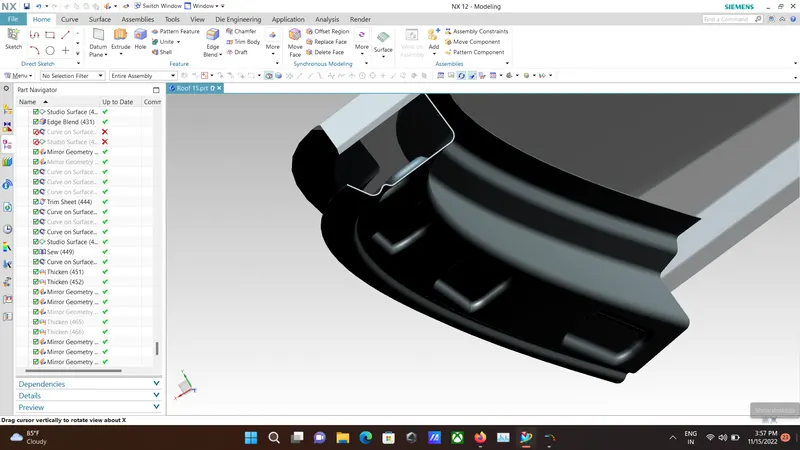
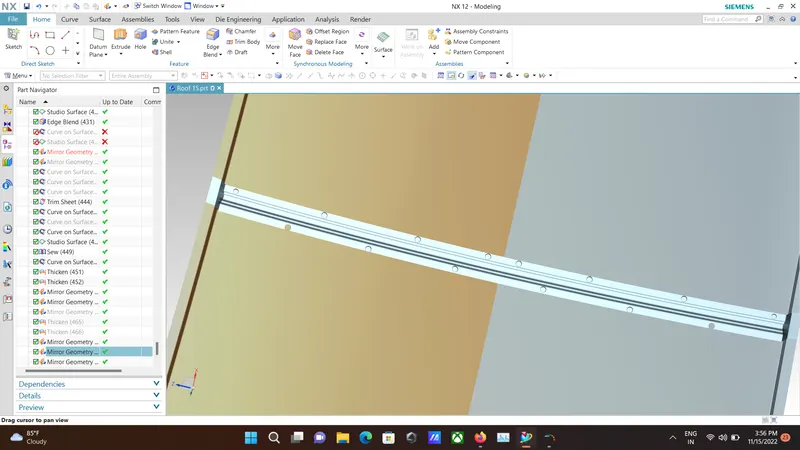
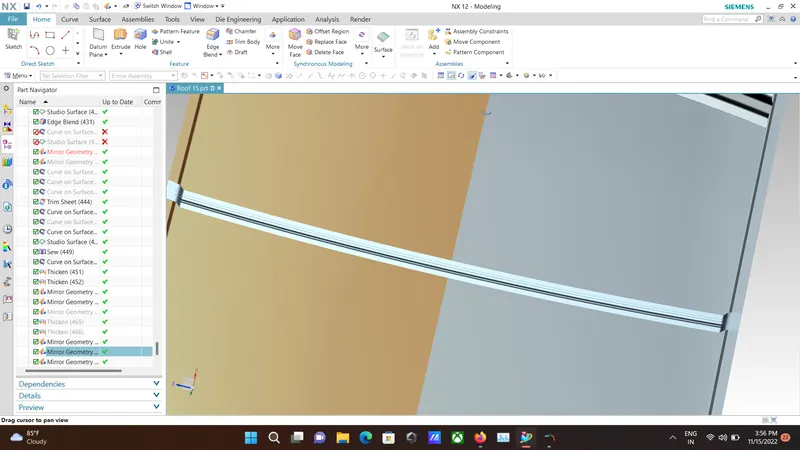
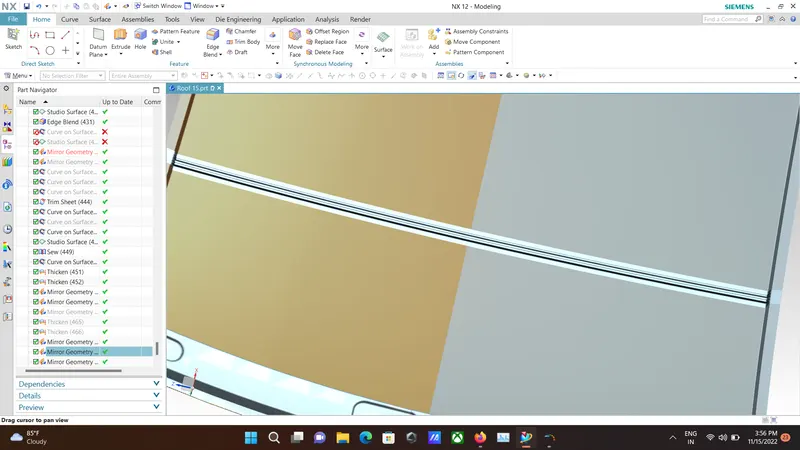
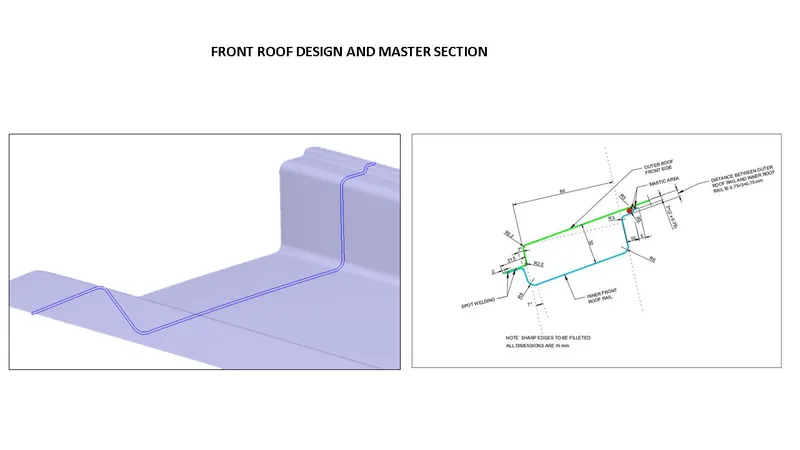
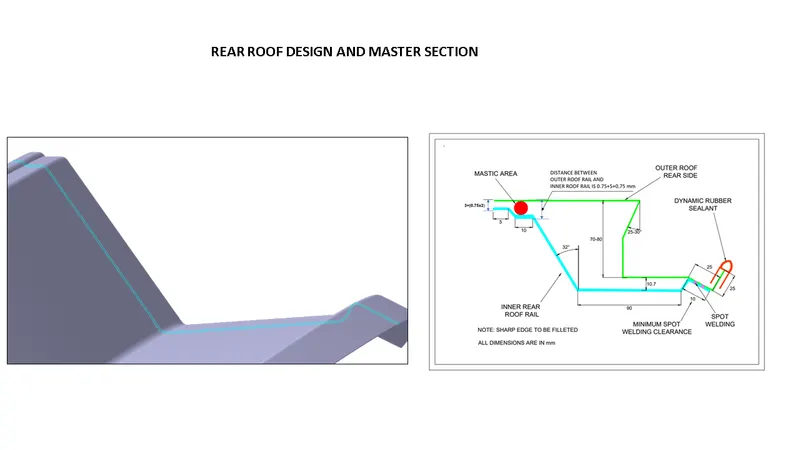
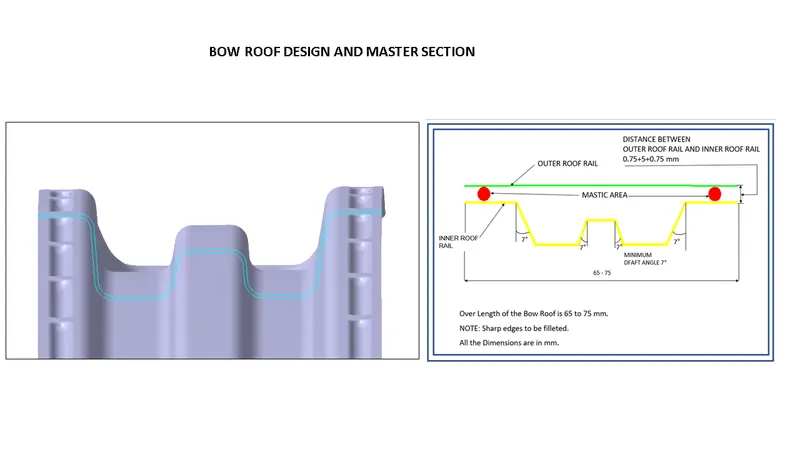
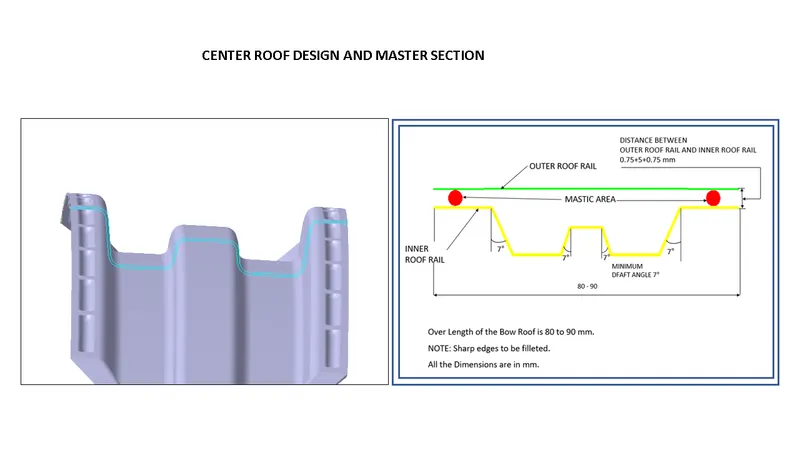
After the design, several calculations are done on components for its proper placements and how well the part will perform in certain situations.
Calculations
- Heat distortion calculation.
Heat distortion is the deformation happens to the part when comes under a certain high temperature in certain regions. This calculation is to ensure that the part is able to withstand such extreme situations. The heat distortions formula is as follows.
W = [1.73 x 10^(-3) x L] + [1.85 x 10^(-8) x (R^2)/t] + [ 1.10x10^(-3) x l] - 2.68
Where,
L = Roof Length in X-Direction[mm](Roof dimension in 0-Y)
R = Roof curvature
R = 2(Rx*Ry)/(Rx+Ry)
Rx = X curvature
Ry = Y curvature
t = Roof plate thickness [mm]
l = Bow Roof Span [mm]
Judgment Condition :
OK< 2.7

- Snow load prediction calculation
In the regions where there is heavy snow fall, the snow will get accumulated on top of the roof of the car. This will apply a certain amount of load on to the roof of the car. The roof should be able to take that load without getting deformed permanently. This calculation ensures the design will be able to pass the snow load calculation.
Qr = [Iy x t2] / [α x s x [(Rx + Ry)/2]2 x 10-8]
where,
α = My x Lx2 x 10-12, My = Y(Ly-Y)
t = Roof plate thickness [mm]
Ly = Distance between the front and rear roof Rails on the Vehicle along with 0Y[mm]
Length of Roof panel with the centre point between Roof rail Front /Rear as the front and rear reference point.
Lx = Distance between the Left and Right end of the roof on the Roof BOW [mm]
The width of the roof panel is exposed on the surface.
Y = Distance front Roof Rail to Roof BOW [mm]
s = Distance for which Roof BOW bears divided load [mm]
s = L1/2 + L2/2
Iy = Geometrical moment of inertia of Roof BOW (Y cross-section) [mm4]
Rx = Lateral direction curvature radius of roof panel Y cross-section on Roof BOW [mm]
Roof panel curvature Radius of the Length Lx in Front view
Ry = Longitudinal Direction curvature radius of the Roof panel X cross-section on Roof BOW [mm]
Roof panel X curvature radius of length s in Side view
Judgment condition :
Qr ≥ 3.1
250 ≤ s ≤ 380

RESULT:
The roof and its reinforcements are made from the given roof styling, created an ASSEMBLY by developing the essential flanges for the outer roof and creating the reinforcements, and carried out essential calculations to ensure the strength of the roof
Thankyou,,