Roof Design
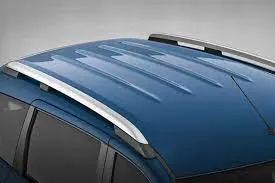
Car Roof :
An automobile roof or car top is the portion of an automobile that covers or sits above passenger compartment, protecting the vehicle occupants from sun, wind, rain and other external elements. Roof is the structure above the wind shield glass having reinforcements to provide required strength to overall structure and to withstand over head forces like snow. Vehicle roof are vulnerable to high heat conditions & moderate load during snowy conditions. Heat load calculation & snow load calculation are done to get a proper design of roof rails. This ensures the safety of the passengers in the vehicle.
Design Parameters :
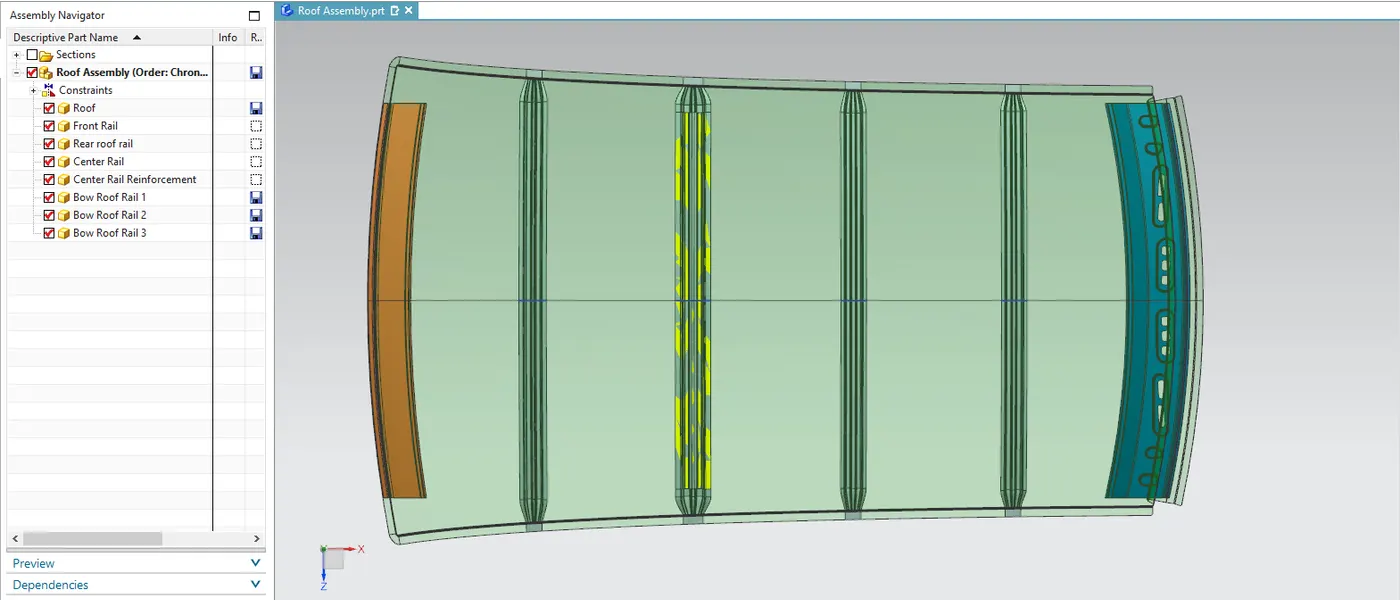
For designing roof, no of roof rails have to be created to ensure enough strength to withstand the load. Bow roofs are primarily fixed in flatter region to enhance strength. Front roof and rear roof rails are fixed to the ditch area using spot weld operation. And front, rear bow roof and center roof rails are fixed to roof using mastic sealants. Gap between roof rails and bow roof should be less for Better NVH rating.
Following criterias are taken into account for roof rail design.
- Visibility criteria
- Head clearance
- Curvature study
- Hear distortion and snow load criteria
- Draft analysis
Why reinforcements are used :
If the rroof is designed as a flat component it would not have enough strength to withstand dead weight condition like snow piling on top, so in order to increase the strength of the roof these reinforcements like front roof rail, central roof rail, rear roof rail and the bow roofs are introduced and joined to the curved surface of the roof with the different joining process like mastic sealents and spot welding.
Different types of reinforcements that the car has are :
- Front roof rail
- Bow roofs
- Central roof rail
- Rear roof rail
Master sections :
These are cross sectional data for 3D models. Master sections are widely used in OEMs and in automobile industries to convey functional requirements of a desired product by the design engineer. Dimensional parameters along with tolerences are to be reffered during designing of the part or component.
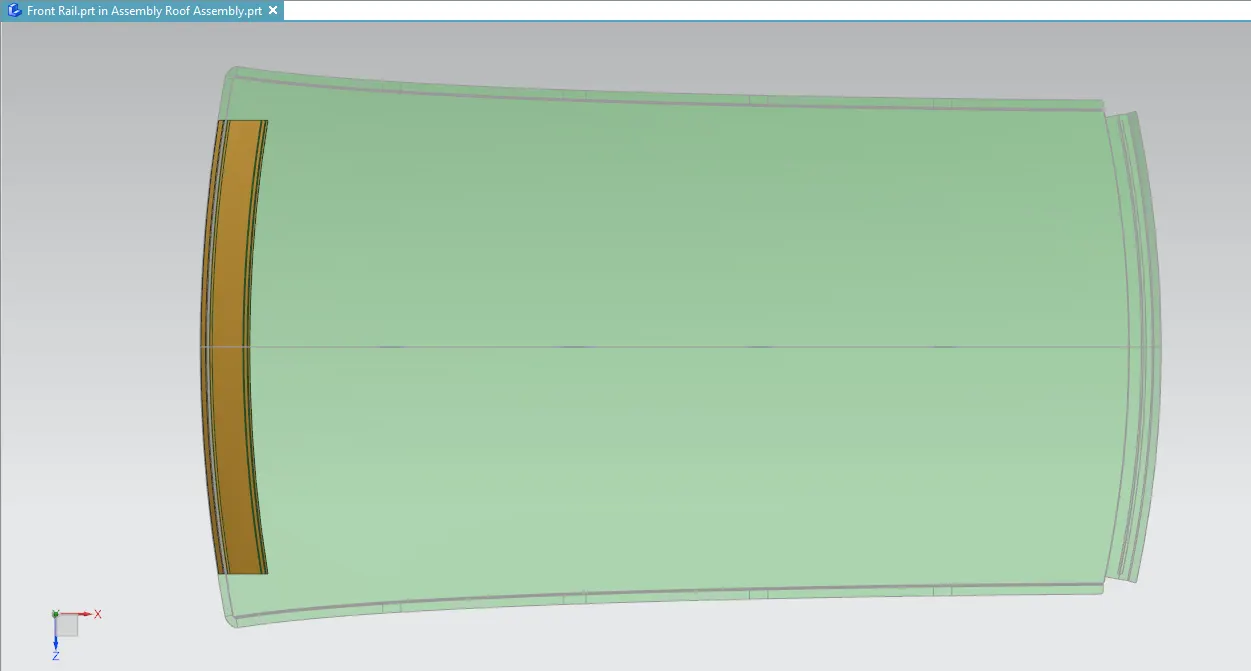
FRONT ROOF RAIL
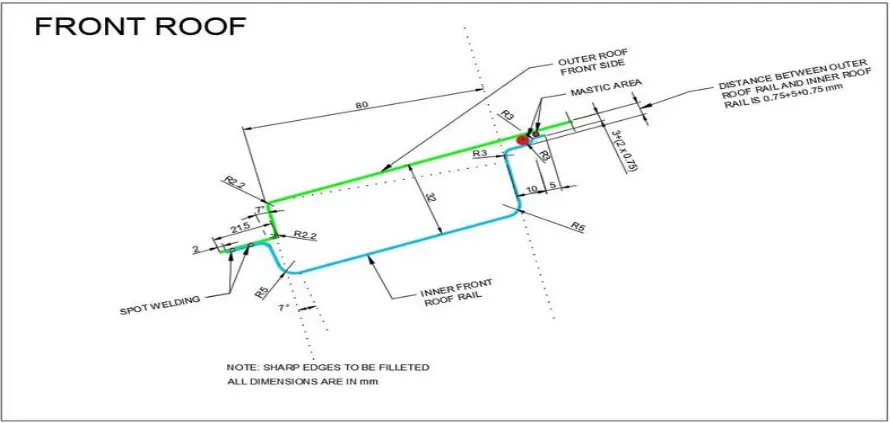
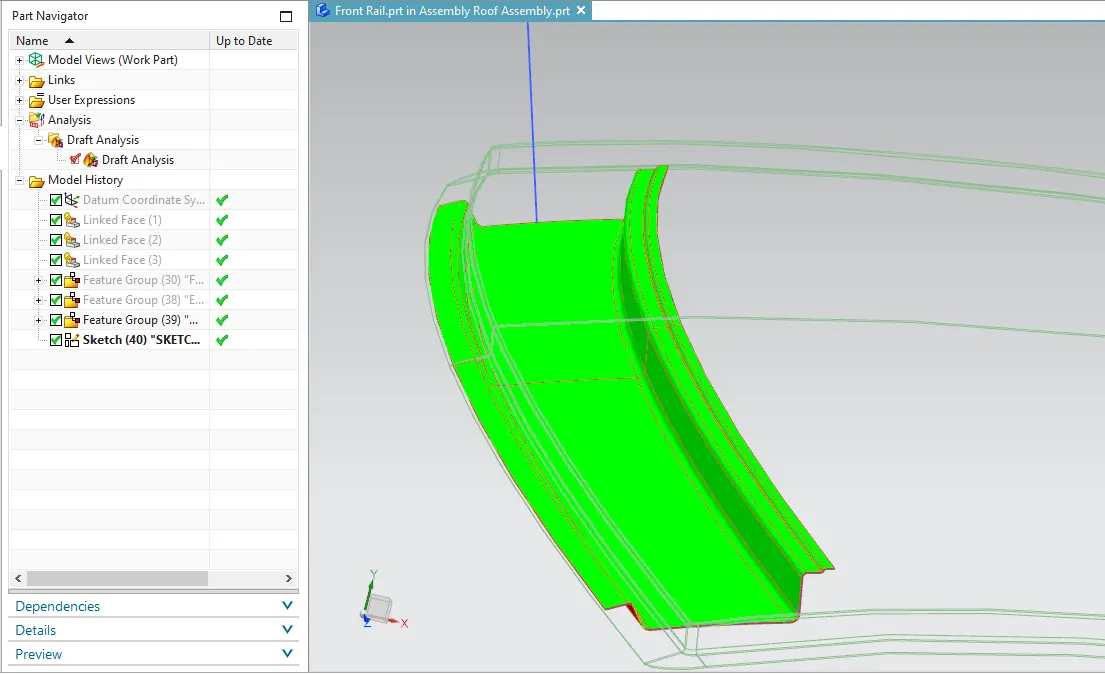
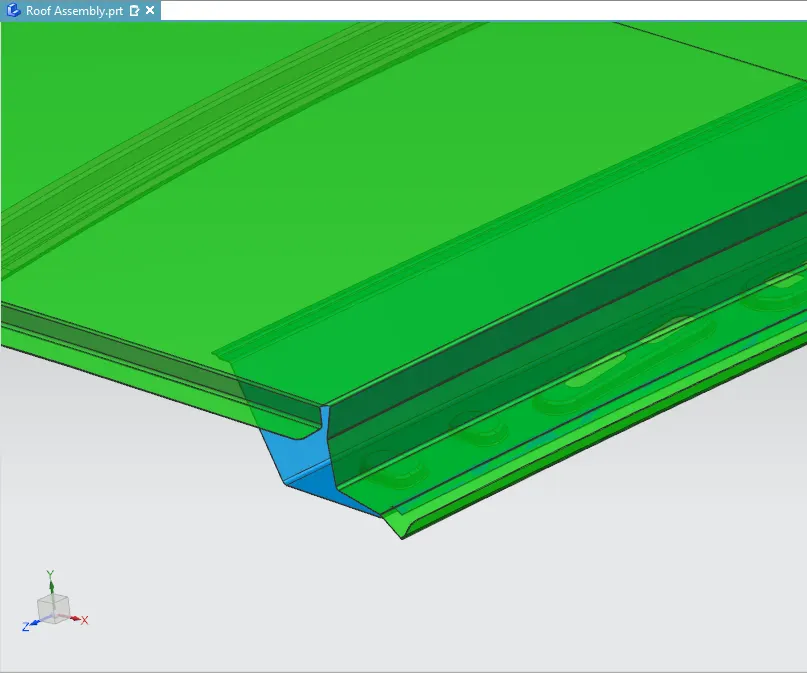
- Front roof rail is joining the wind shield glass with roof. It also joins the roof with inner panel and body side outer.
- The depth of the front roof rail is based on the head room clearance, and width of the front roof rail is decided according to front visibility criteria.
- For joining the front roof rail with flange of roof by using spot welding, and use of mastic sealents for joining the front roof rail with the roof.
- Master section followed for designing Front roof rail.
- Roof outer panel Drip area opening angle 7deg.
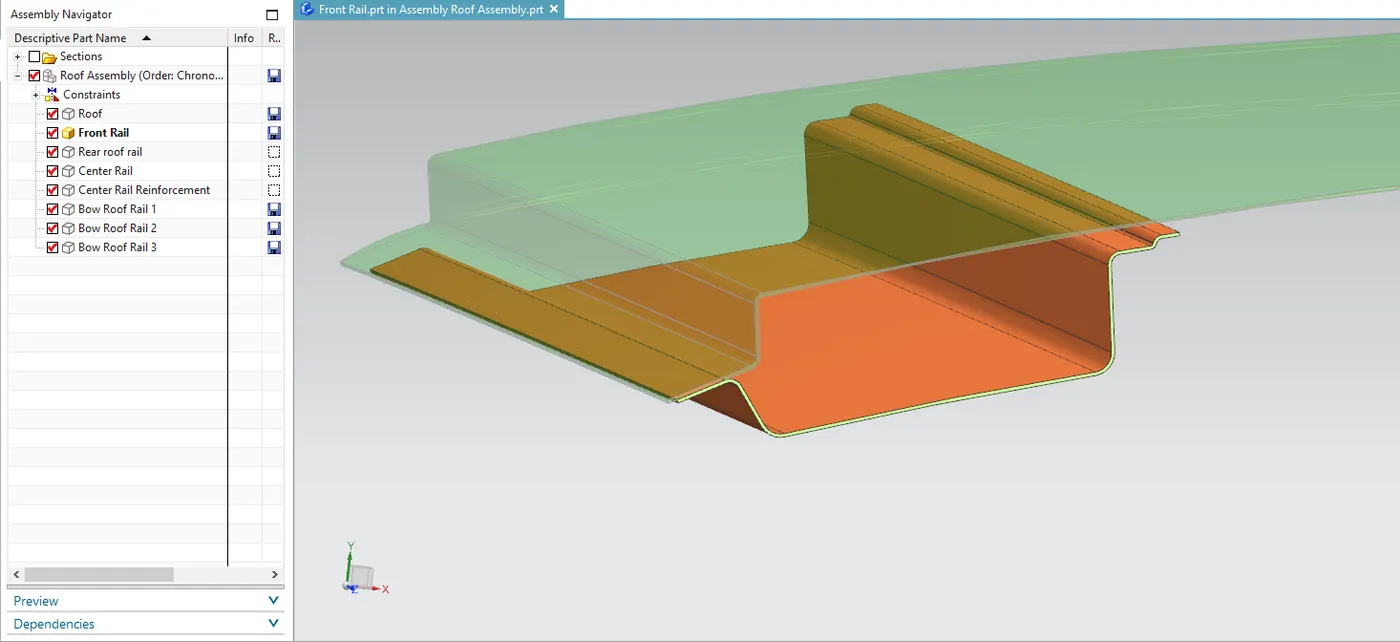
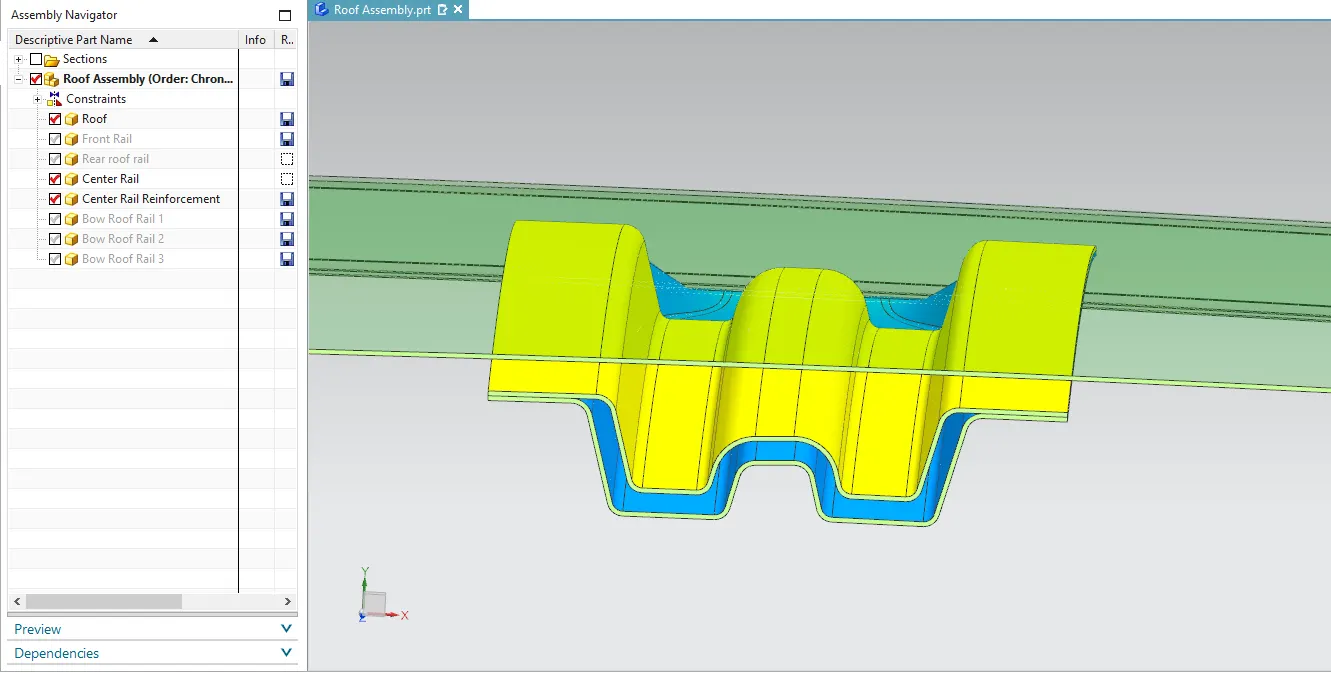
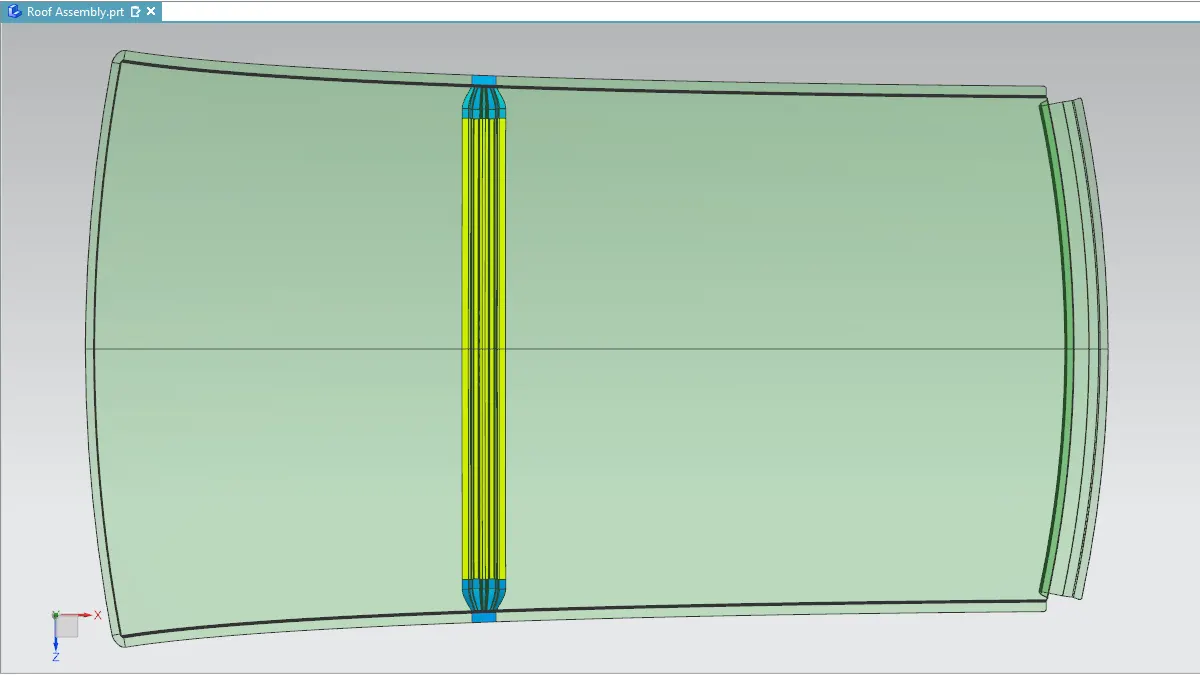
CENTER ROOF RAIL with REINFORCEMENT RAIL
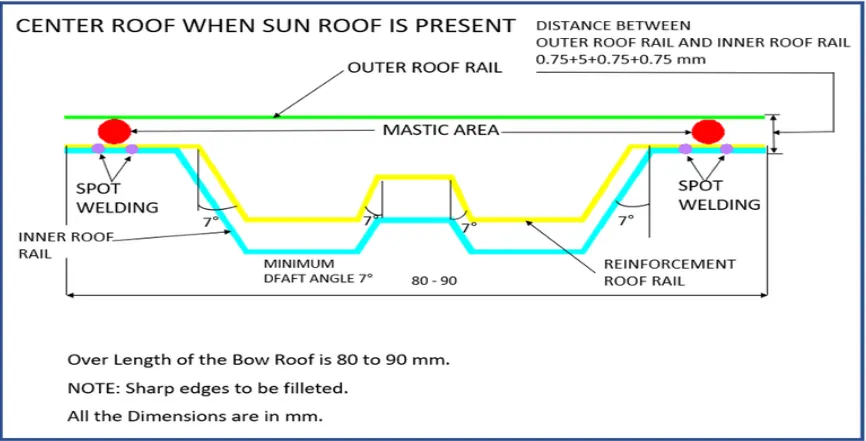
Center roof rail imparts strength to center portion of outer roof panel which is supported by B pillar at both ends.
REAR ROOF RAIL
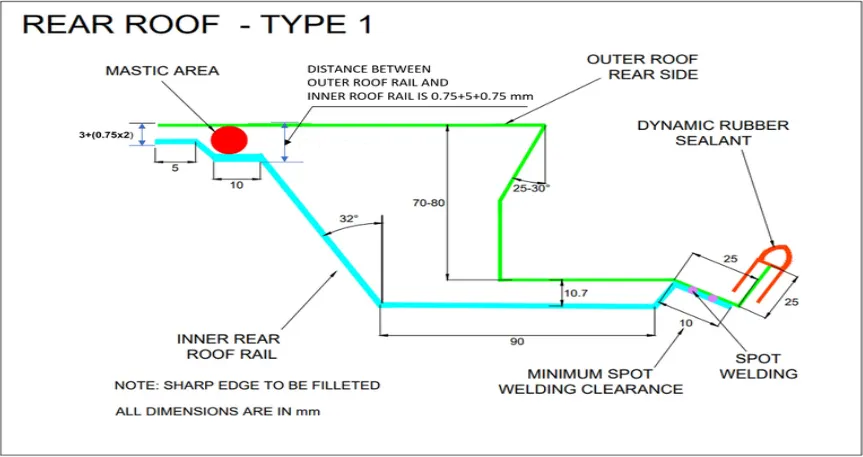
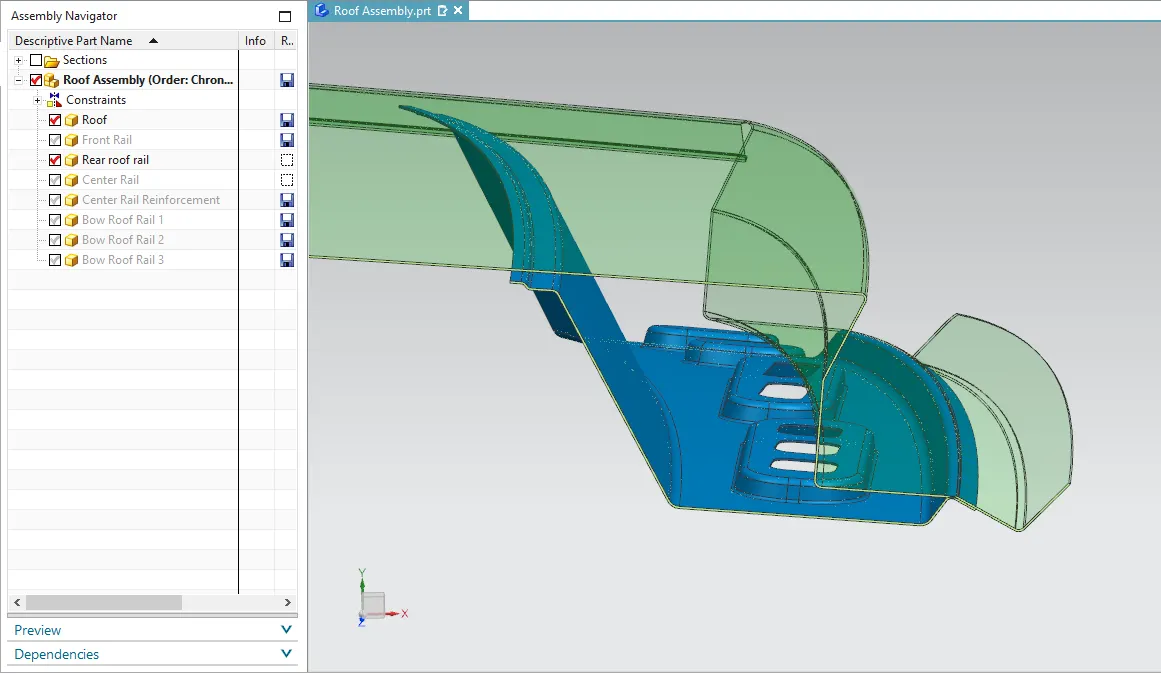
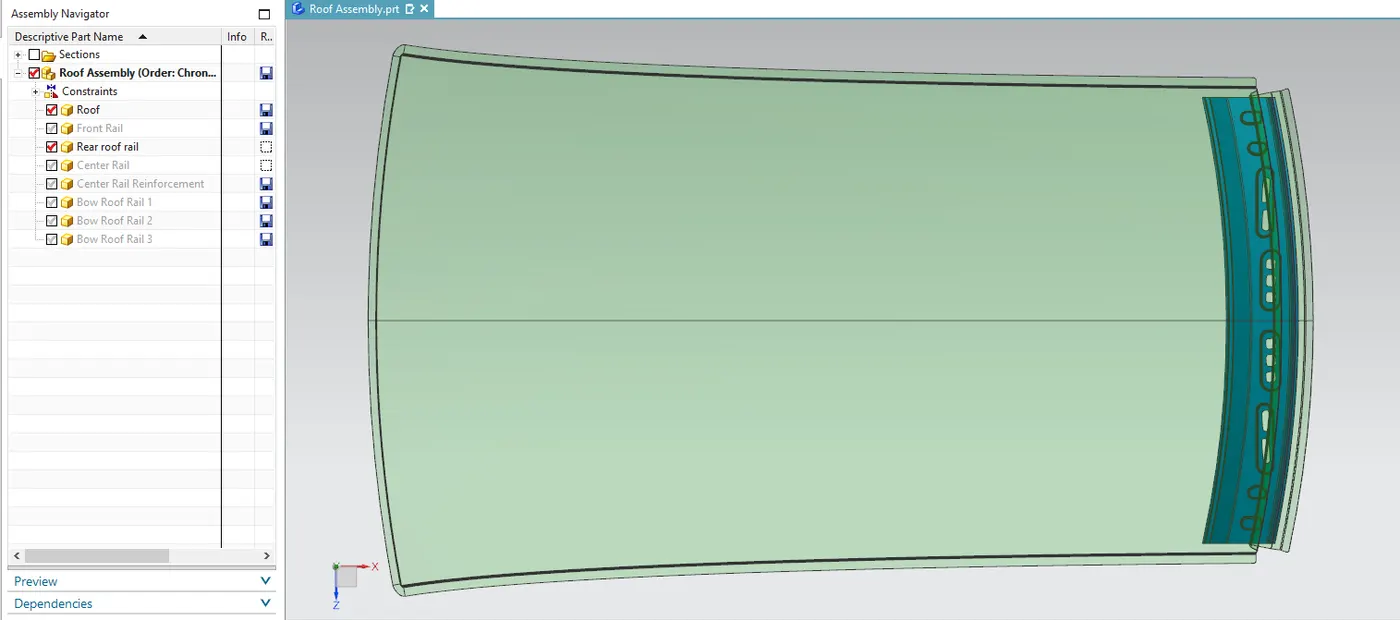
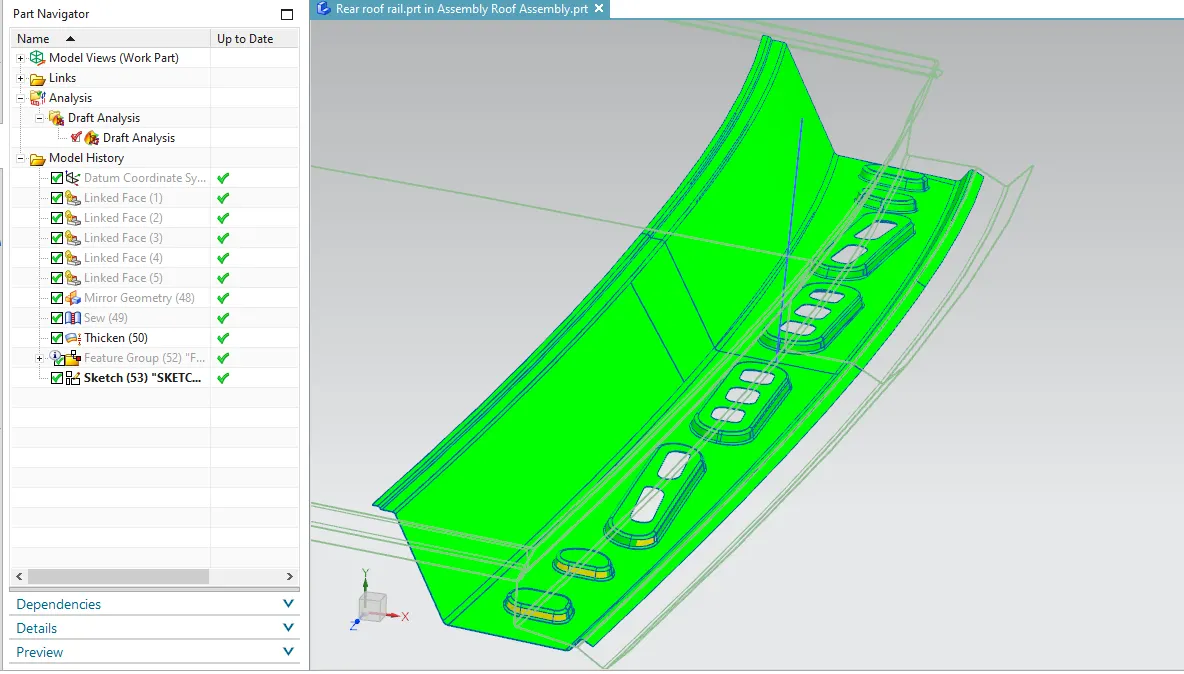
- Rear roof rail is joining the back door with roof, and also joins the body side outer.
- The design consideration for rear roof rail is rear visibility criteria and rear head room clearance.
- For joining the rear roof rail with flange of roof by using spot welding, and we use mastic for joining the rear roof rail with the roof.
BOW ROOF
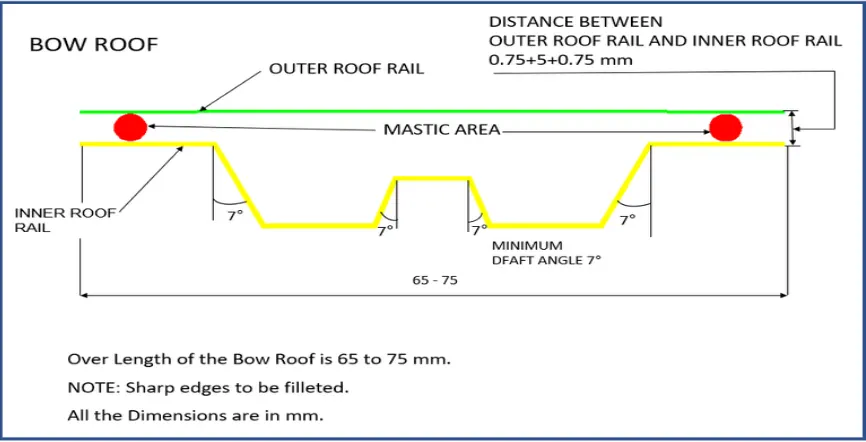
- The Bow roofs are given to improve the torsional stiffness and load-bearing capacity of the roof structure, and overall increase the strength of the roof.
- The number of bow roofs depends on the overall dimensions of the roof. Longer the roof more the bow roofs are integrated to BIW frame.
- The positioning of bow roofs is based on curvature study. The heat distortion criteria and snow load criteria are checked to analyses the position of the bows in various conditions.
- The bow roofs are attached to the outer panel using mastic sealants. Each mastic point will have up to 80 mm circular effective area.
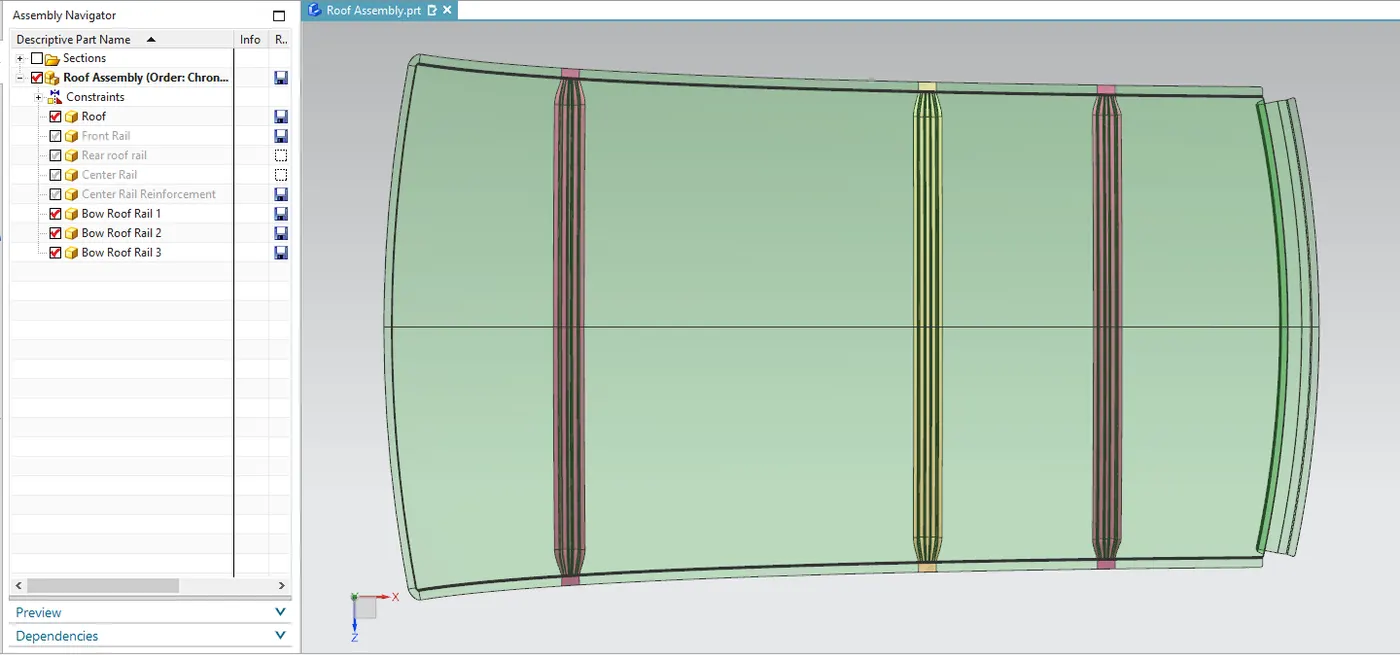
Joining of roof with the roof rails :
Mastic sealants
Bow roof rails and center roof rail are joined with the help of mastic sealant. Here spot welding cannot be used because it damages the styling surface of the roof.
Spot welding
Spot weld are used for joining front roof rail with the roof flange, and also used to join the rear roof rail with the rear roof flange.
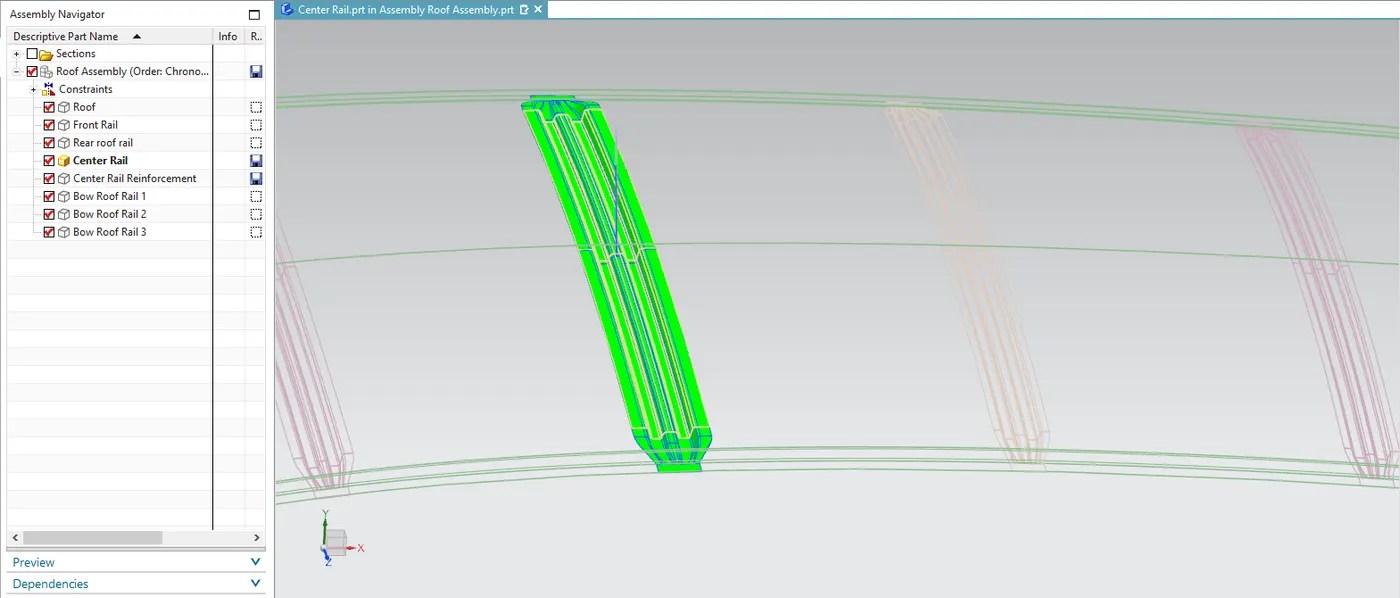
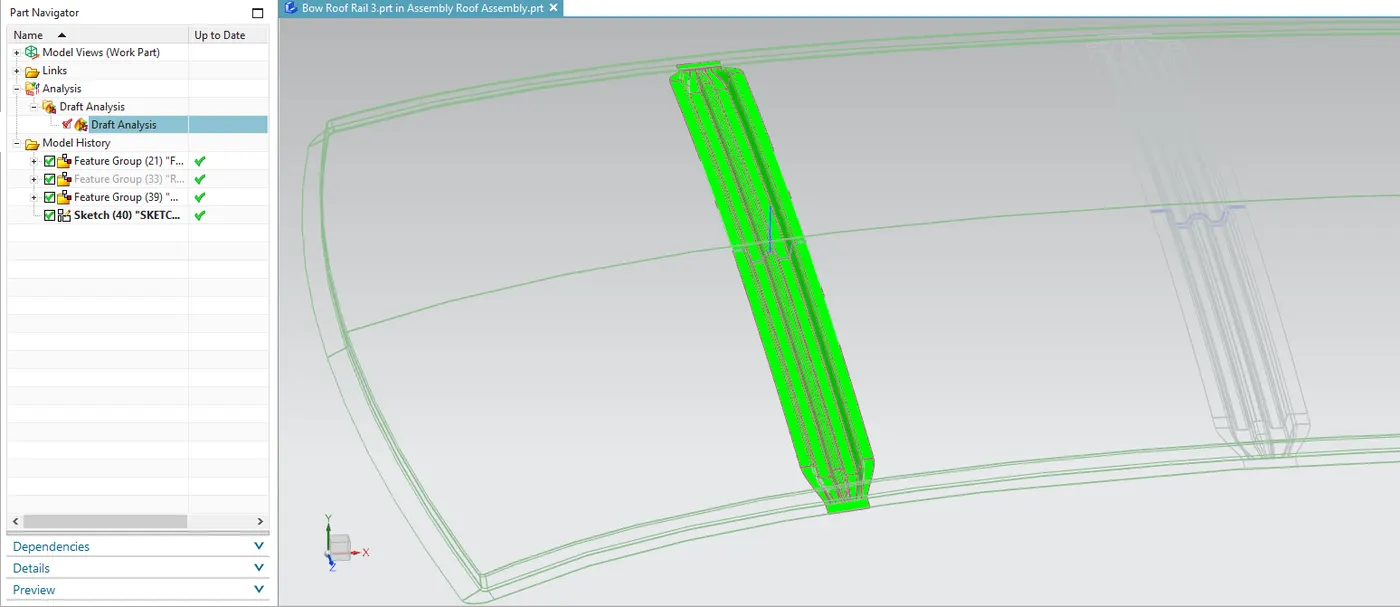
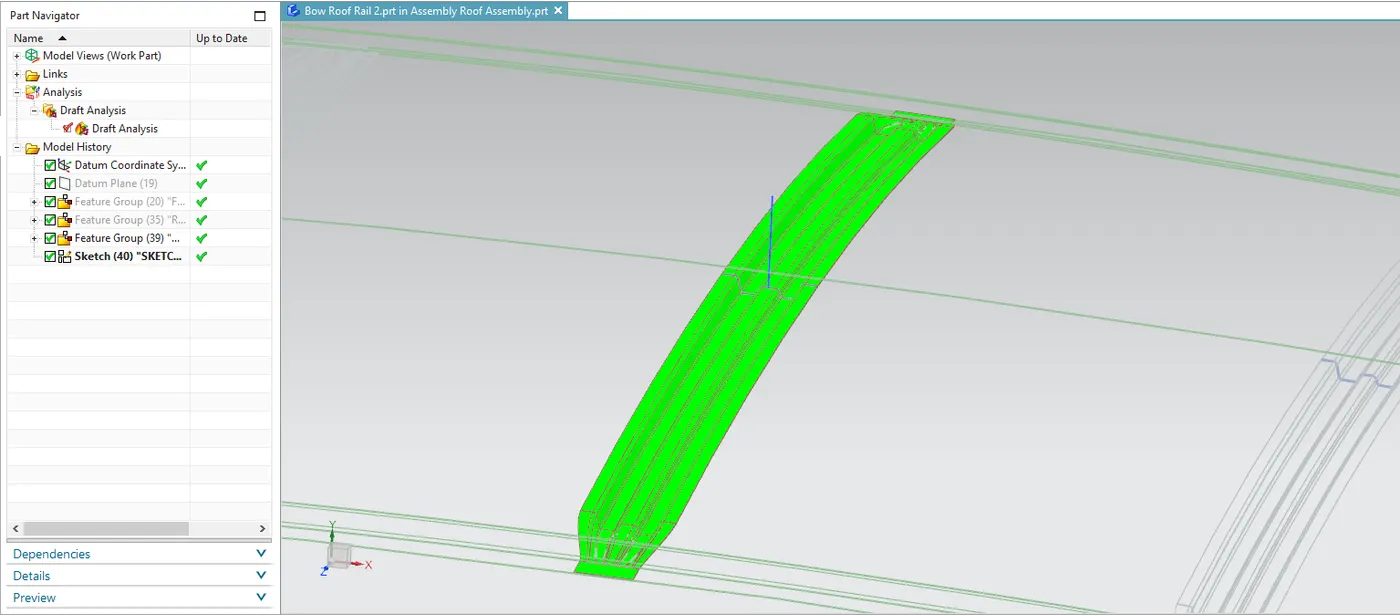
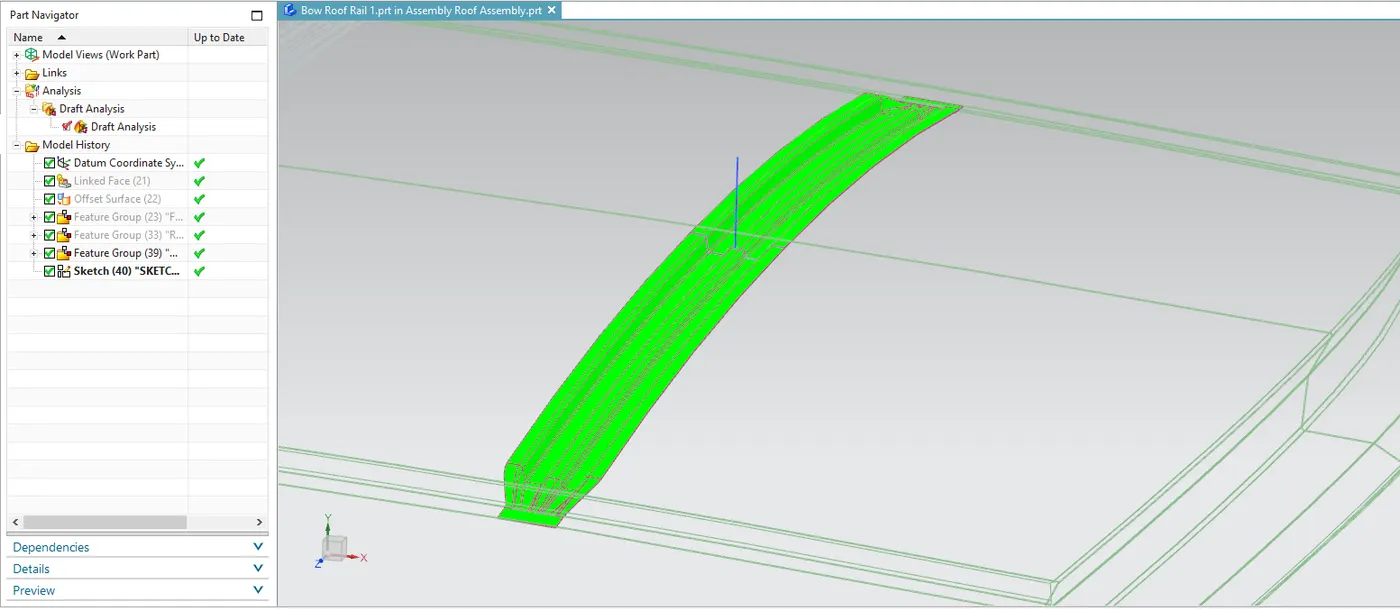
Draft Analysis :
Front Roof Rail
Rear Roof Rail
Center Roof Rail Reinforcement
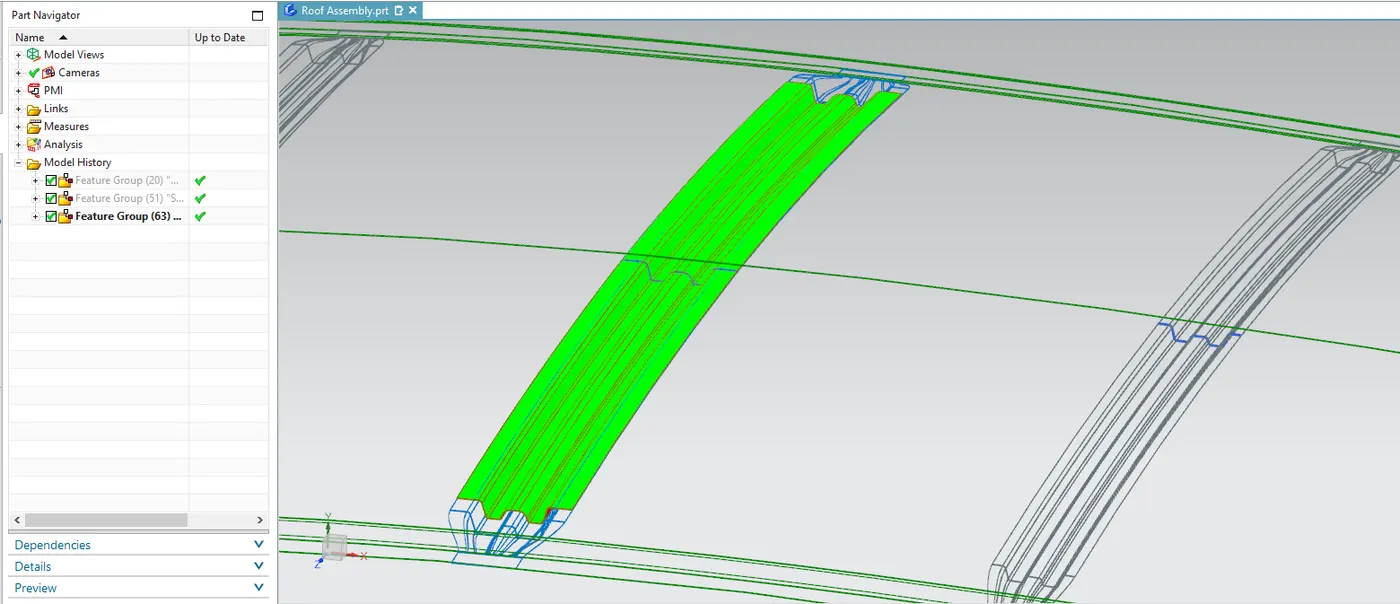
Center Roof Rail
Bow Roofs
BR1
BR2
BR3
Final Assembly :
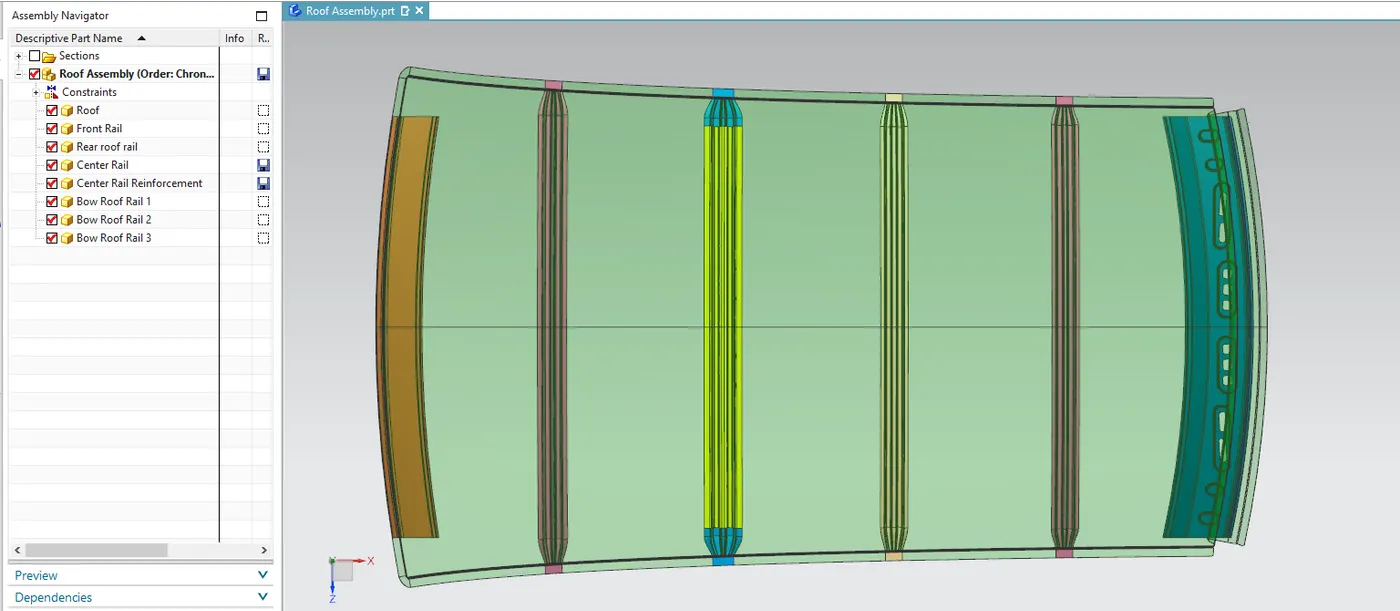
Manufacturing Processes used for Roof :
1 – Blanking and Punching 2 – deep drawing 5 – Spot Welding
3 – Hemming 4 – Gluing (Mastic and Hemming glue)
Blanking – Cutting of the Sheet metal along a closed Outline in a single step to separate the piece from the surrounding stock.
Deep drawing – It is the sheet metal forming process in which a sheet metal blank is radially drawn into a forming die by the mechanical action of a punch. The process is considered deep drawing when exceeds its diameter.
Advantage
1- Manufacture the products more quickly and higher quality.
2- More effective and efficient.
Hemming – Hemming is a sheet metal forming process in which sheets are joined by bending over another part in order to achieve a tight fit.
1- Connects two sheet metal part together.
2- Improve the appearance of a part and reinforce part edges.
Gluing (Mastic) – todays we use gluing for sheet metal joining. Best example Roof reinforcements and styling surface joining by Hemming glue, in hemming we use hemming glue for stability and for strong bonding between roof reinforcement and styling surface.
Spot welding - Spot weld is used for joining front roof rail with the roof flange, and also use to joining the rear roof rail with the rear roof flange.
Corner relief
Basically, at the sheet metal operations like (deep drawing and bending, blanking) mostly at the corners stress or strain concentration occurs so that’s we give some relief to the corners for removing these stress and strain.
Heat distortion criteria
Heat distortion temperature is the temperature limit above which the material cannot be used for the structural applications. This study is used to predict the heat distortions temperature at the material where it starts to soften when exposed to a fixed load at elevated temperature. In order to avoid bending or damages on the roof, based on the heat distortion temperature, this study will predict the bow roof position which helps to strengthen the roof.
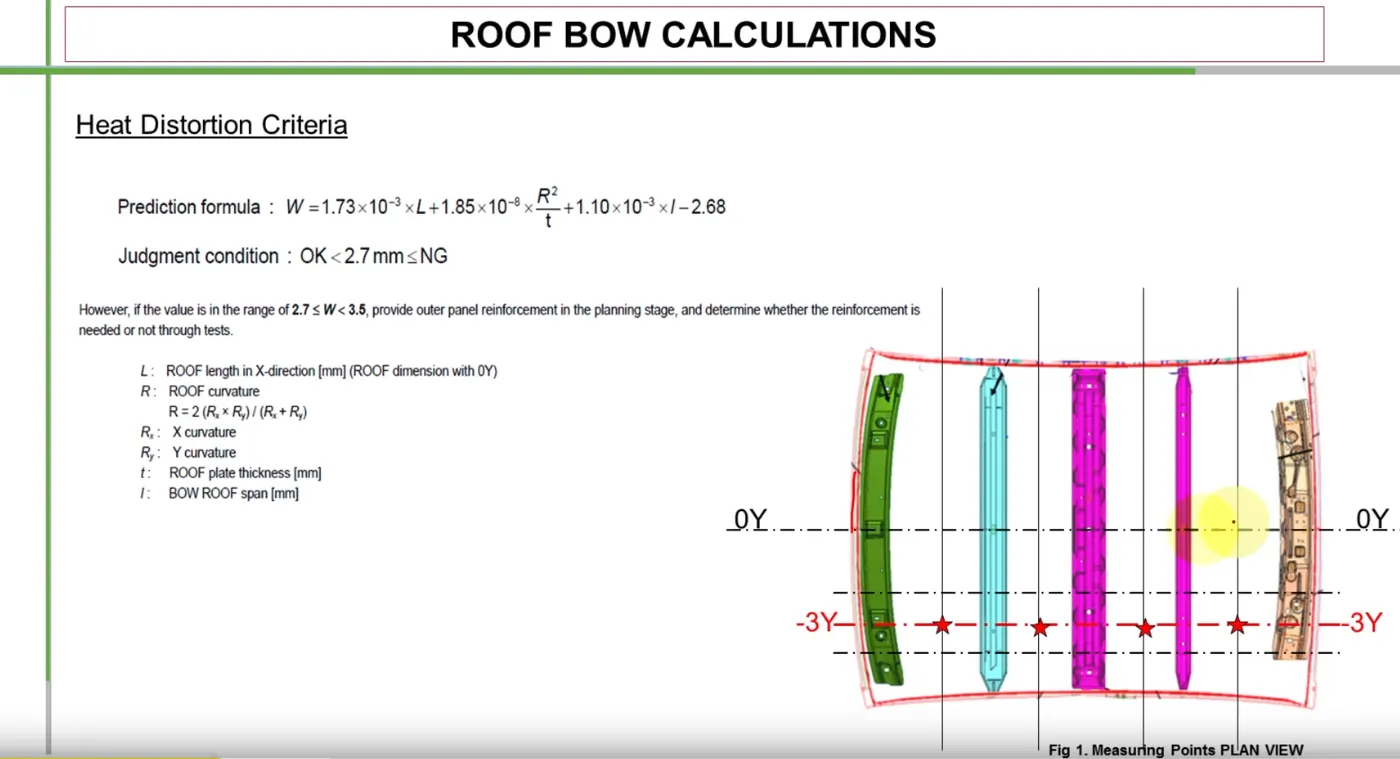
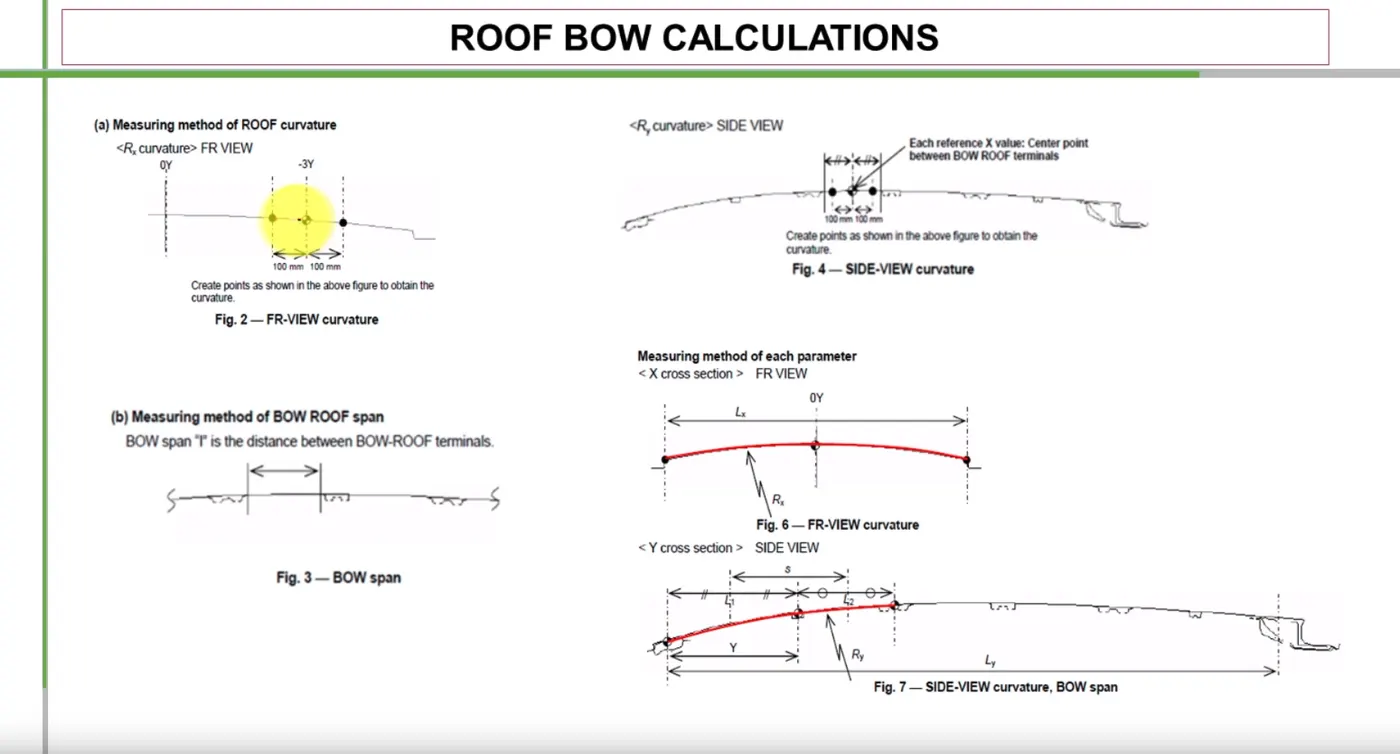
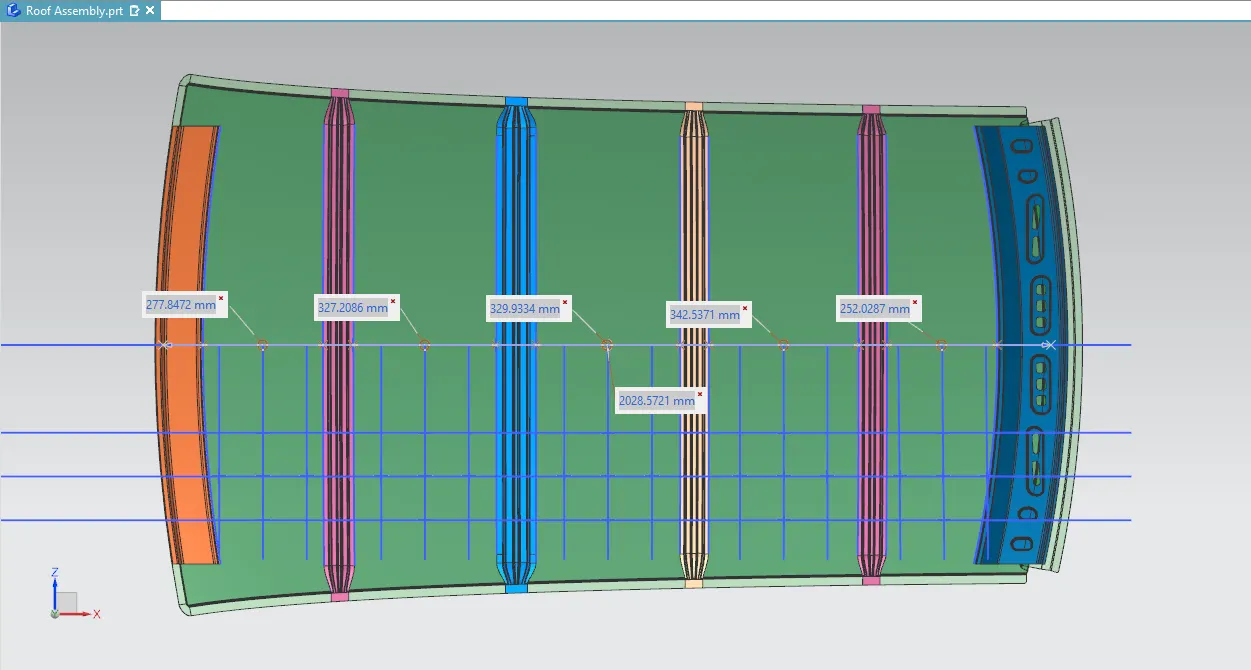
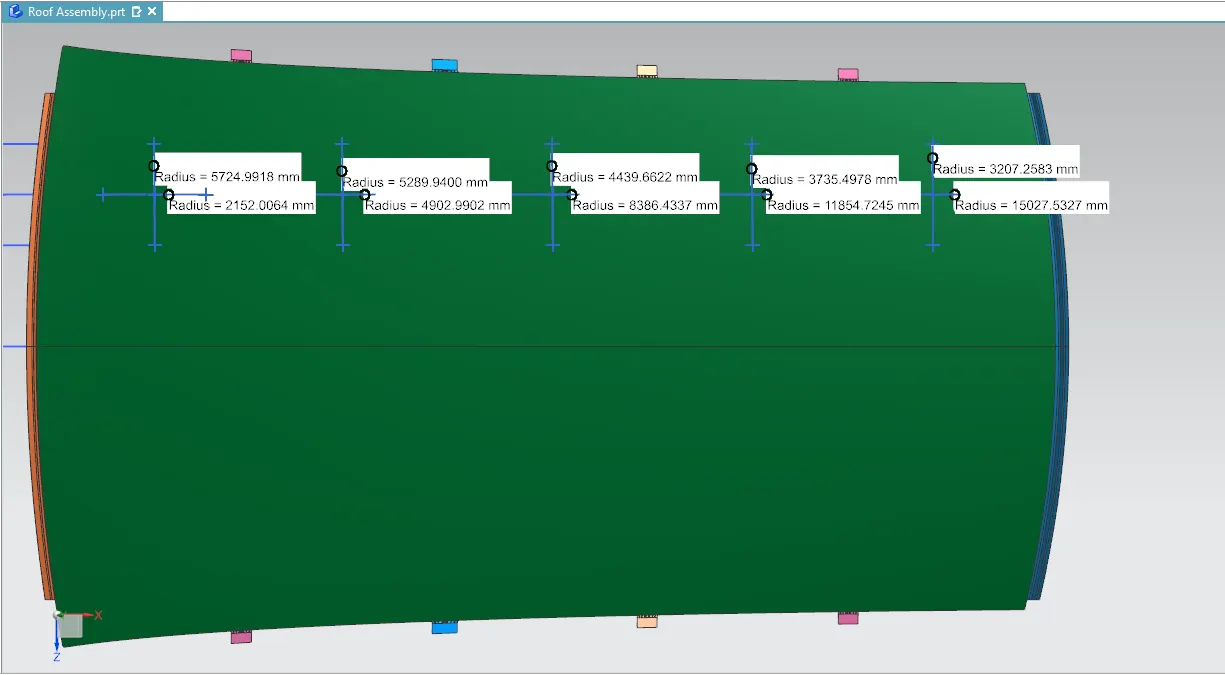
| Sr no | Bow | Rx | Ry | R | t | L | I | R^2/t | W | OK/NG |
| 1 | FR-BR1 | 5729.9918 | 2152.006 | 3128.15077 | 0.75 | 2028.5721 | 277.8472 | 13047102.99 | 1.10 | OK |
| 2 | BR1-CBR | 5289.9400 | 4902.9902 | 5089.1202296 | 0.75 | 2028.5721 | 327.2086 | 34532193.85 | 1.82 | OK |
| 3 | CBR-BR2 | 4437.662 | 8386.4337 | 5805.809185 | 0.75 | 2028.5721 | 329.9334 | 44943227.06 | 1.27 | OK |
| 4 | BR2-BR3 | 3735.4978 | 11854.7245 | 5680.90646 | 0.75 | 2028.5721 | 342.5371 | 43030264.28 | 2.00 | OK |
| 5 | BR3-RR | 3027.2583 | 15027.5327 | 5286.288061 | 0.75 | 2028.5721 | 252.0287 | 37259788.62 | 1.79 | OK |
Roof design is passing in heat distortion condition.
Snow load criteria
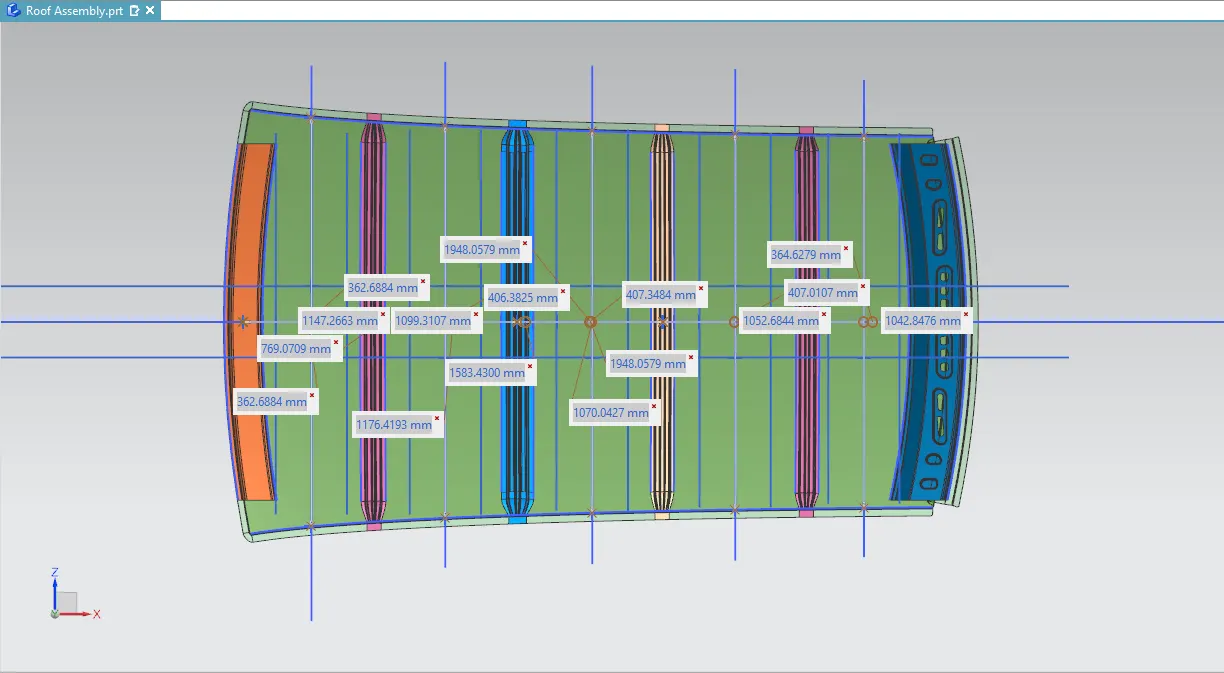
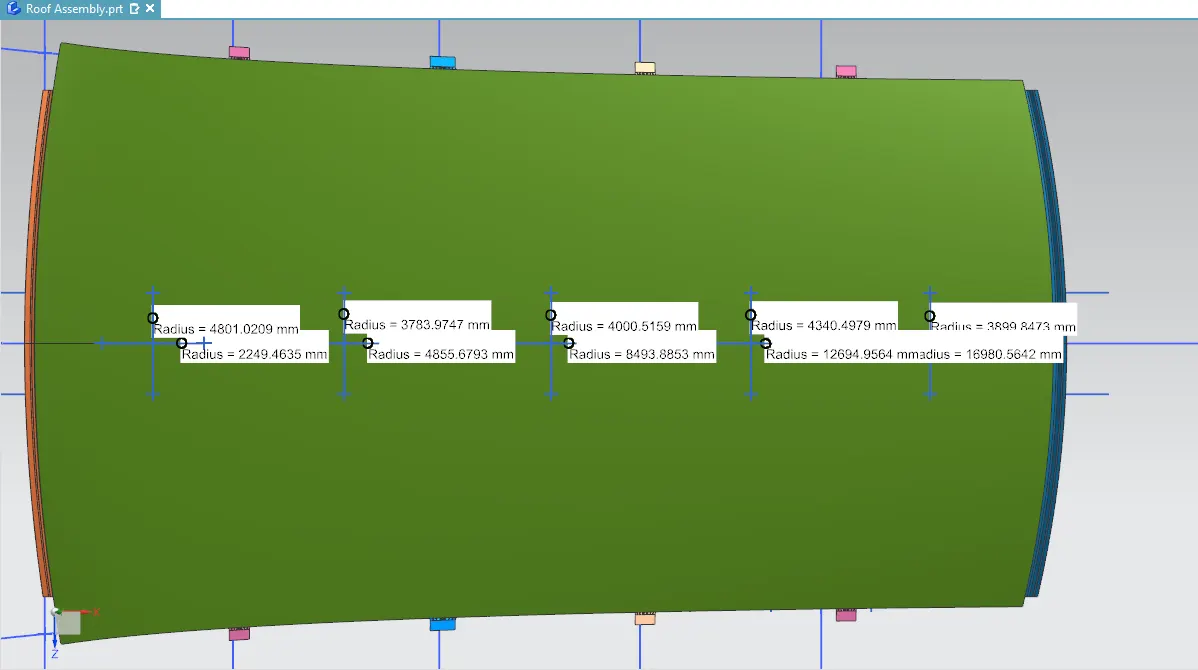
This test is done to know how is the roof behaving when there is a snow over. normally due to the snow weight the dent will happen. But the roof should be designed in such a way that when the snow is removal the roof should go it its original position. This is the basic requirements for snow load criteria.
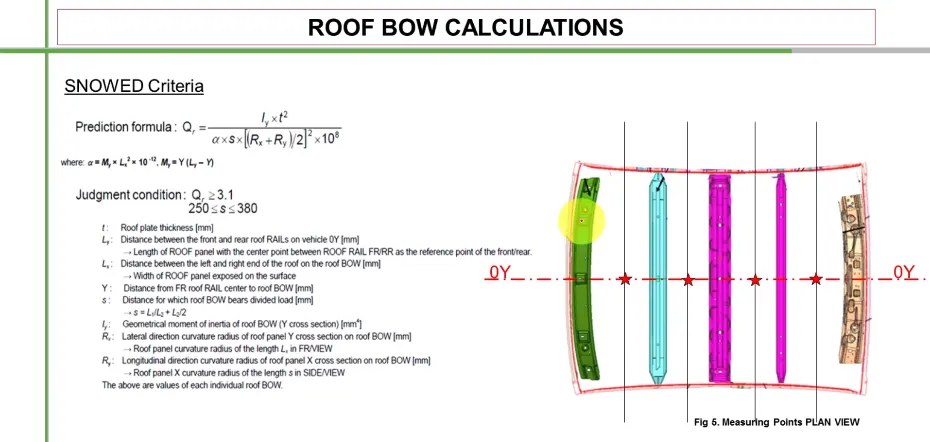
Section modulus
- The section modulus value gives us the strength of the component. Strength basically means that whatever load we apply the resistance provided by the component opposite to the deformation of the component.
- Bending a steel section that has a larger section modulus than another will be stronger and harder to bend.
- In simple terms the section modulus is the ratio of bending moment to bending stress for steel, if your steel has a high section modulus it will be harder to bend and can withstand a high moment without having high bending stress.
There are two types of section modulus
- Elastic section modulus
- Plastic section modulus
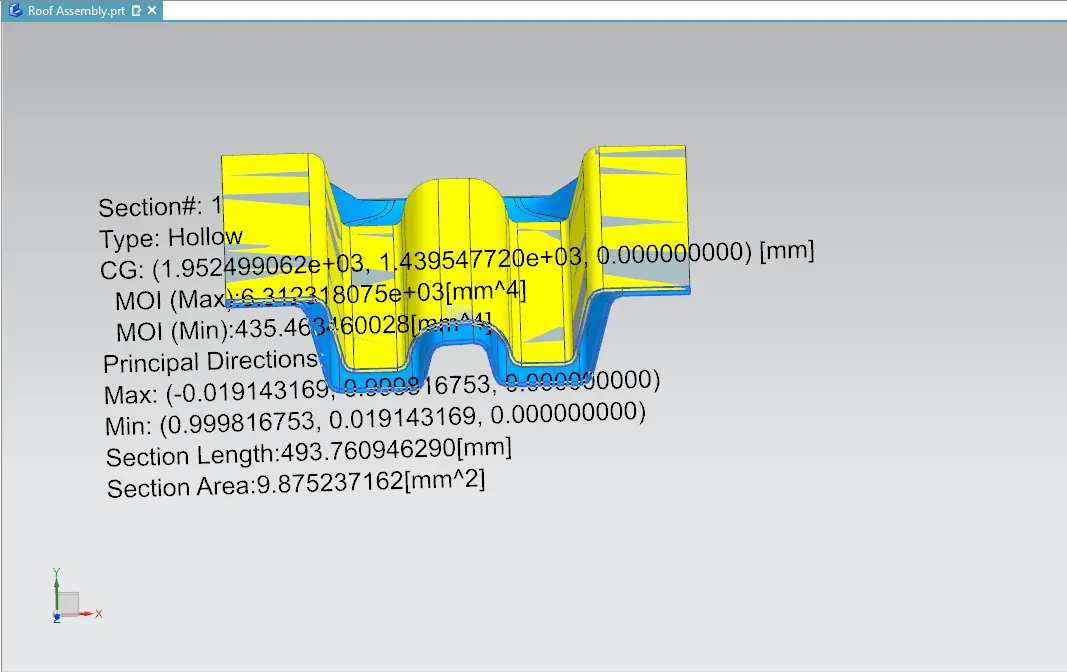
Section moment of inertia
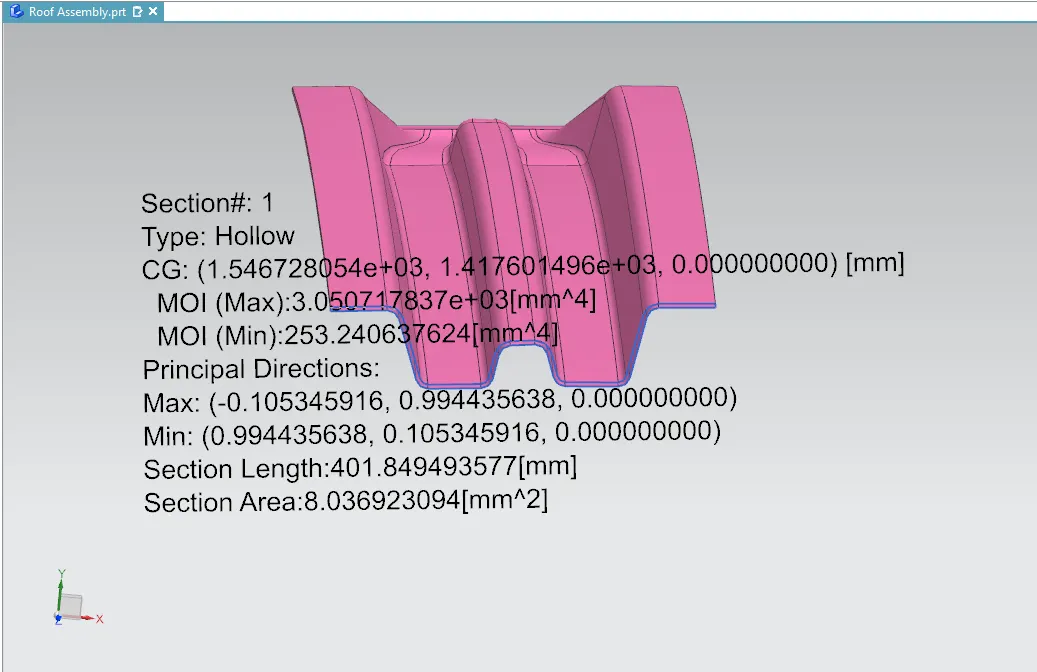
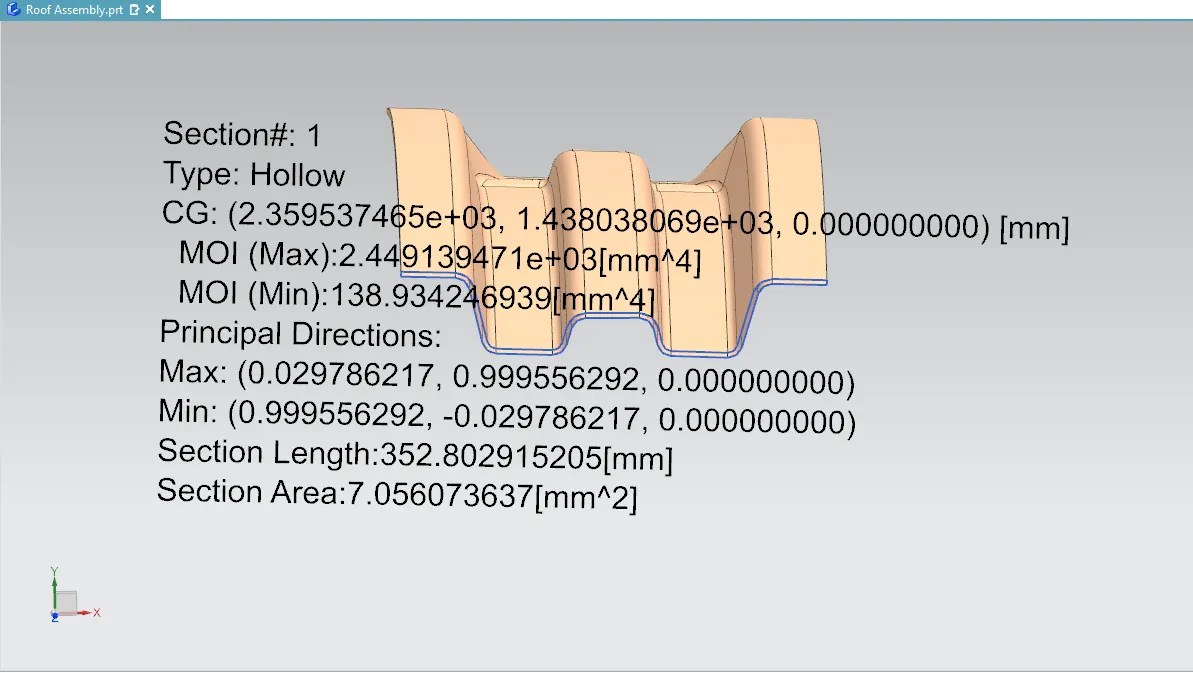
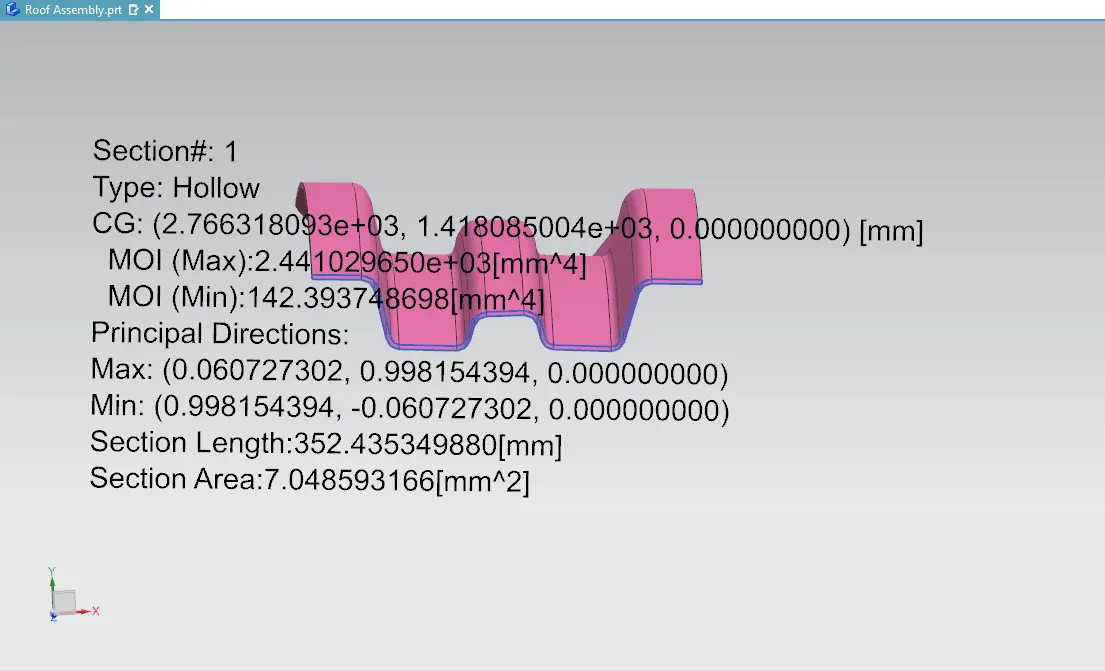
Section moment of inertia is used to predict the amount of deformation and deflection of a part. A higher moment of inertia is preferable as it reduces the amount of deflection for a given force. The thickness of the part and addition of flanges and embosses increase the section inertia of the part. Here the master sections of the roof and roof rails and their section analysis are given.
The elastic section modulus is defined as
S = I / Y
S = Section modulus
I = second moment of inertia (or area moment of inertia, not to be confused with moment of inertia)
Y = distance from the neutral axis to end most point of the fiber.
BOW ROOF 1
 BOW ROOF 2
BOW ROOF 3
CENTER BOW ROOF
| Sr no | Bow | Iy | Alpha | Lx | Ly | y | s | Rx | Ry | t | Qr | OK/NG |
| 1 | FR-BR1 | 87.3190 | 0.75 | 1147.2663 | 1948.0579 | 362.6884 | 384.5354 | 4801.0209 | 2249.4635 | 0.75 | 13.7042 | OK |
| 2 | BR1-CBR | 140.3944 | 1.09 | 1099.3107 | 1948.0579 | 769.0709 | 406.8654 | 3783.9747 | 4855.6793 | 0.75 | 9.5690 | OK |
| 3 | CBR-BR2 | 75.3972 | 1.03 | 1070.0427 | 1948.0579 | 1176.4193 | 407.1795 | 4000.5159 | 8493.8853 | 0.75 | 2.5910 | NG |
| 4 | BR2-BR3 | 75.1341 | 0.63 | 1052.6844 | 1948.0579 | 1583.4300 | 385.8193 | 4340.4979 | 12694.9564 | 0.75 | 2.3965 | NG |
| 5 | BR3-RR | 0 | 1042.8476 | 1948.0579 | 1984.0579 | 182.3139 | 3899.8473 | 16980.5642 | 0.75 |
The roof passes Snow load conditions till Center bow roof.
Remedy:
1) Number of bow roof used increased from 3 to 4 and added reinforcement rail to center bow roof.
2) Requesting styling team to increase curvature inbetween Center bow roof and Rear roof rail gradually, Rx inrange of 4500-5000mm.
3) Providing embosses on roof outer panel to increase strength in relatively flatter portion of the roof in range between center roof rail and rear roof rail.
Conclusion
- We learn how to solve problems in industries how they think about new projects, what is the approach for designing Car BIW.
- We learn about the design parameters of roof like - Visibility criteria (Front and Back), Head room clearance, Bow roof positions etc.
- We learn about curvature study. Draft analysis, snow load criteria, heat distortion criteria, about crash test, bow positions, section modulus, solid moment of inertia, manufacturability of my roof, manufacturing processes of roof.
- The roof design passing in heat distortion condition, snow load condition, manufacturability of design is possible, roof strength is good.
Note : As the zip file is above 20mb sharing Google link.
https://drive.google.com/file/d/1Ya-KP0BuBikm5FonTyE00hpKXGm7r8bH/view?usp=sharing